Saturday, November 16, 2013

Down at the ribosome factory, an archaic jumble

Ribosome production is another clue to the very messy RNA world.

As previously noted, the ribosome, which translates our DNA code from mRNA copies into the final protein, is a sort of time capsule from the very distant past in the history of life. When RNA was the dominant molecule and proteins and DNA were just getting a foothold, or in the case of DNA, may not have been invented yet at all. It is a bit like, if in the history of civilization, metalworking was stuck at the blacksmithing stage. To make up for the lack of efficiency while all other areas of the economy zoomed ahead into the industrial age (and remained completely dependent on the smith's work) they could only increase production by vast increases in scale, making blacksmithing the predominant industry of the whole economy. In bacteria, ribosomes make up over a quarter of dry cell mass.
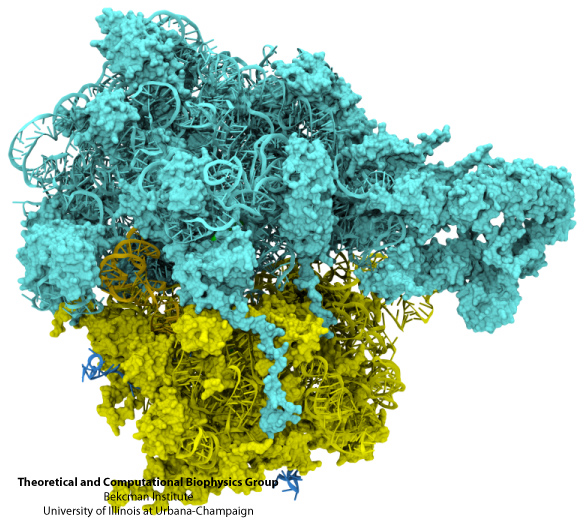
The ribosome, with RNA looking like train tracks and proteins like bits of foam. The large subunit is in aqua, and the small subunit in yellow.

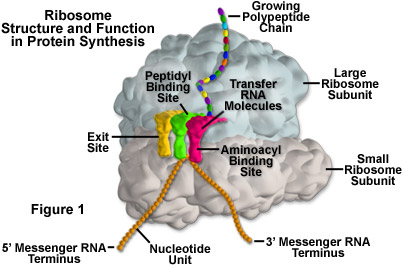
The ribosome is at its core an RNA enzyme, not a protein enzyme. In later eras it became festooned with proteins around its outside- there are over 80 of them in eukaryotes, but they make up only 40% of its weight and have only incidental roles. The core catalytic actions of the ribosome remain RNA-based, taking tRNAs charged with amino acids, (the "L"-shaped molecules in fluorescent colors, below), matching them to mRNA codons as they get threaded through the machine, and linking their amino acids into a growing protein chain. It is a triple RNA nexus, just as one would imagine originally happened if RNA came first in the history of life, and proteins came second, with DNA a distant third.


Why did RNA come first? Because it is a molecule that combines the essential elements of biology- the ability to adopt moderately stable shapes and do things like catalyze reactions, and the ability to be copied, be mutated, and evolve. Unfortunately, it is terrible at all of these roles, but in the land of the blind, the one-eyed molecule is king. So over time, better molecules came along to usurp both of the key roles of biology: DNA to store genetic information in a more stable way, and proteins to form structures and catalysts with far, far greater facility than RNA.

But obviously, the transition from one to the other was tortured and complex, and in the case of protein synthesis, it never really happened. We are left with the hulk that is the ribosome, an enormous  and inefficient relic. But that is not all. A paper recently delved into the process that produces ribosomes themselves, which is another story of waste and inefficiency. They found that some of its consituents are related to tRNA processing, showing unexpected relations among the actors in this ancient process. The findings are pretty minor, but it is a nice opportunity to think about this odd corner of biology.

Ribosome production is so onerous that it typically occupies its own cellular zone- the nucleolus, a sub-compartment of the nucleus in eukaryotes. This is where the DNA genes for the ribosomal RNA (typically present in the DNA in many copies, to better ramp up production) congregate and get transcribed by their very own RNA polymerase. This is also where many processing steps happen with the participation of proteins and RNAs imported from outside the nucleolus, like chopping up the full-length RNA into a few pieces, chemical modifications of certain RNA positions, addition of proteins and other RNAs, and the unusual chemical modifications of those proteins in various places. Much of this processing is guided by yet other RNAs that are complementary to various portions of the ribosomal RNA, and have to be pried back off the structure with helicases later on (see below). And then in the end, the whole mess is transported out of the nucleus through nuclear pores that are barely large enough to accommodate it.

I should add that research on ribosomal processing is something of a backwater in molecular biology. The complexity is daunting and technically difficult to deal with, and the whole process is sort of "housekeeping" for the cell, not involved in cancer, development, cognition, or other exciting issues. But still, the advancing tools of the field allow progress on all fronts. Here, the researchers solve the atomic structure of a complex of two proteins, Rrp7, and a partner, Utp22, that seem to be two of those transiently acting proteins that help the ribosome along to maturity- part of a vast support staff.

Structure of the Utp22+Rrp7 complex, with Rrp7 on the right side in brown and purple. This is the side that binds to the developing ribosome. The D# modules are all part of Utp22. Each partner of this complex is essential for its further ribosomal maturation.

Rrp7 contains the key region that binds the small complex to an RNA site within what later becomes the small subunit of ribosomal RNA, but it requires a guide RNA (snR30) which has to bind the rRNA and stabilize a particular kink before it can do so. What happens next? That part is less clear. Utp22 may bring along other proteins and enzymes, but it doesn't have enzymatic activity itself. The authors do not delve into this aspect, unfortunately. Its role may actually not be to do anything in particular for the ribosome, but simply to bind this intermediate state, and then when released to regulate a set of ribosomal protein genes in a system that makes their gene transcription responsive to the overall level of ribosome processing and production.
"The complex structure of Utp22 and Rrp7 shows that they are unlikely to possess any enzymatic activity and that they rather function as an essential building block in the 90S preribosome."
A small area of the ribosomal RNA, (18S), showing a few sites where Rrp7 binds and can be cross linked (green nucleotides), and also showing the guide RNA, snR30 in blue, which transiently binds to and stabilizes the ribosomal RNA, and is essential for subsequent Rrp7 binding.

What the authors find interesting is the evolutionary history of Utp22, which is that it developed from a tRNA processing enzyme called the CCA-adding enzyme. This enzyme adds a special three-nucleotide end to all tRNAs which is not originally present in their DNA code. Why? Who knows- probably another historical hack that came along prior to the rise of what we regard as more orderly & conventional (dogmatic, one might even say!) molecular biology. A copy of this enzyme was re-purposed to become this small subunit ribosomal RNA processing factor, eventually losing both its catalytic activity (of adding nucleotides to RNA ends) and its RNA-binding function (which was taken over by Rrp7).

This is only a taste of the intricacies of this field. Biology is full of hacks and workarounds, also called adaptations, but the ribosomal system takes the cake for its overall cost, its focus on RNA as the central and primordial molecule, and its byzantine chemical and macromolecular complexity. Life is certainly weird tech, but it isn't always high tech.


Saturday, November 9, 2013

Who pays for structural unemployment?

Just where are people supposed to get work-related skills?

Another conservative meme of the moment is that current unemployment is "structural", rather than something we can address through government action. Problem solved! And thankfully, by this theory unemployment is all the fault of the unemployed themselves, who didn't have the foresight to train themselves for the entrepreneurial info-tech jobs of today.

Economists typically divide unemployment into three classes- cyclical, frictional, and structural. The frictional component is what even the best job market would show ... the inescapable lag between losing one job and gaining another, which becomes a constant low rate of unemployment at any one time. Nothing the government can do here. Cyclical unemployment is attributable to weak business conditions, such as classically where auto sales are low, some workers are laid off, but are immediately rehired when business picks up again. Here, the government could do something, if you adhere to Keynsian theories, but conservatives regard such meddling as not only distasteful, but ultimately self-defeating since the market always knows best the most efficient level of activity and employment.

Last is structural unemployment, where the worker in question can not find work because she is unskilled in any work that is on offer. Plenty of jobs may go begging, but the nothing offered matches this worker's skills.

A good deal of work has shown that, inconveniently for conservatives, the current job market is not beset with a high degree of structural unemployment. Firstly, it is inconceivable that just as Lehman collapsed, tens of millions of workers let their skills lapse and can not be gainfully employed by anyone in the US. Nor is the job market beset with wild imbalances of very high pay being offered for specialized jobs, due to uneven labor demand, as employers suddenly changed their technologies and practices in the wake of the global financial crisis. No, the problem is classically one of low demand, caused by financial panic and its ensuing destruction of economic activity, with a longer-term component of deleveraging from a vast overhang of debt, with an even longer-term component of income inequality that smothers broad consumer demand and impairs the consistency of that demand.

But even if the structural story were true, what should we do then? There is always some mismatch between skills needed and skills on offer. Currently, employers put out absurdly detailed lists of what they want, to fend off excess applicants, and probably to maintain negotiating leverage against any that dare to apply. That is if they are serious about the ad and don't already have someone lined up for the job. So advertised skill sets are not realistic benchmarks for gauging structural mismatches.

Pay is a better benchmark. Are employers willing to pay substantial premiums for specific skills? Again, the current job market and income data are telling us, no, this is not common. But at some point, given a large pay differential, it becomes more economical for employers to train an employee missing particular skills rather than expect them to walk in from the street, even if that street is the entire internet.

This is one more element that is being lost in our abysmal job market. Not only are employers happy about not having to give employees raises and pay them decently, they can be so selective in hiring (if they hire at all) that training is an afterthought. It used to be that sending an employee to school was not unheard of, even for advanced degrees. Now it is entirely on the worker to get the skills needed, often through schools and training programs that leave them drowning in debt.

And the frictional employment picture is likewise closely related to the general job market. Friction is going to be dramatically different in good versus bad job markets. In good times, any warm body will do, and will be trained to do the work. In bad times, friction can extend out endlessly, to the point that a worker leaves the workforce entirely, as droves have done doing during this crisis. So these classes of unemployment are far, far less distinct than commonly thought, and all relate strongly back to the underlying strength of the job market and its driver, aggregate demand.

Thus it is doubly, even triply, important for the government to restore economic activity in slack times, so that the labor market isn't destroying workers and their families, and letting skills through the population rot. Such wastage is surely going to affect future economic prosperity and particularly our real capacity to care for the elderly and maintain other common services.


  • Is false hope better than no hope? And is reality hopeless? And the religious bias towards indoctrination ... why is this OK?
  • A small environmental success- getting the lead out.
  • Does GDP growth serve us, or do we serve GDP growth?
  • The median wage is down.
  • Bank lending is still anemic, especially in terms of productive investments. Monetary policy is clearly insufficient. And if you add this to declining public investment, and we are headed downhill.
  • A different cognitive style, or just not that bright?
  • Stephanie Kelton on why federal deficits are good.
  • Ditto from Paul Krugman. Who really serves future generations?
  • Why not deploy stop-and-frisk on the suits?
  • And tax them too.
  • Economic passage of the week:
"According to the Harvard study, most people believe that the top 20 percent of the country owns about half the nation’s wealth, and that the lower 60 percent combined, including the 20 percent in the middle, have only about 20 percent of the wealth.  A whopping 92 percent of Americans think this is out of whack; in the ideal distribution, they said, the lower 60 percent would have about half of the wealth, with the middle 20 percent of the people owning 20 percent of the wealth.What’s astonishing about this is how wrong Americans are about reality.  In fact, the bottom 80 percent owns only 7 percent of the nation’s wealth, and the top 1 percent hold more of the country’s wealth – 40 percent – than 9 out of 10 people think the top 20 percent should have.  The top 10 percent of earners take home half the income of the country; in 2012, the top 1 percent earned more than a fifth of U.S. income – the highest share since the government began collecting the data a century ago."

Saturday, November 2, 2013

A strange loop it is to write about one's I so much

Review of Douglas Hofstadter's "Gödel Escher Bach" and "I Am a Strange Loop", thus saving the reader roughly 1000 pages of helpless digression.

Douglas Hofstsadter laments in his preface to his sequel ("I am a strange loop"; ISL, 2007) to his much  more famous "Gödel Escher Bach" (GEB, 1979) that for all its fame and prizes, including the Pulitzer prize, most people he meets didn't get the point of GEB. And no wonder, as those points flit by with great rapidity amidst a welter of puns, word games, abstruse code exercises, maddening repetition, dilatory dialogs, and wayward tangents.

But here they are (apologies for my lack of expertise ... please comment on any inaccuracies):
" The possibility of constructing, in a given system, an undecideable string via Gödel's self-reference method, depends on three basic conditions:  
1. That the system should be rich enough so that all desired statements about numbers, whether true or false, can be expressed in it. ...
2. That all general recursive relations should be represented by formulas in the system. ...
3. That the axioms and typographical patterns defined byitsrules be recognizable bysome terminating decision procedure. ...
 
Satisfaction of these three conditions guarantees that any consistent system will be incomplete, because Gödel's construction is applicable.
The fascinating thing is that any such system [human thought and language are the obvious references] digs its own hole; the system's own richness brings about its own downfall. … [analogy to critical mass in physics and bomb-making] ... But beyond the critical mass, such a lump will undergo a chain reaction, and blow up. It seems that with formal systems there is an analogous critical point. Below that point, a system is 'harmless' and does not even approach defining arithmetical truth formally; but beyond the critical point, the system suddenly attains the capacity for self-reference, and thereby dooms itself to incompleteness."

All the references to Bach and Escher in GEB are really tangential examples of self-reference. It is Kurt Gödel's work that is the core of the book, as it is of ISL. Gödel made a critique of the Principia Mathematica (PM), by Alfred Whitehead and Bertrand Russell, which attempted to build a tightly closed system of axioms and logic that was both incapable of rendering false statements, and also comprehensive in its ability to found all relevant aspects of mathematics and logic. But Gödel showed that it was incomplete, which means that it could represent paradoxical statements that could not be either true or false. It did indeed found all mathematical logic on very uncontroversial axioms, but it developed (painfully) a language for all this that was so rich that it was impossible to keep within the bounds of truth alone.

Gödel's paradigmatic statement, constructed out of unspeakably complicated machinations of the PM tools (and which Russell never accepted were proper machinations) essentially created the statement "This statement is false". But Hofstadter admits that self-referencing paradox is not the only possible type of ambiguous, unresolvable statement Gödel created or suggested- there is an infinite zoo of them.

The point is that truly intelligent systems are open. They are not cognitively or computationally bound by their programming to tread around some threshing track time, and time, and time, again. They not only are responsive parts of their environment, but more importantly have the symbolic capacity to represent imagined realities, real realities, (and the self!), in such recursive, endlessly complicated ways that no theorem-bound system of cognitive computation can account for it. In this way we are endless, multilevel, strange, loops.

But there is one aspect of all this that is most odd, which is Hofstadter's focus on the self, which is prominent in both books, and especially, even gratingly, so, in the second. Much of his conceptual play concerns self-reference, which is enjoyably loopy. Many philosophers and thinkers generally seem to think self-consciousness the very height of consciousness itself. Perhaps even its definition. As Hofstadter says, "Just as we need out eyes in order to see, we need our 'I''s in order to be!". But I don't think that is the case, at least not consciously. Self consciousness certainly comes along in the package of cognitive complexity, once one is making models of everything conceivable about the world. But to me, the core of consciousness is far more basic- the sense of being, not of self. And the core of the sense of being is made up of the flow of sensations, especially pain and pleasure.

I frequently see squirrels from my window, playing, chasing, eating, hiding, calling, etc. They are especially interested in the bird feeder and have tried no end of strategems to get into it. They are clearly highly conscious beings, driven by pleasures and pains, just as we are. They wouldn't know what to do with a mirror, but nevertheless we immediately empathize with their desires and fears, clearly communicated and experienced by themselves. Their consciousness is not infinitely expansive by way of symbolic representation, as ours is, but nor is it negligible.

Hofstadter makes a special project of declaring that mosquitos have zero consciousness, thus sanctioning his frequent bloodthirsty murders, when he is otherwise a principled vegetarian. Why be a vegetarian if you are interested only in symbolically self-referential and unbounded forms of consciousness? Obviously something else is going on, which he jokingly names "hunekers"- small sub-units of consciousness, of which he assigns various amounts to animals and humans of various grades and states.
"Mosquitos, because of the initial impoverishment and the fixed non-extensibility of their symbol systems, are doomed to soullessness (oh, all right- maybe 0.00000001 huneker's worth of consciousness- just a hair above the level of a thermostat)."
But don't mosquitos experience pain and pleasure? Their behavior clearly shows avoidance of danger, and eager seeking of sustenance and reproduction. We know that the biology of animals with nervous systems (not bacteria) organizes these motivations in an internal experience of pain and pleasure. Would Hofstadter compacently sit down to a session of pulling the legs and wings off of mosquitoes he has caught? I think not, because though we certainly don't know what is going on in those very tiny heads, if anything it is the integration of perception, pain, and pleasure in ways that must earn our empathy, and which amount to a level of consciousness radically beyond that of a thermostat.

Hofstadter adds in the analogy of a human knee reflex, saying that perhaps a mosquito's mind is at that level, which no one would claim is conscious. But the integrative work being done, and the whole point of the integration, is quite different in these cases, making it seem much more likely, to me at least, that the mosquito is working with a very tiny, but intensely felt, bit of consciousness. Indeed one might posit that there need not be any particular relation between the cognitive complexity of an animal's consciousness and the degree of its feelings. We know from human infants that feelings can be monumental, and consciousness of hurt (and pleasure) be extremely acute, with precious little cognition behind them. Do we therefore empathize with them less?

This leads to the more general issue of the relation between consciousness and its physical substrate. Despite the talk of "souls", Hofstadter is a thorough naturalist, steeped in the academic field of artificial intelligence. While he has shown much greater proclivities towards philosophy than programming, the basic stance is unchanged- consciousness is a case of enormously complicated computation with (in the human case) the infinitely rich symbol sets of language and whatever is knocking around internally in our mental apparatus. All of which all could conceivably happen on a silicon substrate, or one of orchestral instruments, or other forms, as long as they have the necessary properties of internal communication, logical inference, memory, etc.

For Hofstadter, consciousness is necessarily a high-level phenomenon. It depends on, but is not best characterized by, particular neurons, and certainly is not specifically associated with quantum phenomena, microtubules, or any of the other bizarre theories of mind / soul that various pseudo-theorists have come up with to bridge the so-called mind-body divide. Indeed he spends a great deal of time (in ISL) on consoling himself that his wife, who died unexpectedly and young, lives on precisely because some part of her high-level programming continues to function inside Hofstadter, insofar as he learned to see the world through her eyes, and through other remaining reflections of her consciousness. Nothing physical remains, but if the programming still happens, then the consciousness does as well.

I have my doubts about that proposition, again drawing on my preference for characterizing consciousness in terms of experience, feeling, and emotion, not symbology. But if one has been trained by one's wife, say, to thrill to certain types of music one hadn't appreciated before, then one could make the case in those terms as well.

The question is made more interesting in a long section (in ISL) where Hofstadter discusses a thought experiment of Daniel Dennett, as written about at great length by Derek Parfit. Suppose the Star Trek transporter really worked, and could de-materialize a person and send them via a (sparkling) light stream to be re-assembled on another location, say Mars. Suppose next that an improved version of this transporter were later devised that didn't have to destroy the originating person. A copy is faithfully made on Mars, but the Earth copy remains alive. Who would be the "real" person / soul? Imagine further that the transporter could send multiple copies anywhere it chose, perhaps depositing one copy on Mars, and another on the Moon, etc... What & who then?

Parfit reportedly mulls this over for a hundred pages and agonizes that there is no way to decide which is the "real" person. Hofstadter also makes remarkably heavy weather of the question, finally hinting that a reasonable way to regard it may be as a faithful doubling, where none of the clones have any priority, all are equivalent, and each goes on to an independent existence built on the structure and history of the original person. Well of course! In programming, this is called a "fork" where a program is replicated and both copies keep running in perpetuity, doing their own thing. No need to fret over soul-division or irreducible essences- if the physical brains and bodies are faithfully reproduced in all detail, then so are the minds in all respects. Each will carry on the prior consciousness and other internal processes, differing only by the occurrence of, and interaction with, subsequent events.

And one can extend this to other substrates, supposing that some means has been devised to replicate all the activity of a human brain from neurons into, say, silicon. Just making such an assumption assumes the answer, of course. But the real question is- at what level would the modelling have to be faithful in order to generate a replicated consciousness? Do all the atoms have to be modelled? Clearly not. The model Hofstadter and I share here is that the overall activity of the brain in its electrical activity and structure-to-structure communication constitutes consciousness. So it is the neurons the need to be modelled, and that perhaps only roughly, to recreate their communication flow and data storage. Generate enough of those elements that perceive, that condense and flag significant information, that tag everything inside and out with emotional valences, that remember all sorts of languages, and world events, and experiences, at explicit and implicit levels, that coordinate countless senses and processes, and we might just have some thing that has experiences.


  • And dogs- are they conscious?
  • J P Morgan, et al. Their practices were not just "shady", they were criminal fraud; signing false affidavits, scamming loan customers and investors alike, corrupting appraisers, LIBOR fixing, etc.
  • Should atheists take an economic position?
  • And do they have better morals?
  • Another way the health-related free markets don't work. Big data is fundamentally incompatible with broad-based insurance.
  • Two can play that game... "Last month, the U.S. raided an Afghan convoy carrying a Pakistani Taliban militant, Latif Mehusd, who the Afghan government was using to cultivate an alliance with the Pakistani Taliban."
  • The Koch folks- apparently too embarrassed to stand up for their own beliefs.
  • Unwritten institutions are often the most important- the long shadow of slavery & oppression.
  • Cuddly capitalism- yes, it really works.
  • Our infrastructure is unsightly and unsafe as well as decrepit. And underfunded.
  • Bill Mitchell on why full employment shouldn't just happen for the sake of killing people.
  • Quote of the week, from Paul Krugman:
"A society committed to the notion that government is always bad will have bad government. And it doesn’t have to be that way."
"But right now we’re awash in excess savings with nowhere to go, and the marginal social value of a dollar of savings is negative. So real interest rates should be negative too, if they’re supposed to reflect social payoffs."

Saturday, October 26, 2013

Scanning for consciousness

Can technology tell us whether someone is conscious or not? Just barely.

How does the brain work? What causes or is that most basic phenomenon- consciousness? Many theists and philosophers dispair of ever finding an answer, or indeed of being able to properly pose the question, calling it the "hard" problem. Our intuitions are perhaps too strong to overcome this sense of magical awe, yet materialists plug along, going with the logical indications from evolution and biology that something very physical is going on in there to mount the drama that flits across our inner stage.

Functional MRI is regular MRI abetted by analysis of blood flow, which responds on a few-second time scale to changes in local brain activity, the brain being a big gas hog, as it were. One would think that with such technology in hand, it would a snap to detect the physical correlates of consciousness and describe all the patterns surrounding it. But no- the brain runs all the time, and the differences in blood flow under activity are very small. Also, the time scale of the key brain activities, like most brain waves, are far faster and spatially far smaller than what fMRI can detect, so it remains, sadly, an extremely blunt instrument.

A recent study looked at twelve volunteers as they went under with the anaesthetic propofol, of Michael Jackson fame. I doubt that propofol-induced unconsciousness resembles sleep very much, so while it may knock you out, it can hardly be the way to a refreshing wake-up the next day. Another study in 2011 , incidentally, did very similar work and came to the same conclusions, and also provides the rationale for using propofol in particular: "The reason why propofol was chosen for this study is that this particular anesthetic has been shown not to interfere with regional cerebral blood flow response at sedative concentrations, and does not modify flow-metabolism coupling in humans".

The researchers tried to measure brain activity in the broadest possible way, tracking correlations among far-flung areas. The upshot is that as sedation becomes deeper, even though over-all blood flow does not change as noted above, correlations among brain activities become increasingly local, losing their long-range character. Which is certainly in line with the general ideas in the scientific community about what consciousness is in physical term: large, wide-ranging, and constantly varying coalitions or patterns of neuronal activity, which are coherent in some sense. This coherence would represent thought to the experiencer, and detectable statistical correlations to the onlooker (inlooker?).

A map of the parcels used by the experimenters to divide up the brains of their subjects into regions of interest (ROI), in order to draw inter-regional activity correlations.

How can these correlations be drawn? "In our analysis the connection is the Pearson correlation  statistic between each pair of nodes." So, despite the crude time scale, they assumed that time-coincident activitions in different locations of the brain reflect functional connection, i.e. communication. They parcelled their brains out into 194 small regions, (using someone else's scheme from prior work), and then computed the average time course of activity within each parcel. Then using statistical methods, one can make a matrix of the correlations among all these time courses and parcels, into the figure below:

Region-to-region matrix of correlations under various conditions: W, waking; S, sedated; LOC, loss of consciousness, and R, recovery of consciousness (to Ramsay level 2).

Clearly, the condition of complete anesthesia (LOC) can be picked out as having sharply reduced connections between different regions, while even just after recovery, connections remain significantly impaired. "As expected, we found a significant effect of condition (... ), indicating that correlation strength systematically varied across conditions. Specifically, W consistently exhibited the strongest average correlation level, across all bins, followed by S and R, while LOC consistently exhibited the weakest average correlation across all bins." 

This result is stated more simply in a graph of correlation to distance apart:


The conclusion they  draw from this is that  the correlation at long distances are not specially impaired relative to that at medium distances. Connections at most distances are impaired, which would, however, naturally decimate long-range communication.

Meanwhile, within the individual regions, some showed increased activity (yellow) and some decreased (blue), consistent with the idea that the long-range effects are dominant overall.

Activity within nodes (also called regions, or regions of interest, ROI) at different levels of anesthesia. Yellow denotes higher activity in the sedated or unconscious states, while blue denotes higher activity in waking or recovery.

Let me wrap up with a couple more quotes from the paper:
"... we find that loss of consciousness is marked by an increase in normalized clustering (), which measures the ‘cliquishness’ of brain regions, potentially indicating an increase in localized processing and thus a decrease of information integration across the brain." 
"... our graph theoretic analysis further indicates that, in terms of network information processing, propofol-induced loss of consciousness is marked by a specific change in the quality of information exchange (i.e., decreased efficiency) ..."

So it remains extremely difficult to differentiate consciousness from living unconsciousness. This is very early days in the  decipherment of brain patterns, and we are far from having tricorders. But there really is something in there to peek at, and one gets the sense that yet more philosophical conundra will eventually be dissolving in this pool of data. Next week, another post on brain science, from a far loftier perspective- that of Douglas Hofstadter.


"The inconvenient facts that the senior officers of JPMorgan, Bear Stearns (Bear), and Washington Mutual’s (WaMu) grew wealthy through the frauds that drove the financial crisis and that JPMorgan’s senior officers will not be prosecuted and will not even have to repay the proceeds of their crimes never appear in the article."
...
"The CEOs’ paramount strategic objective is to prevent real investigations staffed by vigorous financial regulators working with FBI agents that lead to hundreds of grand jury investigations of elite bankers and civil suits, enforcement actions, and prosecutions that make public the facts about the elite frauds that drove the crisis. ... Fraud is criminal even if Holder is too spineless to prosecute it."

Saturday, October 19, 2013

The end of Rome

What happens when the old gods no longer work?

The end of Rome is coming, in my listening of the fabulous History of Rome podcast, after countless episodes (~161). The capital of the Western Empire has been transferred to Ravenna, surrounded by impassable marshes and defensively superior to Milan or to Rome, the prior capitals. It is a stark admission that the Roman game from here out is defensive, not offensive. But where did the Roman empire reside? In the hearts and minds of people, not on a map. And when its rationale turned incoherent or sour, it died.

One has to consider the conversion of the Roman empire to Christianity as part of this story. While Christianity and empire coexisted quite well for another millenium in the Byzantine empire, there is an inescapable correlation between conversion and decline in the Western Empire. Perhaps decline came first, and conversion was a symptom, as the old gods fell off their pedestals, disbelieved. In any case, for the West, Christianity seemed incompatible with the traditional Roman empire. Emperors spent their time dickering about the consubstantiality of Jesus, rather than worshipping power, war and violence in frank terms, as they had done in times gone by. It would all have been to the good if what came after Rome was an improvement, but it is another lesson that virtually any governance is better than none. Darkness and anarchy were the dividends. It took a very long time for the Goths, Franks, Vandals, et al. to assume the mantle of cultural renaissance.

Today, we are in a loosely similar moment. The free market god was, up until just yesterday, globally ascendent and hardly contested. Even the last major holdouts in the pagan bloc, China and Russia, converted with some enthusiasm, and now brandish the cross of mercantalism and international trade as cudgels.

But lo, the financial crisis has exposed Milton Friedman's God as less than regal and perfect. The magic of unfettered markets has a dark side: a license to defraud and destroy the livelihoods and savings of millions of people, as well as institutions of long standing. The bull of greed charged through the china shop of our communities and public institutions, and remains on the loose.

Only a few decades ago, the US was far less doctronaire. It had strong government that had learned many lessons from the Depression and world war, which taught that the public good takes precedence over private markets. Markets are great tools, fostering freedom, efficiency, and (some) innovation, but they are fully dependent on the state and have various defects and dysfunctions which mean that we should never imagine that they replace the need for a state or substitute for it to any great degree. Quite the opposite- they depend on the services of the state, and the rest of us depend on state to protect us from them. The health insurance & care industry is a prime example. The pending obamacare program is going to save the private system from itself, making it more efficient and usable than it has managed to be on its own.

Additionally, we have always harbored socialist planning in the very heart of the free market temple- the firm. Which runs internally like some soviet factory with its bosses, its shirkers, its senseless bureaucracy, and the ability of the top brass to skim off the cream .. just because they can. Internally, it is a fundamentally political organization rather than an economic one.

Unfortunately, the current crisis has given us the worst of both worlds. A crisis not severe enough to impair free market fanticism among its most faithful flock, (who continue to throw fundamentalist tantrums, even taking hostages), but severe enough to selectively disempower the poor and weak. There was an edge of revolution in the Occupy movement, but the dominant faith was too strong, and the alternative insufficiently clear. We are now on a longer road ... hopefully to recover our strength through a lengthy deconversion process, changing the basic ideology of the US back to a mixed and well-regulated system (polytheism, one might even call it) that we already know from our own example, and many others around the world, has the capacity to be prosperous, equitable, and durable.


  • Surowiecki on inequality. 
  • Stiglitz on inequality. "The gross domestic product of the United States has more than quadrupled in the last 40 years and nearly doubled in the last 25, but as is now well known, the benefits have gone to the top — and increasingly to the very, very top."
  • The GOP has cost us $700 billion, and counting. And that isn't counting the latest week of antics from the clown posse.
  • Annals of the easily led: Republicans wilt before faux-populist lobbyists.
  • Annals of religious brainwashing, cont.
  • Yet another Christian delusion.
  • Some basic / applied principles from MMT.
  • Bill Mitchell deconstructs one nobel prize winner.
  • Even the Fed finds that QE is useless. "Currently the U.S. real GDP is about 10% below its long-run trend (see Figure 2) and total asset purchases stand at $3.7 trillion (or less than 25% of GDP). Our model predicts that this level of asset purchases (even if permanent) would have little effect on aggregate output and employment even though it could reduce the real interest rate significantly by 2 to 3 percentage points."
  • Quote of the week: Andrew Fieldhouse on why inequality is getting worse, much worse:
"Meanwhile, the U.S. labor market is only about one-fifth the way to a full recovery; and as long as the jobs crisis festers, inflation-adjusted wages will stagnate or fall for the vast majority of workers."
...
"Recent U.S. income inequality data published by economists Emmanuel Saez and Thomas Piketty show that the top 1 percent of households by income has captured a staggering 95 percent of total income gains between 2009 and 2012, compared with 68 percent of gains between 1993 and 2012."
"I have been to many meeting where policy makers, usually very well adorned in the latest clothing, plenty of nice watches and rings, and all the latest gadgets (phones, tablets etc), wax lyrical about how complex the poverty problem is. I usually respond at some point (trying my hardest to disguise disdain) by suggesting the problem is relatively simple. The federal government can always create enough work any time it chooses at a decent wage to ensure that no-one needs to live below the poverty line. Read: always!"
  • And, Bill Black spells out the nitty gritty of lending fraud:
"It was lenders and their agents who overwhelmingly put the lies in “liar’s” loans."
...
"The fundamental point is that by 2006, fraudulent lenders were originating over two million fraudulent liar’s loans annually and that the only way to sell such loans to the secondary market was to compound the loan origination fraud with fraudulent “reps and warranties” about the quality of the loans."
  • And, Yves Smith, on the next fixation of the right, not entirely without merit:
"So now you can see how the assault on public sector workers fits in. When I was young, teachers and government employees were modestly paid, but they did have job security and decent pensions. Now that the wages of well and even merely adequately paid private sector workers have been beaten down, suddenly these not all that terrific compensation levels arouse jealousy among the newly disenfranchised, who now demand that public sector workers join them in the race to the bottom. Once this sort of beggar thy neighbor attitude is institutionalized, and it has been in many circles, it’s hard to reverse. But if we are going to restore the standing of the middle class, it’s time to reject the notion of competitive pay levels which can be used to justify class warfare, and return to the older, successful model of sharing the benefits of productivity gains between workers and management, rather than having it all go to the rentiers."

Saturday, October 12, 2013

Unconstitutional practices in both houses

Majority rule is constitutional. Minority rule is not.

We have been through the sorry spectacle of the Senate being held hostage by a minority of its members, via the filibuster and other "rules". Indeed in much of its business, a single senator may "hold" action indefinitely. It is thus not only a dysfunctional, but also an unconstitutional, body. Much of this derives from the wish of each member to be a prima dona and mini-president, but for the institution as a whole and for the country, it is a disaster.

The current Republican hostage-taking over Obamacare, "spending", and the misunderstood debt puts a spotlight on the same phenomenon in the House of Representatives, where a straight vote would pass both the budget and the debt ceiling, but the Republicans deny such a vote due to their "Hastert rule", which renders the House both dysfunctional and unconstitutional. This self-imposed rule uses the procedural powers of the speakership to deny any bill a vote unless it has majority support of Republican members. Not a majority of the House at large, but only of the Republicans.

The founders didn't even think it worth mentioning in their masterwork- the constitution- that each legislative body would pass bills based on a majority vote. It was so blindingly obvious and implicit that only a dolt would imagine that other rules might be brought into play. But here we are.

What the constitution does say on the matter is:
"Every Bill which shall have passed the House of Representatives and the Senate, shall, before it become a law, be presented to the President of the United States: If he approve he shall sign it, but if not he shall return it, with his Objections to that House in which it shall have originated, who shall enter the Objections at large on their Journal, and proceed to reconsider it. If after such Reconsideration two thirds of that House shall agree to pass the Bill, it shall be sent, together with the Objections, to the other House, by which it shall likewise be reconsidered, and if approved by two thirds of that House, it shall become a Law."
and: 
"Each House may determine the Rules of its Proceedings, punish its Members for disorderly Behaviour, and, with the Concurrence of two thirds, expel a Member."

Here, as in only a very few other cases, super-majority requirements are mentioned, clearly because it is so rare relative to the default case of majority rule.

It is unimaginable that the founders would have accepted the kind of "rules" or proceedings that both the Senate and House have since lashed themselves to, requiring special or super-majorities for any action but those explicitly mentioned in the constitution. They were opposed to party politics in any case, but to see our great deliberative bodies so hamstrung not only by partisan rancor, but by insidious "rules" by which partisan minorities can stifle public action, would be most maddening. The constitution they constructed already had so many divided powers, elite-friendly voting mechanisms, and brakes on precipitate action that this extra degree of dysfunction is, frankly, sadomasochistic. Or sclerotic, take your pick.

Imagine if the House leadership decided on a rule that Speaker Boehner gets one vote and all others get none. They can make their own rules, right? That would certainly simplify matters, and even promote expeditious decisionmaking. The bounds on these internal Senate and House rules seem to be whatever they can get away with without raising too many suspicions of unconstitutionality. And their point is generally to give power to the powerful, instead of promoting deliberation and the equal distribution of power in what were clearly constructed to be one-man one-vote bodies.

We need to find a way out of this mess. The Republican party may be doing the nation a favor by immolating before our eyes, thus perhaps losing the next election. But a more durable way to address these legislative dysfunctions might be for the President or others with standing to take the matter to the Supreme court and have them put some bounds on the internal procedures with which the congressional bodies can steal the rights of the majority. Even within the now-rabidly conservative court, the clear intent of the founders should not pass completely unnoticed.

Alexander Hamilton, in Federalist #78:
"If it be said that the legislative body are themselves the constitutional judges of their own powers, and that the construction they put upon them is conclusive upon the other departments, it may be answered, that this cannot be the natural presumption, where it is not to be collected from any particular provisions in the Constitution. It is not otherwise to be supposed, that the Constitution could intend to enable the representatives of the people to substitute their will to that of their constituents. It is far more rational to suppose, that the courts were designed to be an intermediate body between the people and the legislature, in order, among other things, to keep the latter within the limits assigned to their authority"

  • Honestly, the tea party is really just the South, all over again.
  • Smart or dumb? Either way the contemporary right is toxic.
  • Is something wrong at the Fed?
  • The devil is still about, and wilier than ever!
  • Democracy for sale.
  • How to make extremely important web sites not work.
  • Newt led the slide in our political system to terrorism.
  • Mariana Mazzucato- is the economic ship starting to turn?
  • Swiss basic income proposal.. better to have guaranteed income, or a guaranteed job?
  • Annals of the easily led: how FOX|RUSH operates like a religious cult.
  • Economic and/or political quote of the week, from Bill Mitchell, quoting Mason Gaffney:
"... the American education system had been corrupted especially in the era of secret ballot and direct democracy where 'voters could no longer be bought … they had to be brainwashed' and the device chosen was 'Neo-classical Economics, which blurred all distinctions between producers and rentiers'."

Saturday, October 5, 2013

Nietzsche, nyet

The boorish philosopher, Friederich Nietzsche

There seems to always be room for a few prominent atheists, perhaps just to keep the pot boiling. From Voltaire to Dawkins, a sort of prophetic / jester slot exists in the culture ... a talk show provocateur, out to unsettle the settled pieties of the age, even if the age, like ours, is largely atheist to start with.

Nietzsche briefly played this part with his famous pronouncement that god is dead, we killed it, and we had better come up with some other moral landscape for ourselves in its absence. An excellent review of Nietzsche's thinking is Rüdiger Safranski's philosophical biography, which lopes through Nietzsche's life and works with enthusiastic but also critical eyes.

I have to say, however, that I do not share Safranski's enthusiasm. I find Nietzsche in the end undisciplined, unsystematic, unsympathetic, and unconvincing. For all the flashes of insight, his thought does not lend itself to a coherent critique of his own or the contemporary age, let alone to the progressive, liberal, meliorist political and social direction that I believe is culturally desirable.

Let's do some quotes, to get a feel for the area. Safranksy describes Nietzsche's mid-career infatuation with Wagner, and the possibilities of art serving religious functions for modern man:
"If art is to rescue the essence of religion, it must succeed in bringing about a lasting inner transformation of people. Ephemeral pleasure in art will not suffice. The will to art as religion pushed at the boundaries of the merely aesthetic event, wihch is a source of great distress to artists who, like Wagner, regard themselves as founders of a religion. ...
Wagner sought to achieve a sacral, redemptive effect by means of his *Gesamtkunstwerk. Art must mobilize all of its power. The music supplies a language for the 'inexpressible,' which comprehends only feelings, and combines with the action on the stage, the gestures, the facial expressions, the sert design, and, above all, the solemn ritual of the festival days in which people gather around the altar of art."
All this is certainly well known on the religion side of the culture, from the sumptuous Catholic processions to the pop-guitars at your local megachurch. But always, there is a point. What is the point of Wagner's über-art, or in turn, of Nietzsche's version of the same principle? As far as I can make out, it was not the spreading of compassion, or the communal nationalism founded on an enacted origin myth. It seems to have been self-reflexive, art for art's sake, because art makes us feel so great.

I agree with the importance of art in this way, but it will hardly supplant religion on this principle alone. Something more would be needed - content.

The content, as far as any exists, is hazy nationalism and general Germanic cultural triumphalism. In this, neither Wagner nor Nietzsche were Nazis before their time. But the Nazis were heavily Wagnerian and Nietzschean. They saw quite clearly the tone of what both had done. The total artistic spectacle was something the Nazis were particularly enamored of, as documented so well by Leni Riefenstahl.

But Nietzsche did have some penetrating insights into the science-religion and science-art debates, as summarized by Safranski:
"It is common belief that the mere presence of something is the simplest thing in the world, but actually it is the most puzzling thing of all. It is easier and more natural to imagine a God and an entire animated nature, because in doing so we project onto the external world what we ourselves are- namely spirit, consciousness, and soul. The greatest challenge is to posit a blind, opaque, merely existing being. .. By immersing himself in the attributes of knowledge, Nietzsche touched on the enigma of being devoid of consciousness. He contended that it is the spontaneous tendency of knowledge to encounter its own principle in all of nature precisely because being devoid of consciousness is actually inconceivable and unfamiliar to it. 'In the great prehistorical era of mankind, spirit was presumed to be everywhere and it did not occur to people to revere it as a privilege of man'".
Which is what Freud would later term "projection". And what relationship do either science or art have to truth?
"Artists shape, create, and produce a new reality. Scientists observe reality. The artists provides forms, and the scientist supplies truth. From the perspective of the artist, Nietzsche discovered in science a fictionality that tended to remain suppressed and unacknowledged. Science seeks truth, but the imagination is also engaged in the process- more than scientists care to admit. Science aims at finding truths, but invents them as well. Art readily acknowledges its basis is imagination; it creates a world of illusions and weaves a beautiful cloak to lay over reality. Whereas science demands that truth be unveiled, art loves veils. Since art is well-versed in invention, it is no secret to art how much invention and drive for refined education is involved in science, much as science is loath to acknowledge that. Nietzsche called this disparity the 'problem of science' as seen from the perspective of art. 
When Nietzsche ventured to contemplate art from the perspecitive of science, he found that its central quandry was a claim to truth. This claim to truth is generally just as unacknowledged in art as is fictionality in science. Art wraps its implicit claim to truth in illusions, and science conceals its implicit fictionality in its claim to truth. Nietzsche attacked art for feigning truth that it cannot provide."
Obviously, this applies particularly to that art called religion, whose veils are steeped in the deepest shades of denial.

Safranski discusses the Greek culture of scientific truth and philosophy, as exemplified by Socrates:
"According to Nietzsche, however, if reality is regarded as increasingly penetrable and controllable, if the first material successes of this culture of knowledge occur in the areas of technology, production, medicine, and the social sphere, and if the hitherto alarming phenomena of natural forces become natural and thus calculable and theoretically controllable causalities, a feeling of optimism extends irght down to those in the lower social strata, who will now begin to share in the dream of the 'earthly happiness of all'. If it become increasingly more feasible to control nature by means of the sciences, why should it not be possible to eliminate the injustice that in inherent in society as well?"
But Nietzsche was not pleased by this prospect at all.
"Nietzsche regarded the Socratic spirit, scientific progress, and democratic upheaval as linked together in this manner. Why, then, was this state of affairs so unappealling to him? Why was he afraid of democracy? We have already seen the answers to these questions in our earlier discussion of his defense of slavery. ... 'In order to have a broad, deep, and fertile soil for  artistic development, the overwhelming majority must be slavishly subjected to the necessities of life to serve a minority beyond the measure of its individual needs.'"
This brings us to the Übermensch, Nietzsche's model of his ideal, a person with no morals or scruples, other than self-actualization. A psychopath, in short. But a highly artistic one, with lots of slaves! One can tell that the Nazis were reading closely here, despite their lip service to socialism and "Volk". The Führer principle is laid out here, in a way.
"In great men, the specific characteristics of life- injustice, lies, and exploitation- are at their greatest."
While one can make many allowances for a philosopher being provocative and seeking book sales, (at this point late in his [sentient] career, Nietzsche had sold hardly any books), the drumbeat of elitism, anti-democratic principles, and valorization of power and ruthlessness is as persistent and unmistakable as it is unforgivable. Nietzsche knew very well what he was doing. He knew the slave societies of antiquity, and took them as his model so that exemplary thinkers and artists (such as himself!) could justify humanity by their own existence and works, and somehow push it forward to something solipsistically called "progress".

The irony is that, for all his vaunted re-evalution of all values, and dismissal of the sheep-ethics of Christianity, Nietzsche was the ultimate Victorian, a prisoner of his time, infatuated with the romanticism of power and of the "great man": in history and in art (and in philosophy!). A romanticism that led straight into the world wars of the next century. It was almost as bad as the Hegelian romanticism of inevitable historical dialectic, which led to its own brand of horrors.

A great culture is made up of more than great men, great works, and great passions. It is made of everyone else too, and of empathy and decency and self-discipline. Of functioning institutions, broad prosperity, and cosmopolitan values. Apollo had a point, as much as Dionysus, and indeed, without patient Apollonian cultural structure and continuity, no Dionysian exuberance can develop into great works, however defined. I'll end with Nietzsche's sneering put-down of bourgeois values, in "Thus Spoke Zarathustra":
"What is love? What is creation? What is longing? What is a star?" -- so asks the Last Man, and blinks.  
The earth has become small, and on it hops the Last Man, who makes everything small. His species is ineradicable as the flea; the Last Man lives longest.
"We have discovered happiness" -- say the Last Men, and they blink. 
 
They have left the regions where it is hard to live; for they need warmth. One still loves one's neighbor and rubs against him; for one needs warmth. Turning ill and being distrustful, they consider sinful: they walk warily. He is a fool who still stumbles over stones or men!  
A little poison now and then: that makes for pleasant dreams. And much poison at the end for a pleasant death. One still works, for work is a pastime. But one is careful lest the pastime should hurt one. One no longer becomes poor or rich; both are too burdensome. Who still wants to rule? Who still wants to obey? Both are too burdensome.  
No shepherd, and one herd! Everyone wants the same; everyone is the same: he who feels differently goes voluntarily into the madhouse.
"Formerly all the world was insane," -- say the subtlest of them, and they blink.
 
They are clever and know all that has happened: so there is no end to their derision. People still quarrel, but are soon reconciled -- otherwise it upsets their stomachs. They have their little pleasures for the day, and their little pleasures for the night, but they have a regard for health.  
"We have discovered happiness," -- say the Last Men, and they blink.

  • America, breaking bad.
  • How did the homeless get here?
  • Why we are for Obamacare.
  • We can cleanly resolve the debt ceiling issue.
  • Republicans and democracy. Note how Republicans are trying to get by extortion what they can not get by democratic means- you know, by electing a majority of lawmakers, or by persuading them by policy arguments. Looks like they have taken a page from Al Qaeda. There are any number of issues, such as NSA lawlessness, high unemployment, lack of prosecution of white collar crime, where the Republicans as a party out of power could mount a very persuasive case for policy change on the merits. But the proposals they choose to make have no merits, at least not in a democratic system, to the majority of citizens, so they resort to terrorism. It is shameful and appalling.
  • But hey, at least the base respects their GOP.
  • Joan Walsh seems a little fed up.
  • Why the mortgage market will never go private.
  • “It was also generally accepted that the incomes of the wealthy should be left untouched in all but the gravest emergencies.”
  • Media patsies didn't do much investigating of the financial crisis either. Fraud and embezzlement were rampant.
  • Markets aggregate perspectives, not just information. But are they rational? Not really.
  • Winner-take-all, or cheater-take-all?
  • Financial advisors are routinely unethical and do not meet a fiduciary standard.

Saturday, September 28, 2013

Protein shimmy & shake

Hemoglobin is a complicated puzzle, not just a carrier of oxygen.

Hemoglobin- the stuff of love and horror, cupid's arrows and Dracula's lust.. what makes it tick? What even makes it red? It certainly isn't the protein. 16,000 daltons of clear protein carry a clear ~700 dalton heme group, whose iron, neatly caged in the middle, only absorbs green to blue light strongly when bound to oxygen. So a very small, if critically important, bit of the protein complex is responsible for all of its color. A bit like the heart being responsible for all of our love.

But the encasing protein does a lot more than just lug the heme ring and its iron around. It is responsible for a few special effects that make our breathing more efficient. These are called allosteric effects, for the way miscellaneous molecules can reshape or regulate a protein, especially its binding of other molecules. One is the Bohr effect, where CO2 (and acidity in general) regulates the oxygen affinity of hemoglobin. In the high CO2 / elevated acid environment of the peripheral tissues, oxygen affinity is reduced, while in the more neutral environment of the lungs, it is raised, appropriately enough.

Another is the cooperativity of the hemoglobin tetramer. Binding one oxygen increases the affinity of the other (and quite distant) three sites for oxygen, again helping speed the process of loading and unloading oxygen in the appropriate places. And a third is the Haldane effect, where, conversely to oxygen, the binding of CO2 is increased in the acidic environment of the periphery. CO2 doesn't bind to the central iron-heme site, but elsewhere on the protein molecule, facilitated by several acid-sensitive histidines.

Fourth is the action of carbon monoxide, which is not really allosteric, but simply competitive, binding 200 times better than oxygen to the central iron binding site, and thereby shutting it down completely, suffocating the victim. The encasing protein of course has other functions as well, and we see one in sickle cell anemia, where the normally cleanly separated tetramers that float around in the red blood cell at very high concentration (35 grams per 100g of packed red blood cells) start to gum up and aggregate due to a single point mutation, (when present in both genetic copies), leading to misshapen red blood cells, and all the other morbidities of this disease.

While most of this molecular intricacy is understood in rough terms, researchers are still nailing down details, and a recent paper used novel statistics and molecular modelling to tease out some more of them. Hemoglobin could be thought of having two stable shapes, called T (tense, with low oxygen affinity, high CO2 affinity), and R (relaxed, with high oxygen affinity, low CO2 affinity). The issue is that in the tetrameric hemoglobin complex of two alpha chains and two beta chains, binding one oxygen in the T state nudges not just its own unit of the tetramer, but all four, toward the R state.

Obviously this requires some complicated transmission mechanism, and that remains the subject of research, including this one. Here is a picture: 
Animation of a hemoglobin tetramer shape changes, focusing on one subunit (reddish) and especially its heme group as it binds O2 (teal).
The researchers tried to break down all the motions of the protein chains into two categories- those that change the relative positions of the four subunits, (quaternary), and those that only affect the internal shape of one subunit, (tertiary), without jutting out to affect the others. This was done with computer simulations based on the many known structures of this protein. Hemoglobin was naturally one of the first protein structures ever solved at the atomic level.

What they found was that they could statistically boil down each of these two classes of shape change into one main value (a principal component). Then the question was how these values and detailed motions relate to each other as the major transition goes along from state to the other. One aspect of the internal (tertiary) motions were clearly correlated to the inter-subunit repositioning, and so could be taken to be part of the allosteric mechanism by which one subunit communicates its binding of oxygen to the others. Much of this analysis is unfortunately cloaked on mathematical abstrusities, ensembles, hyperplanes, etc., so I can neither evaluate it nor fully present it.

They decide that they can differentiate between individual "pushing" and "pulling" contacts between subunits, which significantly channel the interaction. The whole story begins with the binding of oxygen, which pushes away protein arms that reach towards the central heme, and also induces that heme to bend from a bent, to a flat, planar shape:

Edge-on view of hemoglobin heme complex, bent without bound O2, and flat when O2 binds, along with a few other local rearrangements.

Table of dynamic contacts within and between hemoglobin subunits that stretch or switch as oxygen binds and the shape changes from R to T. The amino acids are referred to by single letter codes.

A pushing contact ...
 "A clear example for this is the interaction of lysine 82 of beta 1 and lysine 82 of beta 2 we observed: Close to the T-state both side chains are pointing into the solvent. While moving along cQ [the quaternary-only axis], the two chains approach each other and bring both positively charged side chains unfavourably close. The motion along cTew [the tertiary-only axis] relaxes this repulsive interaction by bending the N-terminal ends of the F helices (the helix notation goes back to Watson, Kendrew and Perutz [16]). Experimental studies introduced cross-links between the two lysines [17], [18]. The derived structure was described to be an intermediate between T- and R-state with characteristics of both states but no cooperativity."

 A pulling contact ...
 "These contacts only stay intact if the system moves along cQ [the quaternary-only axis] and cTew [the tertiary-only axis] together, but break if moving in one or the other direction independently. This is the expected behaviour for contacts which must remain intact for the allosteric mechanism to function. Exemplarily, this was observed for phenylalanine 117 of the alpha subunits and argenine 30 of the beta subunits. The hydrogen bond between the carboxylic oxygen of Phe and the side chain of Arg breaks while moving from the T-state towards the off-diagonal intermediate artificial states (see Figure 3), and forms again when approaching the R-state." 

 Which is to say that the contact stays intact during the actual transition, but was broken here in virtual model terms as the experimenters pursued one or the other of their axes (tertiary or quaternary) alone. It is a sign that this contact helps keep things together in a smooth and concerted fashion as the protein starts to change shape on one side.

A more dramatic type of contact is one that switches during the transition. In the alpha-beta interface, (shown below), contact between apartate 94 on the alpha subunit and tryptophan 37 on the beta subunit (in the T state) is broken and the tryptophan 37 switches to contact asparagine 102 on the beta subunit in the R state. These kinds of distinct shifts help stabilize each of the quasi-stable states, T and R, and the researchers identified four such "switching" contacts.

Cartoon of the subunit border area where tryptophan (W) 37 switches from asparagine (N) 102 to aspartate (D) 94 during the oxygen binding transition, among other changes.

It is remarkable that two atoms- O2- can switch the conformation of an enormous complex with an atomic weight of ~64,000. But it is all in a day's work for proteins, whose structures to start with are relatively floppy in the intense jostling of brownian motion. Putting those flops to work by evolving into structures with two stable states, tickle-able by joined-at-the-hip partners.. that is a bit more challenging, but obviously a life-saver given the absurdly inefficient breathing apparatus we are stuck with.

  • On the development of capitalism, its inequality, and its morality.
  • Misleading information is highly, highly effective.
  • "What was the response to your coming out as an atheist? An enormous number of Christians have threatened to do physical harm to me."
  • Xerces: Effects of neonicotinoid insecticides on agriculturally important beneficial insects.
  • High time to do low-carbon web design.
  • Music makes you better.
  • A program for restoration of accountability, civil liberties and privacy.
  • Rational expectations is pretty much the opposite of what the data shows. "To understand the past and avoid a recurrence of the devastating events we lived through so recently, we need to acknowledge that investors and financial markets do not behave the way rational asset price theory implies."
  • But the rich.. yes, they have rational expectations, of privilege.
  • Corporate profits at all-time high.
  • Non-regulation by the bank regulators. No wonder we are still on FIRE.
  • Outsourcing mortgage & foreclosure fraud- the nightmare continues.
  • Dumbest retirement policy in the world. And don't forget, Social security is going to screw post-'60 baby boomers as well. The new retirement age is 70.

Saturday, September 21, 2013

Horses running wild

Reaping the harvest of an unbalanced ecosystem.

A fascinating review in Science recently laid out the condition of the federal Wild Horses and Burros program. It isn't a pretty sight. The program is severely fenced in by its legal structure. Firstly, the number of wild horses must be kept down to about 30,000, over various Bureau of Land Management (BLM) lands centered around Nevada. This limits both competition with ranchers, and prevents disturbing scenes of mass starvation and overpopulation were the herd to expand to its ecological potential. Second, the excess horses can't be killed, but must be put up for adoption or put out to (non-wild) pasture on the BLM dime, in perpetuity.

Map of BLM lands with wild horses.

The BLM at this point is offering prospective owners $500 to adopt their mustangs, but still can't find nearly enough takers. The agency maintains a population of roughly 43,000 horses (males are castrated) in captivity, having removed a total of 200,000 horses from the wild over the last forty years. And it spends about $46 million on its captive horses, a number that is destined to go up, by the analysis of this article, due to increasing reproduction and capture rates from the wild herds.

This is all a little nuts. While it is admirable that US citizens, speaking through their representatives, dislike the prospect of killing horses that we capture from the wild for a wider ecological (and rancher) benefit, this squeamishness is very expensive, and hardly prevents much suffering, assuming that not all the captive pastures are run under ideal conditions, and that humane methods of killing (let's say euthanizing!) the horses exist.

Now the article authors and others (humane society, NRC) call for massive contraceptive intervention on the wild herd, shooting them up with a vaccine that can reduce reproduction when properly applied to domestic horses, though how it would actually be carried out from a distance (say, helicopters) is not at all clear. Again, another enormous commitment in perpetuity to manage a population that lacks the key element needed for natural balance: an appropriate predator.

Where is the wolf? Extirpated in Nevada. Where are the cougars? In the mountains, and not very interested in hunting horses. They are also managed closely and have their paws full dealing with an enormous population of deer. Where are the cheetas? Back in Africa.  Where are the bears? Mostly extirpated. So it is either us or disease & starvation that is going to limit the wild horse population.

It brings to mind the question of why horses died out in the Americas in the first place. We really have no good explation. After evolving here for tens of millions of years, the horse left for good around 12,000 years ago, along with the rest of the American megafauna. One gets the distinct impression that they were hunted to extinction by our less-squeamish ancestors, but it is rather hard to square such a theory with the horse's subsequent success across Asia.


We have no problem killing untold millions of other animals- cows, sheep, chickens- to eat and wear, and even manage to euthanize our pets. Why not horses? We seem under the spell of an archetype here- of the wild, born-to-be-free animal totem of a world that is long gone. I for one would be all for restoring a bit of that world in the form of predators to make up a more balanced ecosystem. We need more wolves. But if we don't want wolves on the prowl through the Western ranges, we need to step up and do the job ourselves, rather than telling a bureaucracy to do the impractical or impossible, to hide the problem in far-off corrals and pastures.


"So what happened on October 10 [2008]? The finance ministers and central bank governors of the Group of Seven leading high-income countries, meeting in Washington, declared that they would “take decisive action and use all available tools to support systemically important financial institutions and prevent their failure” (my emphasis). The core global financial system became the ward of the states. The idea that this was a private system was revealed to be an illusion. Taxpayers woke up to discover that bankers were exceptionally highly paid and out-of-control civil servants."
  • And, from Edward McClelland:
"Between 1970 and today, the share of the nation’s income that went to the middle class – households earning two-thirds to double the national median – fell from 62 percent to 45 percent."