Saturday, October 1, 2022

For the Love of Money

The social magic of wealth ... and Trump's travel down the wealth / status escalator.

I have been reading the archly sarcastic "The Theory of the Leisure Class", by Thorstein Veblen. It introduced the concept of "conspicuous consumption" by way of arguing that social class is marked by work, specifically by the total lack of work that occupies the upper, or leisure class, and more and more mundane forms of work as one sinks down the social scale. This is a natural consequence of what he calls our predatory lifestyle, which, at least in times of yore, reserved to men, especially those of the upper class, the heroic roles of hunter and warrior, contrasted with the roles of women, who were assigned all non-heroic forms of work, i.e. drudgery. This developed over time into a pervasive horror of menial work and a scramble to evince whatever evidence one can of being above it, such as wearing clean, uncomfortable and fashionable clothes, doing useless things like charity drives, golf, and bridge. And having one's wife do the same, to show how financially successful one is.

Veblen changed our culture even as he satarized and skewered it, launching a million disgruntled teenage rebellions, cynical movies, songs, and other analyses. But his rules can not be broken. Hollywood still showcases the rich, and silicon valley, for all its putative nerdiness, is just another venue for social signaling by way of useless toys, displays of leisure (at work, no less, with the omnipresent foosball and other games), and ever more subtle fashion statements.

Conversely, the poor are disparaged, if not hated. We step over homeless people, holding our noses. The Dalit of India are perhaps the clearest expression of this instinct. But our whole economic system is structured in this way, paying the hardest and most menial jobs the worst, while paying some of the most social destructive professions, like corporate law, the best, and placing them by attire, titles, and other means, high on the social hierarchy.

As Reagan said, nothing succeeds like success. We are fascinated, indeed mesmerized, by wealth. It seems perfectly reasonable to give wealthy areas of town better public services. It seems perfectly reasonable to have wealthy people own all our sports teams, run all our companies, and run for most political offices. We are after all Darwinian through and through. But what if a person's wealth comes from their parents? Does the status still rub off? Should it? Or what if it came from criminal activities? Russia is run by a cabal of oligarchs, more or less- is their status high or low?

All this used to make more sense, in small groups where reputations were built over a lifetime of toil in support of the family, group, and tribe. Worth was assessed by personal interaction, not by the proxy of money. And this status was difficult to bequeath to others. The fairy tale generally has the prince proving himself through arduous tasks, to validate the genetic and social inheritance that the rest of the world may or may not be aware of. 

But with the advent of money, and even more so with the advent of inherited nobility and kingship, status became transferable, inheritable, and generally untethered from the values it supposedly exemplifies. Indeed, in our society it is well-known that wealth correlates with a decline in ethical and social values. Who exemplifies this most clearly? Obviously our former president, whose entire public persona is based on wealth. It was evidently inherited, and he parlayed it into publicity, notariety, scandal, and then the presidency. He was adulated, first by tabloids and TV, which loved brashness (and wealth), then by Republican voters, who appear to love cruelty, mean-ness, low taste and intellect, ... and wealth. 

But now the tide is slowly turning, as Trump's many perfidies and illegal practices catch up with him. It is leaking out, despite every effort of half the media, that he may not be as wealthy as he fraudulently portrayed. And with that, the artificial status conferred by being "a successful businessman" is deflating, and his national profile is withering. One might say that he is taking an downward ride on the escalator of social status that is in our society conferred largely by wealth.

All that is shiny ... mines coal.

Being aware of this social instinct is naturally the first step to addressing it. A century ago and more, the communists and socialists provided a thoroughgoing critique of the plutocratic class as being not worthy of social adulation, as the Carnegies and Horatio Algers of the world would have it. But once in power, the ensuing communist governments covered themselves in the ignominy of personality cults that facilitated (and still do in some cases) even worse political tyrannies and economic disasters. 

The succeeding model of "managed capitalism" is not quite as catastrophic and has rehabilitated the rich in their societies, but one wouldn't want to live there either. So we have to make do with the liberal state and its frustratingly modest regulatory powers, aiming to make the wealthy do virtuous things instead of destructive things. Bitcoin is but one example of a waste of societal (and ecological) resources, which engenders social adulation of the riches to be mined, but should instead be regulated out of existence. Taking back the media is a critical step. We need to reel back the legal equation of money with speech and political power that has spread corruption, and tirelessly tooted its own ideology of status and celebrity through wealth.


Sunday, September 25, 2022

How do Groups Become Individuals?

Investigating evolutionary transitions in individuality, whereby biological entities team up to form greater entities.

As readers are probably aware, they comprise myriads- legions of cells, each teaming with molecules and genes, plus the galaxies of the microbiome. We feel like individuals, but have been assembled over billions of years of evolution out of alot of smaller components, with dramatic steps taking place in what are called evolutionary transitions in individuality, or ETI. A recent paper introduced me to this literature, but it is so poorly written and conceived that we won't mention it any further. 

Some of the landmark transitions of this type are from an RNA world of individual replicators to that of cells, or at least blobs that collected replicators into genes, now organized on chromosomes. Next was the eukaryotic cell, which arose as the joint project of at least two quite disparate microbial cells, one the bacterium that formed the contemporary mitochondrion, and the other the controlling nucleus. Multicellularity came next, building animals out of these eukaryotic cells, first simple, like sponges, but eventually, something amazing. Last came the animal societies, of which ours has only partially transitioned to a new stage of individuality, but where the insects such as termites and ants have completed virtually complete transitions to being super-organisms.

It is inherent in contemplating these transitions that they are examples of group-level selection. In order to achieve higher levels of organization there must be selective benefits of operating at the group level, often in competition with benefits occuring at the individual level. For groups inherently need to regulate and sometimes kill off their members, whether that is a gene that is sliced apart and recombined to serve the immune system of its host, the leukocytes we sacrifice to ward off infections, or the soldiers we send off to battle. Group selection is very real, whether one wants to recast every selective event as gene-centric, (where the mutation takes place), as Richard Dawkins has, or recognize the actual ecological / operational level of selection.

One important form of regulation is of reproduction, without which a true individual will never emerge at the higher level. The group (say, an organism with lots of cells) needs to suppress to reproduction of most of its members, eliminating individual competition and selection. Instead, it will need to select some representatives to stand for the whole and carry out reproduction, while not themselves having an independent livestyle that would conduce to selection on any relevant traits- i.e. those that might compete with the important traits of the collective. That is where germ cells come from, as much-reduced versions of actual organisms that so briefly carry out the hapoid phase of most organism's lives. 

Humans are obviously nowhere near this kind of reproductive control, outside of science fiction and societies that, if they have ever occurred, are extremely rare in their degree of totalitarian control. So our groups are nowhere near becoming a new level of biological individual. This is unlike the most developed social insects, whose reproduction is totally controlled at the group level. One interesting paper in this field brought up the case of dictyostelium, a soil amoeba whose life cycle, while mostly individual and independent, includes occasional mass aggregation to produce traveling slugs and fruiting bodies, which put out reproductive spores. In their words:

"The single-cell bottleneck and subsequent clonal development is thus a key trait facilitating the evolution of higher-level complexity in fraternal transitions. Two widely studied social organisms, the slime mold Dictylostelium discoideium and bacterium Myxococcus xanthus, appear stuck in the transition to multicellularity, despite ample time to evolve multicellular complexity (>400 Myr ago for the Dictyostelid cellular slime molds and >650 Myr ago for the myxobacteria). While both organisms possess multicellular life histories that include cellular division of labour, neither life cycle includes a single-cell bottleneck, and genetic conflict is rampant."

The general life-cycle of Dictyostelium. Many of the aggregated amoebae get to form spores, but not all.

The dictyostelium aggregate slug forms a base, stalk, case, in addition to the spores, so it is evident that some of the individuals that came together will be left behind, and not have even a chance at reproduction. At the same time, many individuals do get that chance, out of the body they form as a community. So this species, like humans, forms collectives of convenience, while not controlling either its own clonality or the reproduction of its members, and thus is quite far from achieving any higher level of biological individuality.

So, the key requirements of individuality at any level are:

  • The entity must have traits subject to darwinian selection
  • These traits must be heritable, enabling selection
  • The entity must reproduce, to make new entities and enable selection
  • The reproduction must not be subject to competition by entity members, (i.e. by their own individual reproduction, with their own selective competition and imperatives)

Clearly, clonal colonies of some sort make it easier to form coherent higher level collectives. But that is not enough- reproduction needs to go through a single germ cell bottleneck, preventing the competition among the vast majority of the collective members, while reflecting the collective's overall genetic complexion.

This paper also presented an experiment of selecting yeast cells for collective behavior / structure by selecting those that precipitated rapidly from their growth medium. This is a selection for multi-cellular aggregates, which is relatively easily done in yeast. Successful isolates tend to have defective cell wall separation machinery, so that cells remain attached after division. These entities reproduce, by breaking off occasional flakes of aggregate. This reproduction is largely clonal, with lineal descendents being attached in local aggregates which break off. And whatever trait the aggregate has is reflected in the descendents genetically. So is this a new level of biological individuality? They claim that yes, it is, though limited to this totally artificial regime of selection.

    "Snowflake yeast display a key emergent property: as clusters grow larger, tension among cells increases until it exceeds the tensile strength of a cell–cell connection, resulting in the release of a multicellular propagule5. Once clusters have evolved, they readily become a unit of selection, as whole clusters either settle rapidly enough to survive, or fail to do so and perish. As a result of this shift to cluster-level selection, we observe extensive cluster-level adaptation, including the evolution of larger size, elevated apoptosis and more spherical, hydrodynamic clusters."

These cells would never succeed in the wild, where entirely different and diverse selective pressures exist. Yet the experiment shows that this transition is not intrinsically as hard as evolution makes it seem. Evolution is terribly conservative, with intense selective pressures to innovate only at the margins, given the network of constraints already satisfied by one's ancestors. Coming together to recognize new cooperative opportunities, while giving up one's individuality, is, frankly, anathema.


  • The social cost of emitted carbon is actually three times higher: $185.
  • Political repression and tyranny only go so far.
  • Please don't eat seafood.
  • Our military is particularly beholden to the Middle East.

Saturday, September 17, 2022

Death at the Starting Line- Aneuploidy and Selfish Centromeres

Mammalian reproduction is unusually wasteful, due to some interesting processes and tradeoffs.

Now that we have settled the facts that life begins at conception and abortion is murder, a minor question arises. There is a lot of murder going on in early embryogenesis, and who is responsible? Probably god. Roughly two-thirds of embryos that form are aneuploid (have an extra chromosome or lack a chromosome) and die, usually very soon. Those that continue to later stages of pregnancy cause a high rate of miscarriages-about 15% of pregnancies. A recent paper points out that these rates are unusual compared with most eukaryotes. Mammals are virtually alone in exhibiting such high wastefulness, and the author proposes an interesting explanation for it.

First, some perspective on aneupoidy. Germ cells go through a two-stage process of meiosis where their DNA is divided two ways, first by homolog pairs, (that is, the sets inherited from each parent, with some amount of crossing-over that provides random recombination), and second by individual chromosomes. In more primitive organisms (like yeast) this is an efficient, symmetrical, and not-at-all wasteful process. Any loss of genetic material would be abhorrent, as the cells are putting every molecule of their being into the four resulting spores, each of which are viable.

A standard diagram of meiosis. Note that the microtubules (yellow) engage in a gradual and competitive process of capturing centromeres of each chromosome to arrive at the final state of regular alignment, which can then be followed by even division of the genetic material and the cell.


In animals, on the other hand, meiosis of egg cells is asymmetric, yielding one ovum / egg and three polar bodies, which  have various roles in some species to assist development, but are ultimately discarded. This asymmetric division sets up a competition between chromosomes to get into the egg, rather than into a polar body. One would think that chromosomes don't have much say in the matter, but actually, cell division is a very delicate process that can be gamed by "strong" centromeres.

Centromeres are the central structures on chromosomes that form attachments to the microtubules forming the mitotic spindle. This attachment process is highly dynamic and even competitive, with microtubules testing out centromere attachment sites, and using tension ultimately as the mark of having a properly oriented chromosome with microtubules from each side of the dividing cell (i.e. each microtubule organizing center) attached to each of the centromeres, holding them steady and in tension at the midline of the cell. Well, in oocytes, this does not happen at the midline, but lopsidedly towards one pole, given that one of the product cells is going to be much larger than the others. 

In oocytes, cell division is highly asymmetric with a winner-take-all result. This opens the door to a mortal competition among chromosomes to detect which side is which and to get on the winning side. 

One of the mysteries of biology is why the centromere is a highly degenerate, and also a speedily evolving, structure. They are made up of huge regions of monotonously repeated DNA, which have been especially difficult to sequence accurately. Well, this competition to get into the next generation can go some way to explain this structure, and also why it changes rapidly, (on evolutionary time scales), as centromeric repeats expand to capture more microtubules and get into the egg, and other portions of the machinery evolve to dampen this unsociable behavior and keep everyone in line. It is a veritable arms race. 

But the funny thing is that it is only mammals that show a particularly wasteful form of this behavior, in the form of frequent aneuploidy. The competition is so brazen that some centromeres force their way into the egg when there is already another copy there, generating at best a syndrome like Down, but for all other chromosomes than #21, certain death. This seems rather self-defeating. Or does it?

The latest paper observes that mammals devote a great deal of care to their offspring, making them different from fish, amphibians, and even birds, which put most of their effort into producing the very large egg, and relatively less (though still significant amounts) into care of infants. This huge investment of resources means that causing a miscarriage or earlier termination is not a total loss at all, for the rudely trisomic extra chromosome. No, it allows resource recovery in the form of another attempt at pregnancy, typically quite soon thereafter, at which point the pushy chromosome gets another chance to form a proper egg. It is a classic case of extortion at the molecular scale. 


  • Do we have rules, or not?
  • How low will IBM go, vs its retirees?

Saturday, September 10, 2022

Sex in the Brain

The cognitive effects of gonadotropin-releasing hormone.

If you watch the lesser broadcast TV channels, there are many ads for testosterone- elixir of youth, drive, manliness, blaring sales pitches, etc. Is it any good? Curiously, taking testosterone can cause alot of sexual dysfunctions, due to feedback loops that carefully tune its concentration. So generally no, it isn't much good. But that is not to say that it isn't a powerful hormone. A cascade of other events and hormones lead to the production of testosterone, and a recent paper (review) discussed the cognitive effects of one of its upstream inducers, gonadotropin-releasing hormone, or GnRH. 

The story starts on the male Y chromosome, which carries the gene SRY. This is a transcription activator that (working with and through a blizzard of other regulators and developmental processes) is ultimately responsible for switching the primitive gonad to the testicular fate, from its default which is female / ovarian. This newly hatched testis contains Sertoli cells, which secrete anti-Mullerian hormone (AMH, a gene that is activated by SRY directly), which in the embryo drives the regression of female characteristics. At the same time testosterone from testicular Leydig cells drives development of male physiology. The initial Y-driven setup of testosterone is quickly superceded by hormones of the gonadotropin family, one form of which is provided by the placenta. Gonadotropins continue to be essential through development and life to maintain sexual differentiation. This source declines by the third trimester, by which time the pituitary has formed and takes over gonadotropin secretion. It secretes two gondotropin family members, follicular stimulating hormone (FSH) and leutinizing hormone (LH), which each, despite their names, actually have key roles in male as well as female reproductive development and function. After birth, testosterone levels decline and everything is quiescent until puberty, when the hormonal axis driven by the pituitary reactivates.

Some of the molecular/genetic circuitry leading to very early sex differentiation. Note the leading role of SRY in driving male development. Later, ongoing maintenance of this differentiation depends on the gonadotropin hormones.

This pituitary secretion is in turn stimulated by gonadotropin releasing hormone (GnRH), which is the subject of the current story. GnRH is produced by neurons that, in embryogenesis, originate in the nasal / olfactory epithelium and migrate to the hypothalamus, close enough to the pituitary to secrete directly into its blood supply. This circuit is what revs up in puberty and continues in fine-tuned fashion throughout life to maintain normal (or declining) sex functions, getting feedback from the final sex hormones like estrogen and testosterone in general circulation. The interesting point that the current paper brings up is that GnRH is not just generated by neurons pointing at the pituitary. There is a whole other set of neurons in the hypothalamus that also secrete GnRH, but which project (and secrete GnRH) into the cortex and hippocampus- higher regions of the brain. What are these neurons, and this hormone, doing there?

The researchers note that people with Down Syndrome characteristically have both cognitive and sexual defects resembling incomplete development, (among many other issues), the latter of which resemble or reflect a lack of GnRH, suggesting a possible connection. Puberty is a time of heightened cognitive development, and they guessed that this is perhaps what is missing in Down Syndrome. Down Syndrome typically winds up in early-onset Alzheimer disease, which is also characterized by lack of GnRH, as is menopause, and perhaps other conditions. After going through a bunch of mouse studies, the researchers supplemented seven men affected by Down Syndrome with extra GnRH via miniature pumps to their brains, aimed at target areas of this hormone in the cortex. It is noteworthy that GnRH secretion is highly pulsitile, with a roughly 2 hour period, which they found to be essential for a positive effect. 

Results from the small-scale intervention with GnRH injection. Subjects with Down Syndrome had higher cortical connectivity (left) and could draw from a 3-D model marginally more accurately.

The result (also seen in mouse models of Down Syndrome and of Alzheimer's Disease) was that the infusion significantly raised cognitive function over the ensuing months. It is an amazing and intriguing result, indicating that GnRH drives significant development and supports ongoing higher function in the brain, which is quite surprising for a hormone thought to be confined to sexual functions. Whether it can improve cognitive functions in fully developed adults lacking impeding developmental syndromes remains to be seen. Such a finding would be quite unlikely, though, since the GnRH circuit is presumably part of the normal program that establishes the full adult potential of each person, which evolution has strained to refine to the highest possible level. It is not likely to be a magic controller that can be dialed beyond "max" to create super-cognition.

Why does this occur in Down Syndrome? The authors devote a good bit the paper to an interesting further series of experiments, focusing on regulatory micro-RNAs, several of which are encoded in genomic regions duplicated in Down Syndrome. microRNAs are typically regulators that repress transcription, explaining how this whole circuitry of normal development, now including key brain functions, is under-activated in those with Down Syndrome.

The authors offer a subset of regulatory circuitry focusing on micro-RNA repressors of which several are encoded on the trisomic chromosome regions.

"HPG [hypothalamus / pituitary / gonadal hormone] axis activation through GnRH expression at minipuberty (P12; [the phase of testoserone expression in late mouse gestation critical for sexual development]) is regulated by a complex switch consisting of several microRNAs, in particular miR-155 and the miR-200 family, as well as their target transcriptional repressor-activator genes, in particular Zeb1 and Cebpb. Human chromosome 21 and murine chromosome 16 code for at least five of these microRNAs (miR-99a, let-7c, miR-125b-2, miR-802, and miR-155), of which all except miR-802 are selectively enriched in GnRH neurons in WT mice around minipuberty" - main paper

So, testosterone (or estrogen, for that matter) isn't likely to unlock better cognition, but a hormone a couple of steps upstream just might- GnRH. And it does so not through the bloodstream, but through direct injection into key areas of the brain both during development, and also on an ongoing basis through adulthood. Biology as a product of evolution comprises systems that are highly integrated, not to say jury-rigged, which makes biology as a science difficult, being the quest to separate all the variables and delineate what each component and process is doing.


Saturday, September 3, 2022

One China or Two?

It is time we recognize reality.

Nancy Pelosi's trip to Taiwan (ROC) certainly stirred up a hornet's nest. The PRC (mainland China) threw a fit of hate, saber rattling, and jingoism. The US has been playing into this situation for decades, after the Nixon administration acceded to the PRC's demand to recognize the "one China" policy. Originally, this was not such a big lift, since this was also the policy of the ROC- with the only difference that in its view, China would eventually be unified under the auspices of the ROC, not the PRC. Today, things are different, with the PRC having westernized its economy and grown into a behemoth that vies with the US for world leadership and threatens all its neighbors.

Taiwan has a native population, the Formosans, who are not, unfortunately, part of this discussion at all, but are an oppressed minority on their own island. The island became a province of China roughly from 1700 to 1900 (after being colonized by the Dutch). Then it was ruled by the Japanese empire, after which it was over-run by the nationalists fleeing the Chinese Civil War. Supporting the ROC was reflexive for Western anticommunists, despite it being a dictatorship up to 1987. But now, after it has evolved into a healthy democracy, the US position should be even more simple and direct- we should recognize reality, which is that Taiwan is an independent country on its own historical path that is one of self-determination and independence from the mainland.

All this is subject to the decisions of the Taiwanese themselves, naturally. They have not yet declared independence from China, for instance, and may yet come to some accommodation with their neighbor. But we shouldn't be selling them out to be another Hong Kong. Instead, we should support their right to self-determination and independence, to preserve their highly successful economic and political culture, and their membership in international organizations.

So, what of the PRC? Won't they be irritated, even enraged, if we formally renounce the one-China policy? Absolutely. Would they break diplomatic relations? They might, but we have so many important areas of cooperation and negotiation that such a step would not likely last long. I don't think the PRC can hold out on a diplomatic boycott of this kind for very long, especially if the US is joined by other countries recognizing the reality of an independent, self-determining Taiwan. Back in the Nixon era, we had a very specific goal, which was to use relations with China to scare the Russians. That was quite successful, and led to a long and productive relationship, especially for China.

In general, it is better to irritate bullies than to appease them. The Taiwan situation has reached a critical point for a variety of reasons. On Taiwan's side, they are now the foremost world center of advanced semiconductor manufacture. The PRC would naturally view it as a critical asset in their drive to control the global economy. Mainland China has bided its time for many decades, while it slowly and painfully rebuilt its own power, and one can sense an almost convulsive urge to consummate the re-unification by force, which would be conveniently accompanied by the final destruction of its founding enemies. It is carefully laying groundwork all over the South China sea, in its navy, armed forces, alliances, soft power, and internal propaganda. It is the only actor on the scene threatening war.


It is a situation very similar to that of Ukraine. Russia has had a "one-Russia" policy, in that it regards Ukraine as "little Russia" even though it butchered Ukrainians during its own civil war and then more thoroughly during the great famine under Stalin. They have a fraternal, and fratricidal, relationship. The West nevertheless encouraged Ukraine to become a Westernized country, with possible membership in the EU and NATO. And how we have a war, which has ripped Ukraine apart, with no end in sight. Are we asking for the same outcome in Taiwan? As I write, Russia and China are planning joint military exercises.

Well, we might be, but ultimately it is up to Taiwan to figure it out, as it was for Ukraine to decide which way they wanted to go. We should stand for self-determination and against bullying. At this point in history, seventy years on, there is very little justification for us or the PRC to maintain that the ROC is merely a province and should be subject to hostile re-absorption. It is an ambiguity that may have been diplomatic in the past, but now is misleading and dangerous. No, the ROC has made its independent place in the world, and the sooner we recognize that reality, the more realistic and productive relations throughout the region can be. That includes a recalibration of the PRC's views of the matter, and the recognition internationally that while Taiwan might concievably want to re-unify with the PRC for its own cultural and economic reasons, we fully oppose, on every level, any coerced or military takeover. Our military relationship doesn't have to change. We do not need to enter into a full alliance with Taiwan, only to recalibrate relations to recognize their right to an independent existence, however they choose to carry that out.

There is also a more positive view. The PRC in its current condition would not be an attractive partner for re-unification- it has not been for Hong Kong, or for Tibet, and much less so for the ROC. But mainland China might also change. There is no telling what the future may hold. The recent passing of Mikhail Gorbachev reminded us that history can move pretty quickly, and while the "communist" government of the PRC seems very stable, there are many tensions and problems under the surface. The more they fulminate against the ROC, the more their people would be exposed to the question of what exactly is so terrible about the extremely prosperous, peaceful, and democratic system lying across the Taiwan strait.


  • Doves wring their hands.
  • Critique of the West.
  • Gorbachov was, in essence, the last true believer in the Soviet system.

Saturday, August 27, 2022

The Cooperation Game

Thinking about the balance between competition and cooperation in society.

Imagine a world with no competition. No pay differences, no status differences, no sporting competitions, no voting, no choosing. Mates would randomly assigned, public offices would be randomly filled, as would all other jobs. Products would be offered in one type only. All people and all things we use and need would be the same. 

When people ask for social justice, is that what they mean? Probably not. But relief from competition is at the crux of the issue, and to think about it, we have to figure out the role that competition plays and should play in our lives. It is obviously pervasive, and our political divide is fundamentally about just how pervasive it should be. Human nature is no guide. We are intrinsically both cooperative and competitive, and can be led to extremes of either, from the bayonette charge of battle to the self-abnegation and communalism of the monastary. Temperaments vary tremendously as well, making accomodation of them all in one society truly a conundrum.

Consider the other limit case, of no cooperation. There would be no corporations, no states, not even families, which are, after all, the original communistic enterprise. It would be the ultimate war of all against all, one against the world. This scenario is even more devastating then the opposite, immediately extinguishing the human race. That should provide a clue about the relative importance of cooperation and competition.

Indeed, as a rule, competition is largely destructive, and cooperation is constructive. Competition is what destroys civilizations and its control requires all the means we have to "civilize" ourselves, from manners, to sporting etiquette, legal systems, business regulations, diplomacy, etc. It is competition that needs to be rigorously controlled and channelled into a few virtuous avenues, while most of the training we lavish on children begs, pleads with them to cooperate, to get along with others, and to participate in the cooperative institutions of life.

Competition finds its way into the strangest places.

Competition is, in comparison and at best, the spice of these systems. The thrill of victory, the satisfaction of greed, and the earning of love- all are visceral, but only constructive under rigorously controlled conditions such as the institution of marriage, the legal structures of business, and the rules of sport. For example, the common convention of monogamy among non-Arabic cultures is a control over mate competition, which is immensely helpful in keeping social peace and promoting happiness. Even if it lowers the competitive temperature of a society, and may reduce its future fitness, if one takes a eugenic view. For while competition is destructive in the short term, it can be creatively destructive, sweeping away badly run businesses, insufficiently warlike nations, and per natural selection, less fit organisms. Competition is important for long-term discipline and success, for all its short-term costs and dangers.

The political right wing generally wants more competition. It is, as a rule, composed of those who have done well under the current system, and wish to preserve it and allow successful people like themselves more success in their competitive pursuits. If money wins elections, then so be it, and let's equate money with free speech. If whites win over blacks, so be it. If the US wins over communism, no succor should be extended to the vaqnuished. Business should be red in tooth and claw, regulations be damned. Parents should be able to pay for better schools, better colleges, better mates. And should be able to bequeath all their money onwards to create dynasties of wealth and power. What better success than intergenerational success?

On the other hand, the US has traditionally been thought of, and thought of itself, as a land of opportunity, where there is some base of equality- in the law, in voting, and in the opportunity to work hard to achieve a successful life, without the dead weight of nobility and inherited privilege. Some of these ideals were put into concrete form over the last two hundred years by fostering universal, free education through high school, and land-grant and other state colleges and universities. And here is where we get to the crux of social justice- the prospect of equal opportunity and "fair" competition. Is there such a thing as fair competition?

We should take sports as a guide here. While fundamentally competitive, modern sports are all governed by cooperative bodies that set rules, and keep setting new rules whenever some change in technology, social mores, or innovative technique threatens the "fairness" of the competition. So yes, there is such a thing as fair competition, but only where we have the fortitude to put cooperative bodies (i.e. the government) decisively in control of the rules of the game. 

Such cooperative regulation has, for instance, saved the banking industry from its own competitive miasma, transforming the incredibly destructive boom and bust cycles (and bank runs, and bank collapses) of the 1800's into the well-oiled and well-insured system we have today. Contrast that with people like Donald Trump, who in the depths of psychopathic narcissism have no use for rules or committments to an overarching constitutional, legal order. What they think of as "winning" is more like a trampling of our carefully considered and constructed system of cooperative institutions, in favor of short-term and short-sighted corruption.

Fine, so there is a dynamic balance between competition and the cooperative structures that fence in and run "fair" competitions, and also provide a wide variety of public goods that competition can't provide. The point, obviously, is to capitalize on the human diversity that we have in such abundance, and on natural competitive instincts and imperatives, to organize productive systems in government, business, and society at large. 

Where does that leave social justice? It should be obvious that ideologues of the right wing have gone off some kind of deep end of late in their yearing for culture war, white supremacy, and destruction of the state structures that regulate our way to a more civilized and peaceful existence. On the other hand, the Left is also extreme in its fantasies of unfettered immigration, welfare and housing for all, restitution for historical injustices, and enforced diversity in all possible spectra of underprivilege, disability, and oppression. For example, the iconic competitive high school of San Francisco, Lowell High, recently went through a tumultuous elimination of, and then reversion back to, competitive entrance examinations. Clearly the competitive exams were discriminatory in effect against black and latino students. But were they unfair? What is the point of having elite schools, versus having uniform average schools that serve all equally? 

Another example is Native Americans. If we were to be truly just, European descendents would all pack up and leave, providing thorough reparations to the oppressed, in the form of a pristine, vacated continent. Yet, there was a competition, conducted in the ways of its time, which is to say by warfare, disease, organization, numbers, and technology, by which Native Americans lost the competition for the continent. Should all such competitions be ruled unfair, in retrospect? Can we reel back history to such an extent, and do we want to? Are our standards of fairness getting too refined? Are we growing overly allergic to competition? And is equality of opportunity really enough? The history behind us has bequethed blacks with systematic poverty, so we have tried affirmative action to make some small reparation. But even that small amount has fallen afoul of the ideal of equal opportunity, as seem from the white and conservative side, even as they promote obscene intergenerational transfers of wealth and power that will make of our country another feudal and "old" country.

I think that is what the current right-left divide is really about, and involves incredibly complicated questions of history, human nature, and practicality. And of the future- what we as a nation and culture want to be. Neither the far left nor far right paint an attractive picture of that future, and our political system increasingly whipsaws between the more extreme visions. This is due firstly to its own structural failures that were baked in from the start. But it is also due to changed conditions as we come up against growth constraints. When the pie is growing, it is relatively easy to share its pieces. But when the climate apocalypse is looming, when we are clearly overpopulated with respect to planetary carrying capacity, and are unwilling to build physical and social structures of cooperation, then competition naturally heats up.


Sunday, August 21, 2022

What Holds up the Nucleus?

Cell nuclei are consistently sized with respect to cell volume, and pleasingly round. How does that happen?

An interesting question in biology is why things are the size they are. Why are cells so small, and what controls their size? Why are the various organelles within them a particular size and shape, and is that controlled in some biologically significant way, or just left to some automatic homeostatic process? An interesting paper come out recently about the size of the nucleus, home of our DNA and all DNA-related transactions like transcription and replication. (Note to reader/pronouncer: "new clee us", not "new cue lus".) 

The nucleus, with parts labeled. Pores are large structures that control traffic in and out. 

The nucleus is surrounded by a double membrane (the nuclear membrane) studded with structurally complex and interesting pores. These pores are totally permeable to small molecules like ions, water, and very small proteins, but restrict the movement of larger proteins and RNAs, and naturally, DNA. To get out, (or in), these molecules need to have special tags, and cooperate with nuclear transport proteins. But very large complexes can be transported in this way, such as just-transcribed RNAs and half-ribosomes that get assembled in the nucleolus, a small sub-compartment within the nucleus (which has no membrane, just a higher concentration of certain molecules, especially the portion of the genomic DNA that encodes ribosomal RNA). So the nuclear pore is restrictive in some ways, but highly permissive in other ways, accommodating transmitted materials of vastly different sizes.

Nuclear pores are basket-shaped structures that are festooned, particularly inside the channel, with disordered phenylalanine/glycine rich protein strands that act as size, tag, and composition-based filters over what gets through.

The channels of nuclear pores have a peculiar composition, containing waving strands of protein with repetitive glycine/phenylalanine composition, plus interspersed charged segments (FG domains). This unstructured material forms a unique phase, neither oily nor watery, that restricts the passage of immiscible molecules, (i.e., most larger molecules), unless accompanied by partners that bind specifically to these FG strands, and thus melt right through the barrier. This mechanism explains how one channel can, at the same time block all sorts of small to medium sized RNAs and proteins, but let through huge ribosomal components and specifically tagged and spliced mRNAs intended for translation.

But getting back to the overall shape and size of the nucleus, a recent paper made the case in some detail that colloid pressure is all that is required. As noted above, all small molecules equilibrate easily across the nuclear membrane, while larger molecules do not. It is these larger molecules that are proposed to provide a special form of osmotic pressure, called colloid osmotic pressure, which gently inflates the nucleus, against the opposing force of the nuclear membrane's surface tension. No special mechanical receptors are needed, or signaling pathways, or stress responses.

The paper, and an important antecedent paper, make some interesting points. First is that DNA takes up very little of the nuclear volume. Despite being a huge molecule (lengthwise), DNA makes up less than 1% of nuclear volume in typical mammalian cells. Ribosomal RNA, partially constructed ribosomal components, tRNAs, and other materials are far more abundant and make up the bulk of large molecules. This means that nuclear size is not very sensitive to genome copy number, or ploidy in polyploid species. Secondly, they mention that a vanishingly small number of mutants have been found that affect nuclear size specifically. This is what one would expect for a simple- even chemical- homeostatic process, not dependent on the usual signaling pathways of cellular stress, growth regulation, etc., of which there are many.

Where does colloid osmotic pressure come from? That is a bit obscure, but this Wiki site gives a decent explanation. When large molecules exist in solution, they exclude smaller molecules from their immediate vicinity, just by taking up space, including a surface zone of exclusion, a bit like national territorial waters. That means that the effective volume available to the small solutes (which generally control osmotic pressure) is slightly reduced. But when two large molecules collide by random diffusion, the points where they touch represent overlapping exclusion zones, which means that globally, the net exclusion zone from large molecules has decreased, giving small solutes slightly more room to move around. And this increased entropy of the smaller solutes drives the colloid osmotic pressure, which rises quite rapidly as the concentration of large molecules increases. The prior paper argues that overall, cells have quite low colloid osmotic pressure, despite their high concentrions of complex large molecules. They are, in chemical terms, dilute. This helps our biochemistry do its thing with unexpectedly rapid diffusion, and is explained by the fact that much of our molecular machinery is bound up in large complexes that reduce the number of independent colloidal particles, even while increasing their individual size.

So much for theory- what about the experiment? The authors used yeast cells (Schizosaccharomyces pombe), which are a common model system. But they have cell walls, which the researchers digested off before treating them with a variety of osmolytes, mostly sorbitol, to alter their osmotic environment (not to mention adding fluorescent markers for the nuclear and plasma membranes, so they could see what was going on). Isotonic concentration was about 0.4 Molar (M) sorbitol, with treatments going up to 4M sorbitol (hypertonic). The question was.. is the nucleus (and the cell as a whole) a simple osmometer, reacting as physical chemistry would expect to variations in osmotic pressure from outside? Recall that high concentrations of any chemical outside a cell will draw water out of it, to equalize the overall water / osmotic pressure on both sides of the membrane.

Schizosaccharomyces pombe are oblong cells (left) with plasma membrane marked with a green fluorescent marker, and the nuclear membrane marked with a purple fluorescent marker. If one removes the chitin-rich cell wall, the cells turn round, and one can experiment on their size response to osmotic pressure/treatment. Hypertonic (high-sorbitol, top) treatment causes the cell to shrink, and causes the  nucleus to shrink in strictly proportional fashion, indicating that both have simple composition-based responses to osmotic variation.


They found that not only does the outer cell membrane shrink as the cell comes under hypertonic shock, but the nucleus shinks proportionately. A number of other experiments followed, all consistent with the same model. One of the more interesting was treatment with leptomycin B (LMB), which is a nuclear export inhibitor. Some materials build up inside the nucleus, and one would expect that, under this simple model of nuclear volume homeostasis, the nuclei would gradually gain size relative to the surrounding cell, breaking the general observation of strict proportionality of nuclear to cell volumes.

Schizosaccharomyces pombe cells treated with a drug that inhibits nuclear export of certain proteins causes the nuclear volume to blow up a little bit, relative to the rest of the cell.

That is indeed what is seen, not really immediately discernable, but after measuring the volumes from micrographs, evident on the accompanying graph (panel C). So this looks like a solid model of nuclear size control, elegantly explaining a small problem in basic cell biology. While there is plenty of regulation occuring over traffic into and out of the nucleus, that has critical effects on gene expression, translation, replication, division, and other processes, the nucleus can leave its size and shape to simple biophysics and not worry about piling on yet more ornate mechanisms.


  • About implementing the climate bill and related policies.
  • We should have given Ukraine to Russia, apparently. Or something.
  • Big surprise- bees suffer from insecticides.

Saturday, August 13, 2022

Titrations of Consciousness

In genetics, we have mutation. In biochemistry, we have titration. In neuroscience, we have brain damage.

My theisis advisor had a favorite saying: "When in doubt, titrate!". That is to say, if you think you have your hands on a key biochemical component, its amount should be clearly influential on the reaction you are looking at. Adding more might make its role clearer, or bring out other dynamics, or, at very least, titration might allow you to not waste it by using just the right amount.

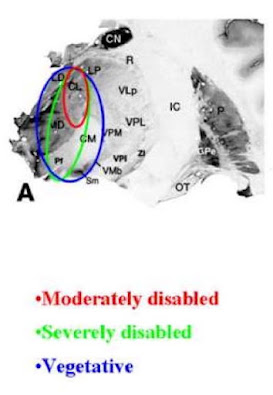
Neuroscience has reached that stage in studies of consciousness. While philosophers wring their hands about the "hardness" of the problem, scientists are realizing that it can be broken down like any other, and studied by its various broken states and disorders, and in its myriad levels / types as induced by drugs, damage, and by evolution in other organisms. A decade ago, a paper showed that the thalamus, a region of the brain right on top of the brain stem and the conduit of much of its traffic with the cortex, has a graded (i.e. titratable) relationship between severity of damage and severity of effects on consciousness. This led to an influential hypothesis- the mesocircuit hypothesis, which portrays wide-ranging circuitry from the thalamus that activates cortical regions, and is somewhat inhibited in return by circuits coming back. 


Degree of damage to a central part of the brain, the thalamus, correlates closely with degree of consciousness disability.

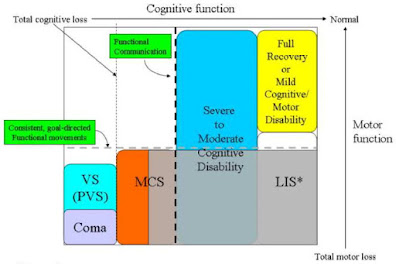
A classification of consciousness / cognition / communication deficits, ranging from coma to normal state. LIS = locked in state, MCS = minimally conscious state, VS = vegetative state (now unresponsive wakefulness syndrome, which may be persistent (PVS).

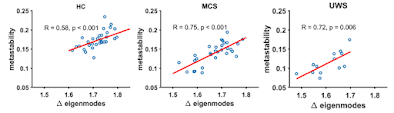
The anatomy is pretty clear, and subsequent work has focused on the dynamics, which naturally are the heart of consciousness. A recent paper, while rather turgid, supports the mesocircuit hypothesis by analyzing the activation dynamics of damaged brains (vegetative state, now called unresponsive wakefulness syndrome (UWS)), and less severe minimally conscious states (MCS). They did unbiased mathematical processing to find the relevant networks and reverberating communication modes. For example, in healthy brains there are several networks of activity that hum along while at rest, such as the default mode network, and visual network. These networks are then replaced or supplemented by other dynamics when activity takes place, like viewing something, doing something, etc. The researchers measured the metastability or "jumpiness" of these networks, and their frequencies (eigenmodes).

Naturally, there is a clear relationship between dynamics and consciousness. The worse off the patient, the less variable the dynamics, and the fewer distinct frequencies are observed. But the data is hardly crystal clear, so it got published in a minor journal. It is clear that these researchers have some more hunting to do to find better correlates of consciousness. This might come from finer anatomical localization, (hard to do with fMRI), or perhaps from more appropriate math that isolates the truly salient aspects of the phenomenon. In studies of other phenomena such as vision, memory, and place-sensing, the analysis of correlates between measurable brain activity and the subjective or mental aspects of that activity have become immensely more sophisticated and sensitive over time, and one can assume that will be true in this field as well.

Severity of injury correlates with metastability (i.e jumpiness) of central brain networks,  and with consciousness. (HC = healthy control)


  • Senator Grassley can't even remember his own votes anymore.
  • How are the Balkans doing?
  • What's in the latest Covid strain?
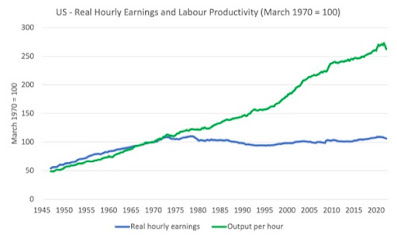
  • Economic graph of the week. Real income has not really budged in a very long time.

Saturday, August 6, 2022

The Stories we Tell Ourselves, in Art

Why paint saints, dreams, and theologies?

I am enjoying a lecture course on great churches- a delightful survey of one and a half thousand years (plus) of architecture, painting, sculpture, and general devotion. At the same time, I am reading an amazing, though much shorter, book on Navajo sand art. The conjunction is curious, possibly fertile, and puts the question forthrightly.. why? Why all this art, and such various art, when the truth of the matter is supposedly not in question, and not susceptible to flattery either. People have, in the past at least, clearly put their best efforts towards sacred arts.

Perhaps the question is simpleminded, but it is to me at least as a non-artist as well as non-religionist, continually mystifying. In the current time, art is rarely inspirational. It may be mystifying, difficult, and expensive, but modern artists rarely pander or glorify- that is the province of lower-brow activities, done in velvet. The best artists interrogate, they don't instruct or celebrate.

The interior of Monreale Cathedral in Palermo, Sicily. It is a blend of Norman, Byzantine, and Islamic styles, with acres of mosaic art.


While Navajo sand art is not done on the scale of cathedrals, it is incredible art just the same. Until the tourist trade, it was never durable, but was performed as part of a healing ritual, during which the patient was placed on the finished painting and contact made with the patient to transmit the magical powers of the symbols, guardians, and deities the shaman had depicted, and to draw off the illness. Its abstraction is totally different from Christian art, which uses a variety of symbols (halos, crosses, fish), but is basically realistic, as its historical conceits are realistic and its story a purported truth in not just spiritual but historical and scientific respects. Not so with Navajo art, which hearkens back to all sorts of indigenous art going back to the Australian dreamtime. This art is incredibly modern and evocative- directly archetypal in its intricate symbology and high design sense.

Every character, color, orientation, and symbol of this sand mandala has significance, and according to the story, (larger myths called "ways", such as the shootingway, blessingway, holyway, etc.), healing power.

But what does all this art do? Religion is at core about ligation (ligare / ligio) between people- connecting us socially and spiritually. It is a shared story- a culturally structuring story that is immensely influential on building our sense of place in the world, and of meaning. Given the fundamental meaninglessness of existence, there are no rules given a priori. There are no human rights, no legal systems, no gods, no norms, .. nothing. We make all these up as part of our social system. So while the rich symbols of Christian or Navajo art may seem absurd, dubious, or playful, they are actually extremely serious as expressions of the cultural structure. 

To see how this works, consider Donald Trump's big lie. He also came up with a culturally structuring story. It functions almost as scripture for his believers. It is a badge of honor as well as a test of allegiance to believe in it. It is obviously false, which makes it even more powerful in those roles. No one needs to structure culture around the story of gravitation- that is given and already in the background. Structuring culture involves beliefs that are a bit more costly- which provide novel "explanations" and restructure reality to generate a new social system. The one Trump is building might not be one we want to live in, but it is a well-worn style of both art (garish, tasteless) and society (authoritarian, cynical, corrupt). 

By feeling the overwhelming impact of gothic cathedrals, you get a sense of the power such art has to beat its story into the viewer. Making sure that everyone understands the story and adheres to it is naturally the first job of any coherent social system. Whether by an inquisition or some less forceful means, cohesion relies on sharing this cultural core. 

We in the US are clearly coming apart in these terms. Religion may not have been our guiding story, but rather an enlightenment optimism, redoubled by the grace of "virgin" lands, rich with resources that have powered our rise to greatness. This culminated in World War 2, the space race, and the landing on the moon. What was supposed to be a New Frontier has turned out to be a sterile wasteland. Space is an incredibly harsh place, far worse than our worst visions of Earth under global warming, or even nuclear war. So that whole story of progress, enlightenment, growth, and limitlessness that was structuring American culture and dreams for decades, (while carried on in fine style by Star Trek), has collapsed in practical terms. 

We need something new, and the current culture war is being fought over that story and its structures. Will we turn to planetary stewardship and social justice? Or will we re-establish a frankly racist Christianity as a way to order society, control women, keep out the riffraff, imagine that no change is needed, reap what resources are left, and leave the future for God to sort out?


  • Fear.
  • The wages of bullying ... is even Kazakhstan edging away from Russia?
  • And is China's bullying enhancing its image and power abroad? This analysis is floridly and absurdly apocalyptic.

Saturday, July 30, 2022

Auto-Tune, or De-Tune, Keeps the Brain Humming

A more granular investigation into the control of brain waves in setting up transient connections between anatomical locations.

Electrical brain waves (now called neural oscillations) have been a long-standing interest of this blog. They were a relatively early discovery, are tantalizingly dynamic and diverse, but have been resistant to full understanding. But now that understanding is gradually developing, through the relentless process of normal science. A theory put out several years ago laid out in some detail how communcation in the brain can only happen when different locations are in "sync", which is to say that they are firing with the same rhythm, such that the receiving neurons are ready at the right time to process and relay the messages they are getting. But not all areas of the brain can be in sync at the same time, and different areas are positioned at different distances. The model posits dynamic coalitions of co-firing neurons that are in communication at the moment, but which then quickly decay as the thought passes. It also posits that time lags between locations are accounted for in the physiological design, so that for instance, bi-directional communication is not instantaneous, but separated in time such that A-->B happens first, then B-->A happens sequentially, in cases where feedback is an important element. While one of the typical partners of the oscillation entrainment system is stimulus from sensory inputs, another is attention from upper levels, which can emphasize and sustain some coalitions (thoughts) while shunting others to die out.

"Local cortical neuronal groups synchronize by default in the alpha band. During alpha-band synchronization, network excitation fluctuates at 100 ms cycles, but is tracked by network inhibition within 3 ms. This curtails effective communication and renders the respective activity invisible to other neurons. ...Visual scenes induce many local gamma rhythms with varying strength and frequency, reflecting the bottom-up stimulus salience and stimulus history. The gamma landscape in e.g. V1 thus in the end reflects stimulus properties, experience and top-down influences. At a given time point, one out of these coexisting gamma rhythms succeeds in entraining postsynaptic neuronal groups. This gamma entrainment allows to transmit a stimulus representation and to selfishly shut out competing stimuli's representations. The entrainment establishes a cycle-to-cycle memory of the active link that maintains until it is terminated at the end of a theta cycle. The presynaptic gamma rhythm allows network excitation to escape its ever chasing network inhibition." - From a discussion of how the visual processing system may use gamma oscillations (vs other frequencies- alpha, theta) to offer salient results to higher visual areas.


Well, how is all this managed? The core properties of neuronal firing are pretty well understood, particularly that each firing is followed by a brief refractory phase, imposing some of the cyclicity on the system. The anatomy is set in a relatively static way (on this scale) but with connections going in all directions. How can oscillatory entrained coalitions be created in so many different directions? Additional complications and opportunities are introduced by oscillations happening at different frequencies. A recent paper (with review) dives into the particular cells and layers of the hippocampus to lay out one example of how such a system is managed, to a very small degree, by inhibitory neurons.

These researchers are as usual working with mice, and have given up on actual mazes in favor of video mazes so that the mouse's head can be held still. This mouse is running (virtually) through a maze, so is accessing its memories of place and time actively while the researchers get into its head. The image below shows (green) how one of their electrodes pierces the mouse's hippocampus, sampling several layers at once. The neuron of interest (dark red) is gl-B182a, which is an inhibitory (neurogliaform) neuron. Its output is a bit diffuse and slow-acting, compared to the other neurons in the system that are being sampled (the u1 and u2 neurons in the trace shown at bottom. The main trace shows the gamma rhythm, (roughly 75 Hz) whose amplitude rises and falls in time within a slower theta rhythm (bottom, roughly 11 Hz). 


An electrode (green) is stuck through a mouse's brain, in the hippocampus, and records from several cells, including one inhibitory neuron, dubbed gl-B182a. The recording is below, compared to several other traces, such as the incoming gamma rhythm (gray, idealized in black), firing of specific target cells, and an idealized theta rhythm (bottom, black). gl-B182a has a very specific and peculiar firing pattern, right at the trough of gamma waves that are at the high points of the theta rhythm.

They note that the neuron they are following fires around the peaks of the general theta rhythm, and precisely at a trough in the fast gamma rhythm. The whole paper is about how this class of inhibitory neurons is specially tuned to fire with the gamma rhythm, (which is coming in from cortical inputs, through the entorhinal cortex), but is also inhibitory, and has the effect of throwing its target cells (called CA1 pyramidal neurons) off this rhythm again, almost immediately. The interesting thing is that they do not inhibit the firing of their targets overall, but only their timing. Thus the paper claims that they have found a novel class of cells that actively, rapidly, and specifically de-tunes target cells that would otherwise merrily just keep humming along with the incoming rhythm. The point of this is that the cells have already been entrained for a couple of gamma cycles before the effects of this new inhibitory cell kick in, which might be enough to communicate what they have to communicate. So it falls to this inhibitory system to break up the party and reset the local cells so that they can be drawn into new and different coalitions / thoughts.


A model of what is going on above with these inhibitory NGFC cells. The gamma rhythm from elsewhere (teal) comes through the hippocampus and recruits select cells such as the CA1 pyramidal cells (purple). When local synchrony is achieved, the neurogliaform cell (NGFC) steps in with an inhibitory burst, enough to knock them out of rhythm again, without significantly lowering their firing rate.

Granted, this is not a full explanation of what is going on with local information processing or with neural oscillations. Especially, it does not imply that the inhibition is being controlled by higher cortical inputs to these cells that might constitite attention or its opposite, and therefore constitutes some kind of transistor-like gating mechanism. But it is an important ingredient in their usefulness, by modulating how thoroughly local cells get caught up in them. The oscillation keeps on going, but thanks to these inhibtory cells, it is highly selective in which local cells it recruits, and how briefly. Note that since we are talking about the gamma rhythm here, these phenomena go by in a matter of milliseconds, far below our range of awareness. They are thoroughly unconscious, as most of our mental processes are.