Saturday, September 14, 2013

State and Firm: the transition from predation

As governments become more democratic and accountable, do workplaces?

The classic interpretation of the state is that of gradual transition (hopefully progress!) from the Hobbesian war of all against all, to organized banditry, to stationary banditry, to feudalism & aristocracy, and ultimately, by degrees, to increasing regard and accommodation to the populous subjects of the state, to the point where in a democracy, the ruled are, and control, the rulers for the broadest interest of all. A nice story, though the current rule by Wall Street looks like a step backwards in some respects. Corruption serves as another method of predation, more or less organized, available to individuals and state organizations at most levels of the progression.

The firm could be viewed similarly, coming from a Marxist perspective (thanks to Bill Mitchell for a couple of blogs on the topic). As feudalism wore down, its forms of control split between the public state and private capitalism. A transitional example of the latter was the plantation economy of the American South. Capitalists need to exploit labor, as the feudal lords exploited their serfs and other subjects. How is this done, other than through management? Management wears the two faces of, on the one hand, guiding and facilitating the work of the firm, putatively something salable on the open market, and thus of positive social value both to customers and to the workers who create it (assuming they are voluntarily employed). The other face is that of guardian of the interests of capital, extracting as much surplus value as possible from the workers, and paying as little as possible. Making use of the labor market, such as it is, and the political system, and any other tools, including in the not too distant past, physical violence, to keep labor powerless, subservient, and poor. Additionally, other resources than labor are  treated similarly. Public goods are expropriated or destroyed for private profit, patents poached, public officials corrupted, public institutions coopted, and media blanketed with disinformation, for any possible advantage.

My question is whether the predation of the firm has replicated the more or less progressive trajectory of the state, or whether progress in that relationship has stagnated over recent decades. For the state, the world has been swept by democracy. Even the Arab world has caught wind of this trend, though it is ending in tears in some precincts. Civil rights have expanded, to ethnic minority populations, to women, and to sexual and other minorities. Even with the sclerosis and backsliding we see in the US political system, with the top-heavy security state and war establishment, the people, in their media-addled state, are in control when they want to be.

To the original question, one would have to say, no. Death is no longer a routine part of predatory capitalism- workplaces have become safer for most workers. But the economic divide between workers and those they work for has grown enormously, which shows heightened predation over the last few decades. All labor productivity gains have gone to capital, and none to labor. Peonage has made a comeback in the form of predatory lending. This is hard to defend on any rational or moral basis, and one has to conclude that, through the many tools of politics, media, corporate governance, and ideology, capital has grown more predatory rather than less, contrary to the trend of lower predation by the public state.

Ironically, the ideologues of the capital have used the language of civil rights, equal play, and freedom from the evil public predatory state to defend the capacity of capital and employers to predate on workers. The entrepreneur is celebrated as the free spirit who brings immeasurable value to the masses, and whose freedom to organize must not be impinged. Yet the worker's freedom to organize and create a counter-capital power structure that, among other things, raises pay - that is a different story! Collusion in the boardroom, to pay each other in crony capitalist terms and evade accountability ... no problem there. But collusion among the cubicles is not to be tolerated. The irony continues as labor gets paid less, and can buy less, leading to a seizure of the macro-economic cycle that the entrepreneur was supposed to be leading by his miraculous "supply-side" efforts. Which only serves to unmask the whole exercise as one of simple greed by the top end of town.

Of course the Marxist question is whether this whole setup was fair in the first place. Does the mere possession of money entitle a person to the perpetual future flow of more money, via rents and profit streams? Is this truly consistent with human values and just deserts? Back when capital was scarce, this practice / ideology may have made more sense. But today, when capital is not at all scarce, (as shown by the level of interest rates), the economic and political machinations required to keep & even grow power in the hands of capital appear to be an unseemly anachronism, counter to the public interest.

But putting aside the deservedness of the capitalist and the managerial class, and assuming that private firms do work that serves the public interest, (or could be appropriately regulated to do so), perhaps a more fundamental question is on the labor side. How many workers need the specter of poverty, low-wage jobs, and social stigma to be lashed to work? Could our society function if everyone who works was paid decently by their employer, and not forced to collect extra money from the government to relieve their employer of the burden? Could our society function with public service jobs offered to everyone wanting to work at a decent floor wage, and with a lower maintenance payment to those unable to meet even a basic work standard? Could private employers function having to pay more for labor? Would having fewer fast food establishments and other services, and higher food prices be an acceptable price for having everyone live in dignity? Would the number forsaking the private workforce for public service jobs exceed the number that has been involuntarily thrown out of work by the business cycle? And if so, would that be a bad thing?

Most people want to work. They want to be useful and not on any dole. But the current system, controlled for the interests of capital, (and also by the blind vagaries of the free market, leading to highly damaging booms and busts), generates a large army of unemployed and underemployed. Which in turn leads to immediate waste and disgruntlement, and long-term generational dysfunction. We can build a better system, and with a modicum of management in the public interest, which our government has proven itself capable of in the past, we can create not only a far more compassionate country, but one with higher prosperity and economic well-being for the vast majority of citizens.

  • Rich people in a democracy.. the use of idiot populism.
  • Stiglitz chimes in- inequality is engineered, and poisonous.
  • Just who gets to collude / organize in the modern economy?
  • Poverty is still very high.
  • Brainwashing and Christianity. Sort of a system of terror. Especially in Texas.
  • Hell:  the psychology is way too strong to just do away with it.
  • Carbon and business as usual- not a happy future.
  • Let's get rid of coal.
  • Renewables are still approaching parity.
  • The Taliban is now using clear-and-hold.
  • Those selfless non-prosecutors, non-regulators at the SEC. And derelict reporters into the bargain. And why isn't the NSA snooping at the real evil-doers?
  • We still need that Tobin tax.
  • Subprime is right back in the saddle.
  • Chemical corruption in the US.
  • Economic quote of the week, from Paul Krugman
"So what can be done? For the moment, the kind of transformation that took place under the New Deal — a transformation that created a middle-class society, not just through government programs, but by greatly increasing workers’ bargaining power — seems politically out of reach. But that doesn’t mean we should give up on smaller steps, initiatives that do at least a bit to level the playing field..., for example,... universal prekindergarten education, paid for with a small tax surcharge on those with incomes over $500,000. ... For extreme inequality is still on the rise — and it’s poisoning our society."
  • Economic graph of the week, showing the trillions of output and income (roughly 5 to 10 trillion at current count) that have been stolen / lost due to the economic debacle caused by our leading financial institutions, including derelict regulatory officers and instutions. All to keep the casino going for the top end.


Saturday, September 7, 2013

Bach: a book

Review of Eric Siblin's "The Cello Suites"

This is a good book, a little over-written, and a little self-indulgent. Siblin presents parallel portraits of Johann Sebastian Bach, composer of his six famous cello suites, and Pablo Cassals, who resurrected them into the top-drawer recital pieces they remain today.

It is extremely interesting, and probably the material on Cassals was added to fill out the void that is our knowledge of Bach's personal life. But to me it seemed a strongly tragic story, with Bach unrecognized as a great composer in his lifetime, and his wife dying in paupery. How could this be? Now, Bach is all the rage, with full releases of his hundreds of cantatas, and thorough scholarship of his over one thousand-work catalog. But in his day, GF Handel couldn't be bothered to visit Bach even when passing through a town 25 kilometers away. And those famous suites where pretty much unknown for almost two hundred years after being written.

It makes you wonder whether disco is going to take the world by storm in some future epoch. Music goes in and out of fashion, and in Bach's time, his music was very much going out of fashion, which was travelling from sacred polyphony to popular opera and homophonic song (in the early 1700's). He was as fusty in his musical tastes as in his politics, religion, and dress. But the music, ah! Bach also didn't get around much. After visiting the Hamburg area in his youth, he spent his whole life in his homeland of Saxony. Having 20 children probably didn't leave much time for travel.

Speaking of which, the notorious genetics of the Bach family are a clear indication of eugenics (or at least assortative mating) at work. That musical talent is heritable seems as clear as the heritability of intelligence, height, and all sorts of other behavioral and physical traits. Whether we have the philosophical or moral foundation to even want to put such principles into practice is a separate question, but the potential is obvious enough.

Bach is, moreover, characteristic of great composers and great periods of composition in that he was paid more or less by the yard. Like the great broadway composers, (Richard Rodgers comes to mind), or the Motown era, it was simply expected, in the competitive system of the day, to crank out music continously, on demand. And the fascinating thing is that some composers rise remarkably to such conditions.

And, heartbreakingly enough, some unknown portion of Bach's work is lost. Siblin tells stories of Bach manuscripts found used for wrapping paper and for potting plants. His son C. P. E. Bach was the most filial and successful, but even his collection of his father's manuscripts was sold off under the auction hammer in 1788.

What makes music transcend its time? Innate quality is the first ingredient. But someone has to recognize it and perform it, which can demand going against fashion. The appreciation of other musicians finally turned the situation around for Bach's legacy. He was loved and appreciated by Beethoven and Mozart, but only really popularized by Felix Mendelssohn, who, in 1829, properly put on and publicized Bach's St. Matthew Passion.

Ever since, we have been treated to a flowing bach of music that seems as endless as it is astounding.

"So the ideological push to make capitalism appear to be fair led to the development of marginal productivity theory. Thus, the theory became that people are paid according to their contribution to production. That was then represented as a fair system and was used politically to negate the claims that workers were being exploited."

Saturday, August 31, 2013

Work is a fundamental value

What happened to family values, the work ethic, and bootstrap-pulling?

Judging by the actions of the current Republican class in congress, it is OK for 10 to 20 million Americans to loaf around, not doing anything productive. They and their families can decline into social disfunction and all the other ills associated with poverty. They can lose their skills and indeed desire for work. That is OK.

Sure, they should all help themselves, but with far fewer jobs than unemployed, and fewer decent jobs than poverty-level ones among those, it is a game of musical chairs with more than one chair missing. Sure, they should all start their own businesses, cleaning yachts or something, but the rich are not really in a spending mood. The rich (or other consumers) would have to spend more overall in order for this kind of entrepreneurial spirit to result in a net increase in jobs and higher economic activity. But they are still saving, and indeed complain that interest rates are too low, impeding their saving plans.


One wonders what ethical planet the Republicans, conservatives, and other chamber of commerce types are on. Did the imperatives of class war somehow over-rule their platitudes about hard work and family values? Has maintaining a vast reserve army of the unemployed, with all the employer power that represents, become more important than promoting a middle class with universal values of fair play, decent pay, and stable communities? It looks that way from here.

Unfortunately, with democracy in America (if not governance entirely) temporarily suspended in the interest of the moneyed interests, one can only propose better policies in an abstract, long-game sort of way. And the two we need are: a living minimum wage, and a guarantee of a job for everyone who wants to work. The two policies combine forces by paying a decent living salary to any citizen who wants work, to work for public projects and needs of which we have no shortage. Then private employers can bid on top of that to get the workers they need, if they have worthwhile work to do.

As we learned in the Great Depression, work is a fundamental value. Everyone needs to feel useful and do something useful. No one wants a handout when they could be helping others, earning their way, and supporting their family. The depression was not only economically, but psychologically devastating, with the realization that, due to some technical problems with the monetary and banking systems, a quarter of the population was suddenly denied work and thrown into poverty. The fundamental point and nature of the economy was put in question.

The last century also showed that no pure system, whether communist or free market, works sustainably by itself. We need elements of both for a healthy economy and culture. We need the freedoms and competitiveness of the private market system. And we also need intelligent policy and legal controls over market systems to make them work effectively, as well as robust safety nets that insure us all from their recurrent, inevitable failures on small and large scales.

On this labor day, it is time to realize that we in the US are rich enough to use all our labor at all times, out of both self-interested as well as compassionate motives.

"The War Bonds and the Revenue Act creating the personal income tax, then, were specifically created not for the purpose of “collecting” money so the government could have it to spend—but rather for the purpose of destroying money so the government could then issue and spend even more dollars without feeding an uncontrolled inflationary spiral."
  • .. and from Bill Mitchell on the class war, quoting Heidi Moore on a simple point about food stamps, welfare, earned income tax credits, and the like:
"The article points out that because of the appalling remuneration of low paid workers in the US, the provision of safety nets in the form of food stamps etc, means: '… that the government is paying to subsidize company profits: as businesses pay a minimum or near-minimum wage, their workers are forced to turn to government programs to make ends meet.'"
"In an effort to help clear Pakistan's clogged courtrooms, Pakistani officials have created a mobile court that will mediate small civil cases, minor criminal cases, and juvenile cases across the country (Reuters).  There are about 1.4 million cases pending in Pakistan and frustration over decades-long cases as led some litigants to turn to tribal jirgas instead.  While these councils offer instant decisions, sentences can include being buried alive, gang-raped, or stoned to death.  Court officials are hoping their mobile justice system, which launched on Tuesday, can offer an alternative.  The mobile court heard 29 cases in Peshawar during its first day in action and the government hopes to launch 11 more buses by the end of the year."

Saturday, August 24, 2013

Empiricism: good for tiny and unimportant things!

Baseball succumbs to the video replay.

One attitude that intrigues me in discussion with defenders of religion is their appreciation of logic and science. They are often effusive about its value and relevance to all kinds of practical and mundane things. But when it comes to the so-called "big questions" and super-important topics, well, then intuition and whatever-I-feel-in-my-gut rules the day.

It is as if the enlightenment and multiple scientific revolutions came and went, in one ear and out the other. As if humans hadn't learned they are fallible, and do not intuitively come up with all the right answers about the structure of reality, automatically, by sheer inspiration. As if they still had an imaginary friend.

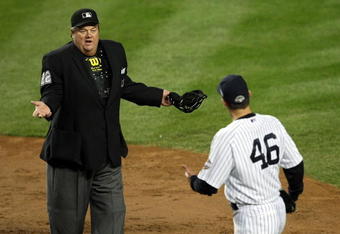
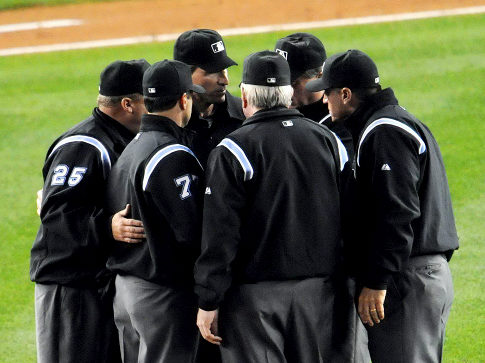
This all came to mind again when I read that baseball is finally giving in to the instant replay. Spectators at home watching their Tivo'd HDTV games can see all the bad officiating in excruciating detail, and the league can no longer hide behind a best effort / intuitive model of officiating. They are forced to deal with the actual truth, which may not come from the eyes of umpires, but more reliably from the unblinking camera. Like countless areas of science, sports is (reluctantly) transformed by instruments that improve on our natural endowments, and help us see new things, or the familar in new ways, with greater accuracy.


Similar progress is afoot in law, where the reliability of eye-witness testimony has over the recent decades come to be recognized as among the worst evidence, while technological marvels like DNA identification provide a whole new level of accuracy.

So, what about religion, the exemplary province still ruled by intuition? By coincidence, Steven Pinker wrote a strong plea in TNR recently for a truce between science and the humanities, including religion, to cooperate rather than hiding in mutual ignorance, hurling meaningless language such as "scientism". His point was not only that science has had important humanistic underpinnings and effects over the last several centuries, but that those humanities most vexed by "scientism", such as postmodernist philosophy and theology, have not had a lot of accomplishment to crow about themselves. They had better learn from other fields and take what is useful, rather than take obscurantist potshots.

In return, it is obvious that science and scientists need to be careful about what they have expertise in, and what values they and the humanities respectively bring to the table. But one important point here is that, under the cover of "hard" sciences and objectivity, science has made great strides in recognizing human cognitive limitations, both explicitly in the fields of psychology, and implicitly in the other sciences, whose whole modus operandi is built around the recognition of human weaknesses, which require constant vigilance, by open argument between competitively motivated scholars, by mathematical formulations where possible, by the discouting of authority, by careful and public documentation, and, most notoriously of all, by empirical experiment.

Have enough experiments been done to say whether prayers work? Have enough experiments been done to say whether god saves its chosen people, favors one team over another, or one nation, or one religion? Have enough experiments been done to indicate that religion has a deep psychological basis that belie its florid claims to objective truth?

Yes. We know all these things, and much more. For those viewing at home, the primary property of god is its "hidden-ness". For those rewinding and watching in depth and slow-motion, another primary property is the abundant anthropomorphic projections and wishes (and fears) attached to "Him". It is quite clear where all this comes from, and it isn't from telescopic observation.


Connected with this, we also know that we are fundamentally alone. While there may (or may not) be other intelligent beings in the universe, we know already that they won't be genetically or cognitively related to us, and will be so distant as to be fundamentally cut off from interacting with us. There is no one else to turn to.

Part of being existentially alone is having no outer standard of morals or other subjective values. We answer to no god or other being, we go to no Valhalla after death. Part of what we have learned is that for all the objective reality out there, the values and desires we have are our own, part of our subjective (and biological) makeup, in a constant dance with the wisdom (and desires) of those around us, and with those who have gone before and cultured our way through the world. This is the one place where intuitions really do rule supreme, since they make up our values by necessity ... there is nothing else to go by.

One can sense the discomfort of those yearning for something more certain to hang on to- a father totem to tell them what to think and how to feel. But, checking the instant replay, god is still dead and gone ... the movements of theology, postmodernsim, religious "discernment", and post-60's backlash are made up of people working out their own issues, groping in the dark without help from above. A key tipoff is their moralism. What is real or not is secondary to whether their communities live in a properly patriarchial moral order agreeable to them.


Incidentally, Steven Pinker discusses the fascinating issue of "explaining away", which is a common fear coming from the humanities. If we understand some interesting topic in a fully worked-out reductionistic sense, does that rob us of some aesthetic appreciation, of some of our humanity? Does music theory kill one's appreciation for Bach? Does knowing molecular biology kill one's appreciation for biology, or does instant replay destroy our appreciation for baseball? I don't think so.

What empiricism and science in general do "explain away" are ... bad explanations. There may be a certain charm in thinking that hurricanes are caused by immorality, birth defects by sins in a past life, that prophets received divine "revelations", or that god forms us in "His" image, (take note, females!), but we have to make do without such tales when we learn more about how things actually work. If you value "inspired" scriptures, mystical "forces", and folk theories about all and sundry, then yes, we lose something by this rationalistic, reductionistic, remorseless instant-replay process of enlightenement. And, frankly, good riddance.


  • "Intellectually unsubtle"!, fumes Russ Douthat. Of all people.
  • God still hanging around in some very small council chambers.
  • Dawkins: evil, or just right?
  • Why are attitudes about science shifting.. or are they?
  • At least some fields (cougheconomics) could use another dose of empiricism.
  • Malthus and modernity. Why does population outrun development in some countries, not others?
  • Fannie and Freddie should be made entirely state run, not destroyed.
  • The brotherhood's gamble.
  • When will Egypt get a competent civilian government?
  • Republicans... still the party sort of opposed to governing.
  • On the values of leadership.
  • We have to take nuclear seriously. After we get that carbon tax, of course.

Saturday, August 17, 2013

Not even feudal

The many pieces of the Pakistan puzzle. Review of "Pakistan: A hard country", by Anatol Lieven

The good news is that Pakistan is quite a stable country, in the opinion of the author, a King's College, London scholar with who has travelled and interviewed extensively all over Pakistan (excepting where he would be killed, in the vicinity of Waziristan!). The bad news is that much of this stability is due to the most backward elements of its society- the immovable tribalism, corruption, poly-theism, and divisiveness of its politics, which prevent any single revolutionary movement, Islamist or otherwise, from sweeping the country or breaking it apart. And the one thing all Pakistanis agree on? That they hate the U.S. and India.

It is an excellent book, delving into more details than I thought possible for a Western author. Each province is discussed in some detail, each party explained, and the obscure workings of the military and graft system untangled, at least slightly. He commends the hard-working nature of Pakistan's politicians, who have to juggle an unending stream of favors, bribes, nepotism, and more or less formal militias and street fighting, leaving little time (or desire) for grand visions, party ideology, or good government technocracy.

But let's back up a little. Pakistan was founded (67 years ago this week) from the dissolution of British rule over India, in Britain's dramatically weakened state after world war 2. The Muslims of India knew they would never get to rule in a future Indian democracy, (despite their history of presumably glorious Mughal rule), and, among many other things, asked for a legally stipulated 50% share of all government positions. Well, that was typical ... and hardly realistic, so what started as an abstraction, threat, and bargaining chip - partition- turned into a slapdash reality, as a boundary commission composed of Cyril Radcliffe and colleagues (who knew nothing of the area) took a month to draw a border, known as the Radcliffe line. Mixed communities on both sides were quickly ethnically cleansed, and what was a roughly 20% Hindu population in the future Pakistan became less than 1%. Hundreds of thousands died, and many millions fled to their newly declared religio-ethnic homelands.

While the haste of line-drawing was certainly a defect, one has to say that the competing model taking place in Israel/Palestine, where a line is never ever drawn, is hardly better. But it was really the implementation that failed- the British cut and ran within two months, and virtually no one on either side was prepared to take over their new nations, let alone manage (i.e. police) the gradual disentanglement of centuries of mixed living. Who was more at fault? Well, India still has roughly as many Muslims as Pakistan does, at about 13% of its population, so just going by the numbers, the ethnic bias of the Muslim side seems distinctly stronger. After partition, Pakistan proceeded to start three wars against India, each of which it lost. It also lost its co-religionists in Bangladesh who originally constituted "East Pakistan", and who were regarded as distinctly inferior by their Western brothers. Nor was Pakistan ever taken seriously by the Islamic world at large as its leading nation and beacon, as it had hoped.

A miscellaneous picture from contemporary Pakistan. Breakfast on the train, by Steve McCurry.

So Pakistan arose in tumult, wedged between two highly artificial boundary lines, and while more or less purely Islamic, still contains multitudes, including all possible sects of Islam. The refugees from India formed a special community and party in Karachi, founded on their special sacrifice for Islam (the Muhajirs), which again, the other communities are not terribly impressed with. The Punjabi farmers constitute the heart and majority of Pakistanis, ringed around by India on one side, and their tribal cousins the Sindis to the east and south, the Pashtuns to the north, and the even more tribal Balochs to the far east on the border with Iran. Each community is of course riven itself with various political lineages and ethnic allegiances. Indeed, the only national and highly functioning "tribe" of sorts is the army, which preserves a prim and disciplined, but not always intellectually penetrating, legacy from the British and more recently its U.S. relationships.

For example, the Pakistanis routinely blame the US for "forgetting" about them and about Afghanistan, after the Soviets were driven out. But we didn't live next door. Pakistan did, and its military establishment and ISI kept funneling money and arms into the Afghan civil war, and thereafter supporting the Taliban. Lieven discusses in detail how the ISI saw the unrest and strife in Afghanistan as a model for what Pakistan could also do to Kashmir. Promoting development in Afghanistan doesn't seem to have crossed anyone's mind in Pakistan.

Two other critical sources of fracture are, as Lieven portrays it, language and the judicial system. The official language is Urdu, which is largely Hindi written in an Arabic-like (via Persion) script. It is used by only a minority of the population, and what is more, is frowned upon by the true elites who speak English. Most of the population speak one of the many local languages- Punjabi, Sindi, Pashto, Hindko, etc.

Yet the justice system runs on English, due to its British precedents and structure (save for trial by jury, which was left out of the bequest, oddly enough!). So the vast majority of the population can not speak the language of their own justice system, let alone write it (indeed, literacy overall in any language is about 57%). And most of the functionaries who must operate in English do so tenuously. Combined with pervasive and flagrant corruption, this means that cases can grind on, Kafka-esque, for decades, amid misunderstandings and hidden influences. This means in turn that both officialdom and private citizens take matters into their own hands as a matter of course, using "encounter killings" on the part of the police, and blood feuds, kidnapping, general violence and riots by the latter.
An informant in Swat tells Lieven: "A khan politician would use his gunmen to seize some poor farmer's land and his political connections to stop the administration doing anything about it. Then he would say to the farmer, 'Sure, take me to court. You will pay everything you have in bribes, you will wait thirty years for a verdict, and the verdict will still be for me. So what are you going to do about it?' Well, when the TNSM [local Taliban branch] came up that farmer could do something about it. He joined them."

It also means that the alternative systems of justice offered by the Taliban, advertised as Sharia, (though typically owing as much to the tribal code of pashtunwali), is for all its flaws, extremely popular with Pakistanis in Pashtun areas and beyond, mostly because of its great rapidity and effectiveness. Crime, drugs, and "licentiousness" can be cleaned up virtually overnight. Yet upon closer inspection, the beneficiaries grow a little less enamored of the Taliban's justice, bought as it is at the price of totalitarian terror, and capricious, often downright un-Islamic, barbarity.
Indeed, the whole sense of justice is slightly different than Westerners might imagine. Lieven mentions the concept of honor or reputation (izzat), prevalent not just in tribal areas, but all over Pakistan, indeed all over southwest Asia: "Walsh speaks of izzat as an individual matter, but it is equally important to famillies, extended families, and clans. Indeed, most crimes committed in defense of izzat (and for that matter, most crimes in general) are collective crimes, as other family members join in to help or avenge their injured kinsmen in battle, to threaten witnesses, to bribe policemen and judges, or at the very least to purjure themselves in court giving evidence on behalf of relatives. This is not seen as immoral, or even in a deeper sense illegal. On the contrary, it takes place in accordance with an overriding moral imperative and ancient moral 'law', that of loyalty to kin."

The larger political system is likewise fractured, with overlaid westernized, feudal, and tribal institutions. The upper levels of government operate ostensibly on a western model, with prime minister, president, parliament, etc. But scratch the surface, and the substrate looks much more like a tribal system. The main parties are basically hereditary fiefdoms. For instance, the PPP of the Bhuttos are waiting for Benazir Bhutto's son to come of age to take over from the lackluster husband Asif Zardari. Their program has virtually nothing to do with ideology or approach to governance, but rather with patronage down a chain of smaller office holders to the local big-man system that runs most of Pakistan. Rural landholders are commonly referred to as the "feudals", but I think that oversells their powers of organization and governance. There are many tribal elements involved, and not just in the explicitly tribal areas.

The fuel of this system at all levels is patronage, graft, deceit, and corruption, whereby taxes are forgiven and neglected, jobs handed out, police actions directed for polical ends, and contracts let for projects that are never built. This leads to a dynamic where each party can only be in power briefly, since its empty popular campaign promises never are or can be fulfilled, nor enough graft generated to satisfy all adherents, leading to a cycle of disappointment and party-switching, not to mention governing mediocrity.

The author, like most observers, is starkly judgemental and anxious to see Pakistan modernize. But what would that mean? As people, we are all competitive, and Pakistanis are clearly prize specimens of competitive spirit, accessorized with a variety of narcissistic delusions, from the superiority (indeed the truth) of Islam on down to Pakistan's leading role in the Ulema, their superiority over India, obsessions with tribal honor and patriarchy, their especially toxic feeling of superiority over Afghanistan, and in general the various successes they would have but for the evil conspiracies of the US.

The problem is, delusions aside, that this competition is mostly zero-sum. One political party wins so that it can take the jobs away from the other party and give them to its incompetent hacks. The military promotes the perpetual war with Eastasia so that it can keep eating the lion's share of the budget, not to mention billions in aid from the US. But the society at large does not benefit. Tribal competition may be great for genetic evolution, killing the unfit and distributing spoils to the most ferocious and clever. But it does not (on any acceptable time scale!) generate cultural or economic development. That only happens when human competitiveness is channeled into constructive pursuits, the capitalist system being a prime exemplar, and professional governance another. The hidden hand is fueled by human competitiveness and existential necessity just as surely as are the most bitter tribal feud. But it creates far more wealth and public good (when properly regulated!). Pakistan's per-capita GDP ranks 141 in the world, out of 187 countries, significantly behind India, among many, many others. Much is due to complete lack of population control, but that is only one facet of Pakistan's deep failures of civil and institutional development.

What to do? From the US perspective, my prescription would be for the US to end monetary aid to Pakistan, or at least put it on the same footing, per capita, as our aid to India, which would amount to the same thing. The stunning process by which, after many decades of alliance, we are thoroughly and universally detested in Pakistan, points to very deep psychological issues which money does not help, within a relationship which could be called abusive. Anyhow, what Pakistan needs from us and from the West generally is not money, let alone aid to its military, but content- intellectual, managerial, governmental, institutional, philosophical. We should be on the friendliest possible terms on all those fronts, but not in ways that blackmail us into giving them money for their efforts (or lack thereof) towards being a basically civilized state. The cold war is long over, and Afghanistan has far more urgent need for our aid, for, among other things, defending itself against Pakistan. We have shown that we can do without military transport through Pakistan. China's relationship with Pakistan is far from being a threat to our interests either. Just as our process of leaving Afghanistan promises to ease a great deal of bitterness and tension there, disentangling our relationship with Pakistan would do likewise, benefiting both countries.
An interviewee in the Mohmand agency on the Afghan border talks about his brother: "He joined the Taleban because he believes in Islam, and because the Americans attacked Afghanistan without cause. Afghanistan is an occupied country like Kashmir. He and other Taleban do not want to fight the Pakistani army, but they have no choice because the army is attacking them on the orders of America. The Taleban would like to make an agreement with the government here so that they can go and fight in Afghanistan. But America doesn't allow the government to do that. It wants war in Pakistan so that Muslim will kill Muslim."

  • Another typical, duplicitous day with India: "On Tuesday, Salman Khurshid, India's Minister of External Affairs, told reporters that there was a sense of shock in New Delhi over the 'ceasefire violations by Pakistan,' and a spokesman for the ministry confirmed that the tensions in Kashmir would delay secretary-level talks between the two nuclear-armed neighbors (Dawn).  In his statement, the spokesman for the ministry said, 'For peaceful dialogue to proceed we need an environment free of violence and terror. And certainly what has happened last week doesn't fit into that.'"
  • Is Pakistan getting serious about its internal terrorism?
  • Egypt looks headed back down a similar path as Pakistan, as a militariocracy.
  • A little commentary from a British onlooker.
  • Another zero-sum activity that gives us nothing.. day trading.
  • How it works in Pakistan-on-the-Mersey.
  • Studies in US corruption.
  • Indeed, our mortgage crisis is one long litany of unprosecuted criminality and corruption.
  • Conventional, even elite, wisdom isn't very good. Everyone, please think for yourselves!
  • Not only is the 401K "system" off-loading risk from employers to financially unskilled workers, and allows employers the a la carte option of zero cost for providing a "retirement benefit", but the plans are also structured to fleece employees. Great job, congress!
  • Tempest over the IMF & Rogoff.
  • Robert Bellah as closet theologian and evangelist.
  • Religion and intelligence.. hmmmm.
  • Liberals unclear on the science concept.
  • On the psychology of evolution. Why we don't believe in it. I can add one more facet of likely disbelief. Humans are very groupish and tribal. We are attuned to very small gradations of difference between ourselves and others.. even non-existent differences cooked up in ethnic fantasies. This is one reason why some Americans are called African-American as a matter of course, while virtually none are called German-American or Russian-American. So the idea that a monkey is our "uncle", as it were, if many times removed, is instinctively disturbing, unless we have, as the article notes, adopted a very abstract and long-range view of time and change in biology.
  • Economic quotes of the week, from Bill Mitchell:
"The deficit should be whatever is required in each period to ensure that effective demand is at a level that is consistent with achieving potential output – that is, full employment. That might require a continuous sequence of deficits forever. Most likely given the historical behaviour of the external sector and private domestic sectors in most nations."
  • And.. from Bill Black:
"Given the fact that the CEOs of large fraudulent lenders are criminally liable for tens or even hundreds of thousands of acts of mortgage fraud we should be seeing our prisons overrun with elite white-collar criminals.  Instead, the DOJ has no convictions of the elite bankers who led the control frauds that caused the crisis."

Saturday, August 10, 2013

The god that failed

The boys of 1945, and degrees of humanity.

I don't know what people get out of horror films, but I do know what we get out of the holocaust literature. A sickening sense of moral depravity, of every value turned upside down, and of a world crying out for justice. There is also a sense of absolute Darwinism at its most brutal, both in the genocidal tribalism of a Germany gone mad, and in the grinding imperative to stay alive for every one of the exceeding few who survived.

This is occasioned by reading Martin Gilbert's "the Boys", about one remnant of Polish Jewry liberated from the concentration camps at the end of world war 2 and sent to England for recuperation. 732 children in their mid-teens, more or less, mostly boys, had undergone this harrowing journey, losing everything and everyone, and coming out through various strokes of luck and backbreaking labor into a world which generally went on without much ado, back into its normal grooves and preoccupations.

The outstanding part of the book is the first half, where the survivors tell their tales, frequently after decades of silence during which they were busy likewise getting on with their lives. Gilbert solicited their stories, and we can be thankful that many obliged, with great care and detail. They cover the nature of life in Poland before the war, which was a mixed bag of strong antisemitism in some communities, and unprejudiced positive coexistence up until the German occupation in relatively few others. Then of course the descent into hell. The restrictions, the dehumanization, the ghettos, the shipping to and fro, the labor camps, the starvation, the lice, the gas chambers.
"A few days after the deportation from Kozienice, the Jews working at Szyczki were given permission by their Polish overseer to conduct the Kol Nidrei even service, with which Yom Kippur - the day of atonement- begins. 'As a result', Moneik Goldberg recalled, 'some people figured that nothing would happen if they didn't report to work the next day. I was still observant at the time and wanted to stay in. There was a man, Moishe Zowoliner, whom my father had known very well and he had written him to ask him to look after me. He made me go to work that morning. When we returned to the barracks in the evening the SS from Radom were there. We were all marched to a clearing in the forest nearby. Those who had stayed in were already there. They had dug a ditch and upon our arrival they were all massacred, and we were ordered to fill the ditch with dirt. That was the first massacre I witnessed - on Yom Kippur 1942. I was fourteen years old.'"

Few of the survivors in this group remain religious. They are very much Jewish, but god for them seems to have pretty much failed as a concept. One typical query, from Meir Sosnowicz, now Michael Novice:
"There was another, very important question: 'Where was God?' I prayed to Him to redeem us. I acknowledged His presence. I looked for the miracles of redemption which we had learned about during our Bible studies at home and at school: the Exodus from Egypt, the story of Korah, who was punished immediately for his sins. The sins of Pharaoh seemed much less than the sins of the Germans and their cohorts. How long could God allow these obscenities to continue? Where was He? The redemption seemed a long time coming. Would it ever come? The question reminded me, in a very small way, of when, as a child, I hurt myself, and my mother was not around, it seemed for ever until she came. Where was my mother? I was confused. Today we say that God hid himself, turned his face from us, answered 'NO' to our request. I know that to this day I can not understand what He had in mind, to allow all this to happen for so long a time and to so many good and innocent people."

And do they regard religion good in a more general sense, spurring good morals and humanity?
"'While my behavior towards individual Germans and Poles is very forgiving,' Jack Rubinfeld wrote, 'I am fully aware of the enthusiastic participation by the majority of Germans, Poles, and Ukrainians in the hatred and gross mistreatment of the Jews. As a group, I have not forgiven them. For me, the main responsibility lies within the Catholic, Eastern Orthodox, and Protestant clergy and churches, that planted and nourished the seeds of this hatred. After so many generations of calculated cultivation, it became part of their genes or cultural landscape. Unfortunately for the believers, even hell is an absolute truth.'"

One of the additionally shocking aspects of the story was that after their liberation, many of the victims went back to Poland to their erstwhile homes. They were met there with killing squads, now of the native inhabitants, who perhaps were so full of the German ideology, perhaps so unwilling to face their own guilt and possible loss of ecnomic advantage, that they did their best to bring that final solution to a grim conclusion. Several of the boys describe hair-raising escapes at this time, which finally sent them on their way to England, Israel, and the US as totally, utterly bereft refugees.

For Poland now has a Jewish community of roughly 20,000, less than one percent of the original number. And it is interesting to reflect what a long and strong history Jews had in Poland. For over five centuries, it was a golden place, a Mecca(!) for Jews being driven out of Western Europe and Russia. Indeed at one time, Jews in Poland consituted the majority of all Jews world-wide. It is astonishing to think about.

It gives some perspective to the idea that the US is some kind of promised land for Jews. However well things go at the moment, and improve for many minority groups including Jews, there have been such cosmopolitan cultures and promised lands before. It is impossible to predict hundreds of years into the future. On the other hand, going the tiny Jewish country route in a more-or-less hostile world obviously has its risks as well.

Another aspect of the story made me reflect on the US. The survivors tell of the remorseless process of dehumanization that the German policies carried out, clicking the ratchets of restriction, segregation, expropriation, deportation, and down and down, till it ended in ashes around the crematoria. These were all conscious policies engineered out of a fundamentally competitive attitude. The Nazis felt superior in countless ways to the Jews, and wanted their land, their possessions, and everything else they had. And just to turn the screw even more, they played Jews off against each other in their misery, using some to run the ghettos, others to run aspects of the labor camps, even as the Germans themselves rolled the competitive dice on the larger stage by making war against the entire world.

Our own culture traffics in competitive dehumanization as well. To see homeless people trundling their carts around a city, and hear of prisoners in endless solitary confinement is quite disturbing. These people have lost a more individually specific Darwinian struggle, judged by some social process- "the market" in the former instance, and our justice and incarceration systems in the latter. Homelessness in particular seems a specific result of a national ideology: the right-wing combination of individual freedom and low communal responsibility. A bi-partisan commitment to the "competitive spirit". So we see ill-fed and desperate ghosts in our midst, whose only crime was to be born with or into some problem- maybe a bad family, propensity to addiction, or mental derangement- by which they fail the struggle, and become non-persons.


  • Social capital was a positive asset to the Nazis, not a negative one, at least in their original quest for power.
  • Evolution, music, and sociality.
  • Sexism in action.
  • Hooray for the girl scouts.
  • The common belief fallacy, and what to do about it.
  • And religious kowtowing making inroads at the State department as well.
  • As if we didn't know already ... David Brooks is not very bright.
  • What makes buses low-status?
  • Vast methane emissions are not helping the environment.
  • Workers should be paid better.
  • Economic quote of the week, about what China needs to rebalance its economy towards a consumer focus, which means giving more money to ... consumers. A good idea, not only for China.
"Three strands are needed: firstly, reducing the incentives for investment by putting in place fairer resource prices, interest rates, and distributing dividends from state-owned enterprises, secondly, boosting household incomes through higher wages and lower social security contributions, and thirdly, lowering precautionary savings by continuing to strengthen the social safety net and increase spending on pensions and healthcare."

Saturday, August 3, 2013

Expecting good music?

Review of a book on music theory: Sweet anticipation, by David Huron.

Music is one of the more mysterious pleasures of the human condition. Why do we like it? How can composers tap into our deep emotions using notes? Why has modern music gone off the rails? Why do different cultures and time periods make different music? How many different musics could there be?

An author who claims to have many of the answers is David Huron, of Ohio State, whose book, "Sweet anticipation" proposes an psychologically based theory for some aspects of music appreciation, centered around how we predict events, evaluate prior predictions, react to events, and generally relate to the future. (He gives a very nice talk on many of these issues here.)

I can't do much justice to his book in a very brief essay, but will offer a few points. His philosophical basis is very naturalistic- that the brain is a machine for predicting the future, to help us flourish there.

"In many ways, expectation can be regarded as yet another sense: a sense of the future. In the same way that the sense of vision provides the mind with information about the world of light energy, the sense of the future provides the mind with information about upcoming events. Compared with the other senses, the sense of the future is the closest biology comes to magic. It tells us not about how the world is, but how the world will be. It arose through natural selection's myriad efforts over millions of years to produce organisms capable of clairvoyance and prophecy. A stockbroker might value the ability to predict the future as a way to becoming rich. But for Nature, the value of predicting the future is the more precious gift of living longer."

He presents a detailed scheme, graphed through time, of how we relate to any event, with higher mental and evolutionary functions residing farther away from the event itself, and more ancient functions closer. Long beforehand, we imagine and dream about it, whether it is bad or good. As we get closer, tension rises, as we prepare a more physiological response, and register more specific expectations about it. Right after the event occurs, we may have basic flight/fight responses, later tempered by more mature reflection about the actual meaning of the event.

Interestingly, he adds another response immediately after an event, which is a prediction success response. Whatever an event's significance and affect, our success in predicting it provides another and rather immediate kind of affective jolt. If we are going to get poked in the arm for a vaccination, expect that it hurts, and it then hurts, we at least take some satisfaction in the successful prediction.

This is a critically important response for learning, giving rapid feedback to our prediction machinery. For instance, learning to play an instrument, there are countless wrong moves, and somehow, we have an internal reward system that notes what happened back in time to create correct actions, and reinforces those circuits in some fashion based on an emotional satisfaction with the few correct moves. This system is, frankly, still very hard to understand.

For music appreciation, this scheme of expectation and reward, borne of far more general biological imperatives, leads to many typical musical phenomena. Like the stereotypical ending of Western music where notes descend into a resolving chord. We expect it, so the composer is sort of obliged to provide it. But then rebellious composers try to mess with our heads. Huron makes a particular point of Richard Wagner, who apparently made a career out of avoiding typical endings in his pieces. Which can heighten tension and strengthen ultimate enjoyment, but may get tedious over time as well.

We expect notes to follow each other in pretty close succession. Scales are very common in music, while large jumps are more rare. Key signatures are maintained for some time, then modulated in gradual fashion, if at all. Very few people have perfect pitch, rather, most of us appreciate music in a relative way, hardly noticing when a song has been transposed to a different key. This is sensible, given our amazing capacity to consistently interpret spoken language from speakers with vastly different pitches and timbres.

Expectations happen at at least two distinct levels- the memory of a particular piece, and the more general expections surrounding the genre of music, and perhaps the overall cultural approach to music. Any of these can be confounded to create surprising effects- surprises can that entertain when our higher cognition kicks in to say that they are harmless / playful.
"Two general lessons might be highlighted from among the arguments presented in this book. The first is that many musical devices can be plausibly traced to the 'deep structure' of evolutionary psychology. The mental mechanisms involved in musical expectation are biological adaptations that arose through natural selection. At the same time, musical expectations are intimately linked to culture. The expectations listeners form echo the structures of the acoustical worlds they inhabit. In the case of music, those acoustical worlds are defined largely by culture. Both culture and biology shape the phenomenal experience of musical expectation."

The one quibble I would have with Huron is that he attempts to extend his theory of expectation as the foundation for our responses to music to tonality. Substantial space is devoted to tabulating the commonality or rarity of particular chord or note sequences, making the case that Western listeners like what they hear pretty much only because they hear it alot. We have a middle C based culture, but it could have been anything else (like twelve tone-ism, for instance!). Other cultures enjoy quite different tonalities as well as rhythyms. And I would strongly disagree. The way that Asian audiences have taken Beethoven et al. to heart is a testament to the universality of music, and I would counter that there are deep immovable aspects to tonality that provide the basic magic of music. It is not clear that the direction of causality goes from frequency to appreciation nearly as much as it goes from appreciation to frequency.

Sure, there are many variations and musics around the world, and it can take some effort, and even childhood training, to appreciate some of the more exotic forms. Culture has a great influence, and even within a culture, musical fashions change continually. For one thing, the speech patterns we grow up with have strong effects on our ultimate perception of music. Yet it is not clear that, for instance, mothers sing to their children in very different tones around the world, nor is it true that anything at all can come to be a deeply moving musical experience. Twelve-tonism and the antics of John Cage remain pedantic curiosities, not because we have not been exposed to them quite enough times, but because they fail to tap into relatively immovable, inborn pleasures of sound.

Pleasures that long predate any kind of formal music per se, but come up in our interactions with nature around us, in the sing-song patterns of our spoken sentences, and in our spontaneous humming and other nonverbal communications. Great amounts of information (especially emotional information) are conveyed during face to face encounters by the slightest inflection or tone. All this would be hard to wedge into a theory based only on expectations formed out of a statistical templating by the most common sounds, but has to be based to some extent on inborn relations to tonality.
"In Western culture, most aesthetic philosophers  use the word 'pleasure' to imply a sort of crude bodily sensation, the 'pleasure principle' is regarded as some unrefined and perhaps demeaning motive, unworthy of sophisticated people.  Few ideas have been more harmful in impeding our efforts to understand the arts."


"Let us take supply-side theory at its face value, however modest that may be. It holds that the work habits of the American people are tied irrevocably to their income, though in a curiously perverse way. The poor do not work because they have too much income; the rich do not work because they do not have enough income. You expand and revitalize the economy by giving the poor less, the rich more."

Saturday, July 27, 2013

Superhero aquaporin

How does water get into and out of our cells?

Water is an amazing molecule. Common, but complicated. Clear, essential, and taken for granted, but also chemically very weird. Water is more prominent as one goes out in the solar system. The Oort cloud is a vast, cold swirl of ice and dust, from which Earth is thought to have obtained most of its water by bombardment, after the original light gasses were driven off in the earliest hot phase of planet formation.

We are 60% water. Biology originated in water, and all biochemical reactions take place in water as the solvent. One of the first steps to the origin of life may have been controlling water by forming oily membranes to separate inside from outside, creating primordial cells.

Biological membranes are very slightly permeable to water, and less so as one adds cholesterol. By the time one gets to all existing cells in the evolutionary story, there is a need for special proteins that conduct water through the cell membrane at a high rate. These are all passive pores, (not pumps, which would require extra energy), though they can be regulated in various ways to turn on and off. Our kidneys are full of them, with at least six different genes encoding water pores, called aquaporins.

Cells typically regulate their water balance not by pumping water itself around, but by manipulating ion concentrations (of sodium, potassium, and chloride, principally) within. They can build internal water pressure (turgor pressure) by pumping an excess of an ion inward, and waiting for diffusion to attempt to equalize the concentrations inside and outside by sending water after the ions into the cell.

But here is where the aquaporins come in. In bare membranes, this diffusion process is way too slow for most cases of regulation, so cells need a passive, specific, and high-volume way to let water in and out, faster than the membranes themselves allow. And the toughest part of this is making such a channel specific to water alone. Making a hole in a membrane is not difficult. Many pathogens do just that to kill cells. An aquaporin needs to conduct H2O only, not salts, not hydrogen ions (protons), and not OH- ions, either. It is a job for a very intricately structured protein.

A recent paper described a very high-resolution X-ray structure of an aquaporin from yeast cells, taken as a model for all kinds of aquaporins. Typical protein structures come in at around 2Ã… resolution, which is enough to follow a protein backbone around and get a good idea of the overall protein structure. This one is 0.88Ã…, a remarkable achievement for membrane proteins, which tend to be very difficult to crystalize and solve (prior work). 
The quality of this structure is so high that the researchers can tell the difference between an electron cloud shared (conjugated) between the carbon on amino acid Gln137 and its oxygen (red), and an electron cloud more evenly shared elsewhere in the structure, between the carbon on Glu51 and its two oxygens. X-ray crystallography provides only electron densities, from which the identities of the associated atoms and molecules must be deduced.

The overall structure determined by this group, in cut-away cartoon view, with water molecules as red dots. SF is the "selectivity filter", and NPA is another well-studied area, with a "asparagine-proline-alanine" protein sequence.

This resolution allowed the researchers to see individual water molecules snaking their way through the central channel (at least very roughly, there was still some motion that blured them out) in the low-temperature frozen crystals, something very rare in protein structural studies. Because yes, as you would guess, aquaporin channel is a big protein structure that exists entirely to create a narrow channel running through its center.


Youtube provides a computer simulation run by other researchers using another model aquaporin. Brownian motion of the peripheral waters dominates the video, while the waters inside the channel bounce around more slowly. But quickly enough to pass at a rate of billions per second! The channel shows distinct charged areas, blue (+) and red (-), which organize the slightly dipolar water molecules as they slip through. One of the water molecules is highlighted in yellow so you can track it. The simulation shows two particularly narrow regions, upper, near the large blue blob, and also a lower one, where the waters have to squeeze through.
"A single human aquaporin-1 channel facilitates water transport at a rate of roughly 3 billion water molecules per second."

Fine.. but anything could run through here, at least anything smaller than water, which being a three-atom molecule, means that most single-atom ions would be smaller. What makes this channel selective for only water? Here we turn from structure to electrostatics. The channel works by funnelling each water molecule through a channel that is not only narrow, but also lined in very specfic ways to test that each molecule passing is actually water.


Example of a site where one water (#4) is extensively coordinated to tell by shape and charge that it really is water.
"MD [computer simulation / molecular dynamics] snapshots illustrate how this geometry achieves exceptional water selectivity, because all four H-bond donor and acceptor interactions are filled as water moves through the SF [selectivity filter] (C). The presence of four closely spaced water-selective sites optimizes the aquaporin SF’s ability to discriminate water from other small molecules. Hydroxide ions, in particular, suffer a geometric penalty, because they cannot simultaneously donate H bonds to the backbone hydroxyl of Ala221 and to Nε of His212. Conversely, all H-bond interactions are distorted from ideal water geometry, and this avoids binding water too tightly, such that efficient transport is compromised."

A larger view of one of these "selectivity filters" is shown below, where side chains from the protein (in green and blue) reach out to touch the water molecules, shown smaller than their real effective size so that we can see what is going on. Pairs of waters are shown in progressive positions in the channel. The researchers conclude that the pair move in lock-step from one pair of positions to the next pair, all of which show up in the structure, but only two of which can be occupied at a time.


Pas de deux of two waters through the selectivity filter, which coordinates them closely with slight positive charges from Arg227 touching the negative water dipole on the oxygen, while the slight negative charges on Gly220 and Ala221 touch the positive dipoles of the hydrogens.

Which brings up the most sensitive issue, which is that water needs to be sensed very carefully on all sides to bring the right shape through, and kept from bringing along H+ protons, or coming through in OH- form- but not be held so tightly that it can't get through at all. So all these touches are done like in a car wash, on the fly as the water molecules come through one by one.

It is great to see basic scientists digging deeper into the basic mechanisms of life, unearthing knowledge whose application may be very far off, but whose beauty and elegance is a permanent and worthy achievement in itself.


  • Advanced guide to protein crystallography.
  • Free the whales!
  • Goldman, doing god's work corrupting markets and stealing from the rest of us.
  • Doesn't "guest" labor sound so nice?
  • A theologian responds to the Martin case: time to be an atheist!
  • What's wrong with Detroit? Right and left wing prisms.
  • The answer for social security ... expand it.
  • Is the economic ideology tide turning?
  • North Carolina takes up the supreme court's challenge to prevent voting by the "wrong" people.
  • Foxes running the climate change hen house.
  • Searle on souls.

Saturday, July 20, 2013

Injustice, hoodies, and gun nuts

Reaction to the Zimmerman trial.

Apologies for a political post, but I was surprised by the Zimmerman verdict. While second degree murder was indeed a stretch, a verdict of voluntary manslaughter seemed a foregone conclusion. When one participant in an altercation is dead, the remaining evidence is unavoidably tainted and partial. There should be a presumption of responsibility on the killer, not simply an assumption of innocence.

In this case, there was no question who killed whom, and who was armed. The only question was why, which led to the legal hairs being split down the degrees of murder. Zimmerman gave us very little to go on in the core of this case, not even testifying in his own defense. After doing everything he could to provoke a confrontation, he evidently got into a confrontation, and bit off a little more than he could chew, with Martin, (as the trial seemed to establish), beating him from above.

Those circumstances don't justify murder, as far as I understand it. If you start a fight, you don't get a free pass to murder just because the other person fights back. The whole "stand your ground" concept thankfully didn't come up in this case, because Zimmerman wasn't on his own ground, except in the guise of a neighborhood vigilante and faux-cop. So the defense was simple self-defense, based on a decided lack of evidence, the main source of evidence having been conveniently killed by the defendant, while the defendant was tellingly silent on the key events that precipitated the fight. It is a case where lack of evidence speaks volumes.


In the larger picture, we rely on our justice system to deter communally destructive behavior. And the kind of race-tinged vigilate-ism that this verdict approves is certainly toxic and destructive. America used to stand for law, justice, and, you know.. the American way. The South keeps getting in the way of such decent ideals, however. And justice in Florida seems to retain a distinctively Southern flavor, exemplified by this jury. A juror has said that Zimmerman's heart was in the right place, and that the jury was not racist at all. If only the dead could speak, eh?

Incidentally, this case is also a classic example showing that guns kill people. If Zimmerman didn't have a gun, both these people would still be alive today. The gun enabled an idiot to execute the target of his suspicions and hatred with little thought, or, more to the point, careful, polite, interaction. His emotions were to some degree understandable, in a dumbly profiling, stereotyping kind of way, since the neighborhood had seen several crimes over the prior few years. Still, the gun spelled the difference between amateur policing and murder.


  • Some other self-defense cases that give pause. And statistics.
  • Stevie Wonder takes action.
  • Maybe black people should carry more guns?
  • "Florida leads the nation in the number of death row inmates who were subsequently exonerated."
  • Jesus- real or imagined? Rebel hot-head or mystic cool cat?
  • Further annals of narratives, magic, and "dopey sheep".
  • Javascript may have hit a performance wall, in the garbage department.
  • Stiglitz on Myriad, rent, and the inequality of intellectual property.
  • "Respected" economists say everything is fine.. no more jobs needed.
  • H1B visa fraud- no wonder they can't find qualified domestic candidates!
  • Pakistani girl has Taliban on the run.
  • Should we travel in pneumatic tubes?
  • Economics quote of the week, on Bernanke at last calling a spade a spade. Not that Republicans care.
"But he warned that Congress itself remains the greatest obstacle to faster growth. Federal spending cuts are reducing growth this year by about 1.5 percentage points, he said. While the Fed expects the impact to diminish next year, he said there was a risk Congress would create new problems for the economy."