Saturday, December 1, 2012

Thomas Nagel: in search of his mind

Unfortunately, he is looking in all the wrong places, following his intuition.

Philosophy is in a bad state. All problems with any hope of resolution have hived off to other fields. Its star scholars are not taken seriously in the wider culture, other than the occasional charismatic performance artist, like Zizek. It is left ruminating on the perennial "big questions", worshipping at the altar of Plato, and claiming to be the last redoubt of reason and critical thought in an ever more classical-averse culture.

Which is odd, since the ultimate resource and criterion of the contemporary philosopher appears to be his or her own intuition. Each defends her intuition with whatever rhetoric and precedent she can bring to bear, and criticizes that of other philosophers, though with the decorum appropriate to an ecumenical community of not-very-rational belief systems with little hope of resolution or reconciliation. If it were up to me, their academic departments would be renamed Departments of the History of Philosophy, and they would give up any pretense (doubtless owing to physics-envy) of doing "research" or of making "progress".
"The best we can do is to develop the rival alternative conception in each important domain as fully and carefully as possible, depending on our antecedent sympathies, and see how they measure up. That is the more credible form of progress than decisive proof or refutation." - Nagel on doing philosophy.

This week's example is Thomas Nagel, whose recent book, "Mind and Cosmos: Why the Materialist Neo-Darwinian Conception of Nature Is Almost Certainly False", sets out his intuitions on several topics, and follows them out to their cracked conclusions. (Hat tip to Darrell for suggesting it.) At least he claims to be an atheist- one intuition I can agree with. But on every other count- on consciousness being non-material, on reason being inexplicable by evolution, on moral realism, and on the (lack of) explanatory power of evolutionary theory generally, he would rather overturn our understanding of the cosmos than give up his favorite intuition.

Nagel writes very well, and is apparently one of the most eminent philosophers of our day. The book is brief and clear. Unfortunately, this brutally exposes his arguments in a way that other philosophers typically, and perhaps wisely, avoid. Take intelligent design (ID). Nagel makes it clear that he is no fan of theism or theistic explanations of biology. But he takes the intelligent design critique pretty much at face value, with horrified sprinklings of "chemical accident", "random chance", "dead matter", "accidental mutation", and "purely chemical" in his argument. Speaking of ID proponents: "They do not deserve the scorn with which they are commonly met. It is manifestly unfair." Following this school, he doubts not only the capacity of chemistry to explain the origin of life, but of mutation and natural selection to explain the profusion of life's diversity, particularly the origin of his own amazing mind.
"In the present intellectual climate such a possibility is unlikely to be taken seriously, but I would repeat my earlier observation that no viable account, even a purely speculative one, seems to be available of how a system as staggeringly functionally complex and information-rich as a self-reproducing cell, controlled by DNA, RNA, or some predecessor, could have arisen by chemical evolution alone from a dead environment."

All this has been discussed ad infinitum elsewhere, and I hardly need to go into detail. But it is shocking to see this as a founding idea by a leading philosophical academic. Does he also impugn geology as a mere tissue of hypothesis, incapable of really telling us what went on in the Archean era? No. We can't all study the eternal and time-reversible particles of physics, and have to make do with the best theories we can muster and with the evidence at hand. He reserves his incredulity for biology because, as we all know, biological organisms are astoundingly complex and it is, to this armchair philosopher, incredible that evolutionary theory is equal to such astoundingness.
"I realize that such doubts will strike many people as outrageous, but that is because almost everyone in our secular culture has been browbeaten into regarding the reductive research program as sacrosanct, on the ground that anything else would not be science."

Needless to say, he has no better theory to offer, other than vague intimations of teleology and "mind". Nagel made his mark as a philosopher of mind, and retains a Platonic view (oh, that disastrous philosopher!) that the mind can not be reduced. His intuition is that subjective experience is fundamentally separate from, incommensurate with, and irreducible to, material existence. This attitude is what creates the dilemma, the need to question evolutionary theory, and the pining for some way to make of the mind a cosmic explanatory principle. It is not unusual to see this quest among new age cranks, but among scholarly philosophers? What millenium are we in?
(Parenthetically, one of his finest passages is on this divide between materialism and Platonic idealism:  "After all, whatever one's philosophical views, so long as there is such a thing as truth there must be some truths that don't have to be grounded in anything else. Disagreement over which truths these are defines some of the deepest fault lines of philosophy. To philosophers of an idealist pursuasion it is self-evident that physical facts can't just be true in themselves, but must be explained in terms of actual or possible experience. just as it is evident to those of a materialist pursuasion that mental facts can't just be true in themselves, but must be explained in terms of actual or possible behavior, functional organization, or physiology.")

He sees himself in search of a middle way, between the non-explanatory assertions of theism, and the insufficiently explanatory, but irritatingly hegemonic, claims of scientific materialism / naturalism. What does he find when he goes down his intuitive road, which apparently (and inexplicably) also puts him in search of transcendence(†)?

Here are a couple of summaries of his program:
"the respective inadequacies of materialism and theism as transcendent conceptions, and the impossibility of abandoning the search for a transcendent view of our place in the universe, lead to the hope for an expanded but still naturalistic understanding that avoids psychophysical reductionism. The essential character of such an understanding would be to explain the appearance of life, consciousness, reason, and knowledge neither as accidental side effects of the physical laws of nature nor as the result of intentional intervention in nature from without but as an unsurprising if not inevitable consequence of the order that governs the natural world from within. That order would have to include physical law, but if life is not just a physical phenomenon, the origin and evolution of life and mind will not be explainable by physics and chemistry alone. An expanded, but still unified, form of explanation will be needed, and I suspect it will have to include teleological elements."
"The implausibility of the reductive program that is needed to defend the completeness of this kind of naturalism provides a reason for trying to think of alternatives- alternatives that make mind, meaning, and value as fundmental as matter and space-time in an account of what is. The fundamental elements and laws of physics and chemistry have been inferred to explain the behavior of the inanimate world. Something more is needed to explain how there can be conscious, thinking creatures whose bodies are composed of those elements. If we want to try to understand the world as a whole, we must start with an adequate range of data, and those data must include the evident facts about ourselves."

At best, (i.e. in his most sane moments), he suggests that some new principle might make the usual evolutionary paradigm make sense. To explain this, I can offer the analogy of quantum mechanics. Some enzymes make use of electron tunneling, one of the more obscure aspects of the quantum world. This was not because some brainiac designer chose the most esoteric way to accomplish a difficult task, but because all aspects of natural reality are at hand in the evolutionary toolkit, ready to happen and be selected as means to success.

Likewise, Nagel would imagine that consciousness and especially the human style of rich consciousness demands some new element in reality, in addition to that of which we are already aware, which could close out the account of how subjectivity and mental activity broadly happen as part of the physical brain at the pinnacle of otherwise reasonably understood developmental and evolutionary processes.

But, critically, he has no idea what this new element might be. It might be some cosmic pan-psychism, or dark matter, or ... there is nothing there, no alternative hypothesis worth the name. He hammers on the point that to him, it "seems" that the mind is non-reducible, and uses that as his premise for all else in the book, including his vast project to destabilize if not overturn all of modern science, and introduce teleology into the cosmos.
"I am drawn to a fourth alternative, natural teleology, or teleological bias, as an account of the existence of biological possibilities on which natural selection can operate. I believe that teleology is a naturalistic alternative that is distinct from all three of the other candidate explanations: chance, creationism, and directionless physical law. To avoid the mistake that White finds in the hypothesis of nonintentional bias, teleology would have to be restrictive in what it makes likely, but without depending on intention or motives."

If you have ever taken physical chemistry, this line of argument is laughable. The possibilities that chemistry presents are well-known, and are pitilessly random. If some bias were present in the collisions of gasses and the jumbling of molecules, we would know about it by now... it is a topic of great interest, deep theory, and astonishing technological achievement.

Being charitable, one can say that, despite his bomb-throwing attempt to boost book sales, his suggestion in minimal terms is merely that nature is not yet fully understood, and something new may come along to explain minds and other pet philosophical issues (i.e. counter-materialist intuitions). In principle, this is fine. No one pretends that everything is understood in naturalist terms. Even in physics, despite the amazing completeness of the standard model, capped off by the Higgs boson discovery, there are clearly holes, such as dark matter and dark energy, not to mention the arrow of time and the origin of the cosmos.

So the real question is not whether naturalism is incomplete as a general philosophy or has explained everything, but whether it is wrong, (according to Nagel's subtitle: "almost certainly false"), whether there are in any particular instances a different and better hypothesis available, and in the specific case of biology, whether "something new" is needed at all to explain the mind/brain connection or anything else. I think not, and no work among those actually studying these issues points in this direction.

It is important to pay attention to the circumstantial evidence in this field and in biology generally, which points uniformly in materialist directions. Nothing we have learned about the brain so far (admittedly, not very far) has violated physics or materialism. Our thoughts happen at speeds acceptable under normal physics, lesions in the brain destroy thoughts and abilities ... it all makes sense. Do we have a full explanation of consciousness? Not yet, but at this late date, it strains credulity that our intuitions are telling us anything important about it. We need to follow evidence rather than intuition.

But Nagel will have his intuition, first and foremost:
"It seems conceivable, for any Ω, [the observable, objective properties of the brain], that there should be Ω without any experience at all. Experience of taste seems to be something extra, contingently related to brain state- something produced rather than constituted by the brain state. So, it cannot be identical to the brain state in the way that water is identical to H2O."

(Note the extremely heavy lifting done by the word "seems", moving the argument from a fanciful thought experiment to "cannot".)

Is what he is doing science? Well, perhaps, but not very good science. He is, as part of the intelligent design community, expressing doubts about the reigning theory. But without specific disproof, and without a better theory, these attacks are foolish. They are based on bare incredulity in the teeth of a great deal of countervailing direct and circumstantial evidence. My take on this assertion is that given a brain with all the structures, electrical activities, and hum of a working brain, (i.e. it would be alive), its subject would necessarily have experiences. Not only that, but that reproducing such experiences in artificial computers is something whose accomplishment is just a matter of time.

So far, we have not given a fig about the internal experience of computers, which contrasts sharply from the forces of evolution, which put motivation, continuity, and unity of conception and action foremost, thus leading understandably to computational machines that represent their output internally rather than on a printer. In any case, all studies of our cognition are consistent with its computational character, up to the point of subjective experience.

Lastly, once Nagel gets into the weakest point of his argument- his intuition that moral values are objective, (i.e. moral realism or value realism) which conveniently makes another argument for cosmic teleology. He admits, however:
"So I am in agreement with Street that, from a Darwinian perspective, the hypothesis of value realism is superfluous- a wheel that spins without being attached to anything. From a Darwinian perspective our impressions of value, if construed realistically, are completely groundless. And if that is true for our most basic responses, it is also true for the entire elaborate structure of value and morality that is built up from them by practical reflection and cultural development ... Nevertheless, I remain convinced that pain is really bad and not just something we hate, and that pleasure is really good, and not just something we like. That is just how they glaringly seem to me, however hard I try to imagine the contrary, and I suspect the same is true of most people. ... Indeed the disposition to ascribe an illusory objectivity to plainly contingent, response-dependent norms, of language and custom, for example, seems to be typical of humans, and quite useful."

Note once again the work that "seems" does here, and the excruciating work Nagel must do to deny the sensible model in favor of his intuitions, even being aware that his intuitions are perversely well-accounted for by the Darwinian theory. It is a breathtaking piece of philosophy!

He believes that, based on his intuitions about each of these issues, he has demonstrated the necessity of some non-physical explanations that go beyond the scientific / materialist / naturalist paradigm. I think these arguments are poorly founded in the extreme, and by the weight of current evidence incorrect on every count, even putting aside his failure to offer a competing model of any detail. It is high time to put intuition-based philosophy, not to mention intuition-based science and cosmology, out to pasture.


† Note on transcendence...
"Evolutionary naturalism implies that we shouldn't take any of our convictions seriously, including the scientific world picture on which evolutionary naturalism depends.
I will defend these claims in later chapters, but here let me say what would follow if they are correct. The failure of evolutionary naturalism to provide a form of transcendent self-understanding that does not undermine our confidence in our natural faculties should not lead us to abandon the search for transcendent self-understanding. There is no reason to allow our confidence in the objective truth of our moral beliefs, or for that matter our confidence in the objective truth of our mathematical or scientific reasoning, to depend on whether this is consistent with the assumption that those capacities are the product of natural selection."

Firstly, I think he confuses two cases- the case of moral concepts versus the other cases of mathematical and scientific concepts. Under evolution, morals are not objective, thus we should indeed be a bit more humble about our innate faculties and prejudices in this regard. Whatever our intuitions, it would be more accurate as well as helpful in practical affairs if we gave up the idea that morals are objective, particularly our own morals.

On the other hand, the idea that evolutionary theory destabilizes our other senses and especially our ability to accurately do math is simply wrong. No one questions that math is hard. We are not natural mathematicians, at least beyond the number of our fingers. But what we do have are ways to validate our work, looking for logical consistency and forms of calibration that supply the critical perspective that we innately may lack, on both mathematical and scientific issues.

More generally, we have evolved to possess general computational power. That means that we have not only, say, a graphics card (i.e. a visual system) dedicated to visual processing, but also a completely general ability to do logic on any topic we wish, typically assisted with language, pencil, paper, or other devices. This frees us mentally to analyze any question of interest and critique that analysis, devising fully logical answers (i.e. proofs) given a set of premises. These premises may be faulty or unfounded, but that is a separate issue.

So while our visual accuracy is perhaps dependent on the quality of our evolution, (with color-blind people being barred from certain perceptions in the absence of modern technologies, for instance), our logical perception is not dependent on the specifics of our wiring. It may go terribly slowly, but with enough work, we can come up with definitive answers that, yes, transcend our native perceptual abilities. That is the whole point of science and math.

So I do not think Nagel's premises are correct. His quest for transcendent self-understanding also is misguided. If he means a well-founded, objective scientific understanding that is correct within the bounds of current knowledge (i.e. will be ony be extended rather than disproven, in the sense of Einstein's work), then we already have such an understanding in many areas, particularly of biology. If he is pining for a religious perspective on the cosmic mind and its teleological principle, he is barking up the wrong tree entirely.


Saturday, November 24, 2012

White house not burning

Not even smoldering... Johnson & Kwak's miss-titled book on the federal debt.

Simon Johnson and James Kwak have written "White House Burning", about how to solve the putative crisis of US federal debt. It is a very mature discussion of the federal budget, deserving to be read by everyone even remotely interested. They pursue a generally liberal line, working diligently to explain and defend the great insurance systems of the New Deal and Great Society. Since they open with a lengthy history of US budgets, focussing on the war of 1812- which, as usual, was not paid for out of pocket but on credit- they allow themselves to refer to the burning of the White House in that era; not something that turns out to have anything to do with our current predicament or even with the federal debt in general.

Buring or not burning aside, their main point ends up as an enormous let-down from the title which promised a more hyperbolic FOX-newsy polemic. They close:
"Most Americans, we think, are made better off by programs that require insurance contributions today but provide protection against unforeseeable and unavoidable risks in the long term. The question we leave you with is this: Are you and your family willing to face these risks alone, not knowing what will happen in the future, or do you want to live in a society that will protect you from misfortunes that lie beyond your control? For this is what the debate over the national debt boils down to, and its outcome depends on you."

That is great, and they have done a great service in cutting through much of the smoke that characterizes this debate, most egregiously exemplified by the claim that the federal government is "broke".
US federal debt, past and future. Blue shows the projection under current law where the Bush tax cuts expire.

But I think some rather acrid smoke remains wafting about even after reading this book, and deserves some critique. They are remarkably imprecise about the risks and problems of the debt, even as they are remarkably precise in their prescription- debt held at 50% of GDP over the long term. They dutifully refer to the Reinhart & Rogoff work on all sorts of state debt histories, and which sets the dangerous red line at 90% of GDP. But then Johnson and Kwak mention that many of those historical cases were utterly unlike the currency-issuing, debt-in-our-own-currency, floating-exchange-rate system that we have in the US.

Johnson and Kwak put a great deal of weight on our position as the world's reserve currency, and that other parties in the international system may someday tire of lending us endless money so that we can go on domestic, or worse yet, blundering international escapades.
"In the long term, either the voting public will ensure that the national debt is brought down to a sustainable level, or bond investors will do it for us, as they are doing to Greece and Ireland."

They also reflexively mention Greece and Ireland as bogeymen examples of debt gone wrong, which is simply unforgivable, given the vastly different constraints they are under as euro countries- without floating exchange rates to their main trading partners, or their own fiscal policy or currency. Europe tried to hide the fact that the euro had transformed each of its countries from a sovereign state into a federal province, in monetary terms. But that fact has now come to light in unpleasant ways.

Most curious of all is Johnson & Kwak's limp handwave towards Japan, which comes up in only one parenthetical sentence:
"The fourth, [enumerating countries with debt levels over 100%], Japan, has been able to maintain high levels of government debt because it has a high household savings rate and there is little competition from private sector businesses to borrow money."

That is it! Here is a country that has gone through a very similar real estate boom and crash decades before we did, is going through just the demographic transition we are planning for in the coming decades, and carries a national debt of roughly 200% of GDP. One would think they could devote a few more words and brain cells to the question of whether the situation of Japan is truly sustainable, and if so, why it is or is not a model for our own situation. For one thing, it indicates that the whole reserve currency issue is something of a red herring.

As I have mentioned some time back, Japan is the confounding case, which conventional-wisdom economists keep telling us is going to blow up any minute. Yet it fails to blow up. I think the reason is that it is time to come to grips with the nature of post-capitalism and the new role that the Federal debt can play as another in the set of grand insurance schemes offered by the federal government.

Traditionally, capital was scarce, and people who saved found ready takers for their investments. The whole point of capitalism was diverting an investment system that was previously (in all the Victorian novels) almost solely devoted to real estate into an entirely new world of shipping, heavy industry, high technology, trains, and countless other capital-intensive pursuits that have brought us to today's elaborate lifestyle.

But as Johnson and Kwak note of Japan, and as we see around us on all sides, money is no longer scarce. Facebook laughs at its investors and declares it has no idea what it is going to do with its IPO capital. It is probably just going to make its executives and investors rich, not to fund any new employment or other capital- (and labor-) intensive operations. Investors are chasing ever lower returns, and judging from Japan, this is unlikely to end any time soon, even after employment improves and the recession recedes. While the average American may not be saving much, the rich are getting and saving at prodigious rates, saving up about four times GDP in overall wealth in the US.

In this environment, it makes sense for the government to not only provide a variety of social insurance schemes for old-age income and health care, but also a massive banking service, providing what are in essence low-interest extremely safe CDs. The federal government is sometimes called an insurance company with an army attached. Perhaps in the future it will be called a savings bank with subsidiaries in domestic insurance and international policing. The government already insures bank deposits and backstops all those too-big-to-fail banks; why not be the bank?

What is the limit to such banking? The limit is savings desires. When bond holders decide they would rather spend their money than consume it, then real interest rates would go up and inflation might go up as well. As Paul Krugman has pointed out recently, a part of this response, among foreign bond-holders (by far the minority, incidentally) would weaken our foreign exchange rate, which would be beneficial to our export trade and domestic job market. It is an issue we can meet when we come to it. Going by Johnson and Kwak's rule of thumb (debt at 50% of GDP) would obviously not allow this flexibility to serve domestic savings desires.

To me the bottom line is that policy should follow the actual evolution of the economy, and not hold itself to envelope-based and falsely comforting "rules" like the Maastericht 3% deficit rule and these authors' 50% rule.

The cost of the debt is, as Johnson and Kwak allude to, though not with sufficient clarity, the interest that is borne by future taxpayers- a form of redistribution. Might this interest cost become onerous and unfair? Indeed, it might. That is where the inequality and Occupy themes come back into the picture. The debt is generally held by the rich, who have money to save over and above their consumption needs (see Romney, M. W.). This includes pension funds and other large organizations like corporations. So the interest may become a regressive transfer of money in the future from taxpayers to the rich. If the tax and spending code is sufficiently progressive in its other respects,  (like staying away from flat consuption taxes), then the cost comes out in the wash... the rich pay for their own savings benefits in a broad sense.

The interest cost of federal debt is generally the lowest possible interest rate, very near the level of inflation, since due to its full political backing, it has zero solvency risk. But as noted above, if savings desires are truly sated, for instance by a massive demographic transition to old people who consume but do not save, then interest rates even on government debt would rise over the level of inflation, and future taxpayers would face significantly rising real costs on rolling over a large federal debt.

This would be the time to cut federal borrowing & spending, to bring deficits and debt down. But note that the economic situation then would be, unlike today, one of high consumption and low saving. It would be an economic boom, paying richly to those workers who are still young enough to shoulder the load of caring for their elders. Savings would be flowing out of the accounts of the elderly, making it the proper time for the government to reduce inflation by policies including perhaps even running budget surpluses.

So my view is that, as Japan has found, the bond rating agencies don't know anything, and conventional fiscal "rules" are meaningless when one is faced with real economic conditions. The Japanese have been properly feeling their way through a post-capitalist age and I think have arrived at the right policy to support employment, savings, and government services even as enormous demographic and economic shifts have taken place under their feet.

Do we have the policy and political apparatus that could handle such empirically-based economics? Not right now, that is clear. We need a sounder economic theory to have the institutional confidence that we are steering the right, if heretofore unconventional, course. And that, of course, is where MMT economics comes in.


Saturday, November 17, 2012

Humans find some scraps in the genome junkyard

The human genome has a great deal of junk in it, but some junk may be better than other junk.

Humans have been shocked to find out that we have only about 21,000 protein-coding genes, the workhorses of developing and running our tissues. These cover only 2% of the DNA of the genome, so what is going on in the rest of it? Is it just parasitic junk like old retrotransposons, repetitive stutterings, and duplications decayed into pseudogenes?

A large genome evaluation project (ENCODE) has been in the news lately, claiming that perhaps 80% of the genome is actually functional. But that is quite a stretch of interpretation. What they actually found is that this large proportion of the genome is transcribed, typically at very low levels, (detectable with high-technology), or has some other marker of activity like sites where regulatory proteins bind, or signs of activated chromatin, and other features.

It is sort of like saying that cable TV (or Roku, for that matter) has 300 channels, instead of the four or five channels we used to know about in an earlier age. Yet how many of those channels actually count for anything? Perhaps they amount to a lot of garbage, not influencing the larger media and social/political landscape. Perhaps, like FOX, they are putting out a lot of chatter and fluff, but in the end do not help build a greater future...

In biology, regulatory binding and transcription are only the opening steps on the way to gene expression. Only when all the pieces are put together, combining on a real gene whose transcribed RNA gets processed to an mRNA that encodes a protein on the ribosome, and gets transported to the right location, and ... do these regulatory events have effects in the cell and organism.

I think it is likely that, while the regulation of known genes is doubtless quite a bit more complex and distributed than previously realized, (generating the incredibly fine-grained and endless variation that we see among humans), there remains a great deal of junk in the genome, some of which gives rise to biological noise (i.e. transcription and protein binding) whose effect may be minimal.

This was all by way of introduction to a paper that uses this ENCODE data to analyze the genome for signs of recent human evolution, especially of sites which have been newly drafted into use in the human lineage, from what was junk in our ancestors (and remains junk in chimpanzees and other contemporary fellow-species). It is an intriguing story of how genes and regulatory functions may have been fashioned by evolution out of the miscellaneous scraps lying around in the DNA.

An important problem these researchers face is that humans are virtual clones. We have much less genetic variation than other species. We evidently went through narrow population bottlenecks in the recent past (think African "Eve"). The current population of Africa has roughly 1.3 times the genetic variation of all humans outside Africa, due to the extra bottleneck of small groups migrating out of Africa. But human variation is low in any case (a variant every 153 bases in humans, vs every 0.2 bases in other mammals- truly a remarkable difference).

So the researchers turned to mass sequencing of many genomes to assemble enough genetic variation (the 1000 genomes project). This allowed them to map where, across the population, humans have DNA variants. In important areas, there will tend to be fewer variants, and in junky areas, there will be more, since there is no selection for important function keeping mutations at bay (i.e. killing and reducing the reproduction of people carrying variants there).

The second piece of data they use is maps of genome conservation between many mammalian species (26 species, including humans, indicated in blue, below). This allows them to see what has been conserved for a long time. Known genes like hemoglobin will have been around a very long time, be easy to recognize, and be highly conserved, since they do critical work. Most changes in its code are going to be lethal. But elsewhere, most of the genome allows far more leeway and the question is just how much. Are these regions that the ENCODE project identified (indicated in red, below) as being transcribed and sort-of-active important to humans? Or are they still just junk?

Venn diagram of the human genome (the whole black box). The ENCODE project found that most of it (red) is somehow active, either being transcribed to RNA at some low level, or bound by proteins that regulate active genes, etc. "Mb" means thousand base pairs of DNA. The blue part is that which is conserved among mammals, marking it as functionally significant not just in humans, but over a far longer time. Half of this conserved amount was in the "inactive" portion of the ENCODE data, which is certainly odd, and leads to questions about just what the ENCODE folks were looking at.

The answer is a partial one. They found that, on average, the newly found "active" areas of the genome outside known genes and outside areas known to be conserved in other mammals still carried significantly fewer variants than "inactive" areas (non-red). So they seem to have separated quasi-junk from the honest-to-goodness junk.

(Wonk note: But it is important to note that what they regard as conserved among mammals must be a very small proportion of what is actually active and functional in all these species, since the same ENCODE proportion of activity and function would be found in all these other species as well. So I believe they are comparing incommensurate metrics in this paper, and can not really conclude that the selective constraints on ENCODE-specific areas of the human genome are really human-specific rather than long-standing among mammals, if more variable than what is readily captured by typical measures of conservation.)

Graph of human variation, categorized by type of genome element. The axes are two different measures of genome variation. The X-axis is a metric of the density of SNPs, which are single nucleotide (or base) variants in the DNA, which is the same as a single base mutation. The Y-axis is a metric of derived allele frequency (DAF), which cranks the SNP data through an additional analysis to focus on new ones versus ancestral ones. 

I have added red arrows, which point to the ENCODE included and excluded sets among the non-conserved areas of the human genome. The data of the paper essentially boils down to the difference of these two points on the graph, indicating that the "active" designation by the ENCODE project has some functional significance that is reflected in lower-than-average rates of variation (i.e. mutation) in human populations that reflect intra-species conservation, to some small degree. They term this as the "constraint" these areas of the genome are under, from natural selection. 

Other genomic features mentioned in this graph include: "Non-degenerate coding", codes for protein products, and specifically restricted to bases of the DNA that are not in the synonymous part of the triplet genetic code; "UTR", untranslated region, typically immediately leading or following a coding region; CDS, coding sequence, coding for protein or RNA; "Annotated", previously included in atlases of functional genomic elements; "Active chromatin", regions bound by few histones or special histones chemically marked as permissive for transcription; "intron", interrupting portion of genes that lie between the coding pieces and are specially spliced out of the transcribed RNA; "Exon", the coding pieces of a gene that lie between the introns and the UTRs; "Mappable", means pretty much everything- the whole enchilada, whole ball of genome wax.

Everything in this paper is done in bulk: averages drawn over huge areas and over crudely summarized features of the genome. What actually lies within the ENCODE areas that leads to these rather slight findings of selective constraint (and thus presumed biological function) is hard to say, without consulting the much more detailed work done elsewhere in the project. It could be a few important new genes, perhaps coding for non protein-coding RNAs that have become the focus of so much interest recently and which regulate other genes. Or it could be a large cloud of regulatory protein binding sites that tweek the activities of genes lying far, far away, weakening the idea of the gene as a local object on the DNA. Or some new aspect of biology waiting to be discovered. In any case, it reinforces the idea that it isn't how many genes you have, but how you use them that counts- that humans are beneficiaries of an extremely long process of gene-regulatory tinkering, both recently in our own lineage, and through the deep reaches of evolutionary time.


Sunday, November 11, 2012

Government furnishes our freedoms

Ironically, anarchy is the state of least freedom, since our freedoms come from politics & organization.

I was reading a book all about how terrible our federal deficits / debt are, by the eminent economist Simon Johnson, (which may come up in a future blog), when he made a trenchant, if tangential, point worth repeating: that much, or even most, of what we value government for is how it increases our freedoms.

We have been taken over in the last few decades by the paranoid psychosis of the right- that the government is always bad- is sending in the black helicopters to take away our guns, and is stealing our money for its nefarious socialist plots and trilateral commissions to make the whole world a Stalinist gulag.

And obviously some governments are indeed bad. Vigilence against overreach is a constant duty. Our bill of rights and whole constitutional process was a bit obsessed by this ideology, making a great show of granting various rights and constraining the capacity and institutions of the government lest they impinge on our "natural freedoms".

But how are our freedoms natural? With all due respect to the French revolution and its animating characters & philosophies, the state of nature is anarchic chaos where the strong may have some freedom, but only until they meet someone stronger. It is a non-state of no rights where predation is the law of the land. Rights only appear when the sufferers of predation band together to demand freedoms they desire, as the nobles under King John demanded in the Magna Carta. No state, no rights.

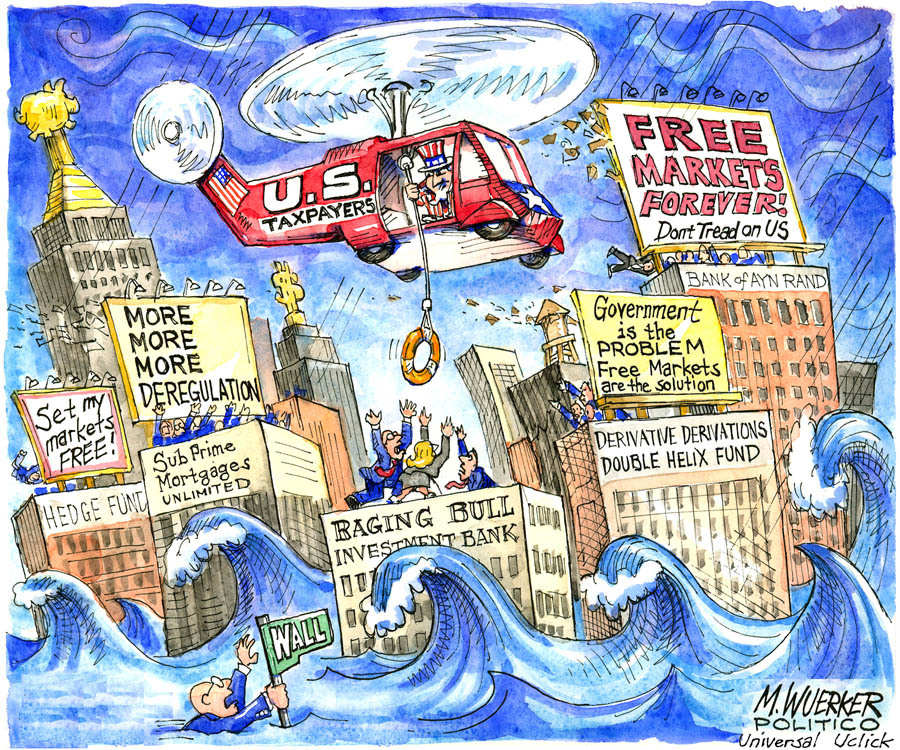
So the conflict at work in our contemporary right-left divide is perhaps more accurately seen as a contest not about freedom in some abstract sense, but about who is to be free- the predator or the prey? Are corporations to be free to despoil our common bequests? Are corporations to be free to abuse their workers? Are corporations to be free to gain monopolies and abuse their customers? The whole notion of a business plan typically revolves around some way to corner a market with some predatory intent, whether that is through patented innovation, through defacto monopolies like the cable industry, through the closed ecosystems our smart phone makers create, through legal intimidation or under-paying labor, or the like. The financial industry is a study in predation brought to high art, especially in the sub-prime debacle, which appears to have sucked wealth from the bottom of the economic ladder with startling effectiveness:


There are many kinds of freedom- freedom to have a voice, a vote, a job with income, the freedom to change jobs, to health care at reasonable cost, from unwarranted surveillance and intrusion, to practice religion or not, from theft and fraud, to breathe decent air, from fear of foreign invasion, to get an education, and many, many others. In our society, corporations are some of the primary destroyers of many of these forms of freedom, and government (i.e. our society by virtue of conscious moral decisions and communal organization) their originator and prime protector. Even while they are themselves creations of the state and dependent on its legal system, corporations bring enormous fire-power to bear in their predatory fights against each other and against the rest of us, battering down regulations and personal freedoms (think of, say, Facebook) for profit.

That is one reason the election went the way it did. The Republican convention was surreal in its relentless vaunting of freedom for the business and especially the business owner. All hail Mr. Potter! They did not seem to grasp that this might not paint the warm and cuddly image they imagined, but one of class war, where they were aligned, with their exemplary candidate, on the losing side.


Saturday, November 3, 2012

Fiction, more or less

How does historical fiction relate to scripture?

The New Yorker recently had an outstanding profile of Hilary Mantel, author of Wolf Hall and other works of historical fiction. While the genre doesn't generally get a lot of respect, Mantel and Robert Graves gave it gems of great accuracy as well as drama. One point was that good historical fiction never replaces facts from the past, and rarely makes up new ones out of whole cloth.
"She says, 'I cannot describe to you what revulsion it inspires in me when people play around with the facts. If I were to distort something just to make it more convenient or dramatic, I would feel I’d failed as a writer. If you understand what you’re talking about, you should be drawing the drama out of real life, not putting it there, like icing on a cake.'"
"Only rarely did she make something up out of nothing—almost always there was some hint in the sources to suggest it. Even many of her tiny, novelistic details came from the archives—often from the gossipy letters sent by ambassadors to their home courts. There was a scene in the sequel to “Wolf Hall,” “Bring Up the Bodies,” for instance, in which a messenger gave Jane Seymour a love letter and a bag of money that Henry had sent her, although he was still married to Anne Boleyn; Jane gave back the money, then took the letter and kissed it, but gave it back unopened. That came straight from an ambassador’s correspondence."

We typically do not gain more historical knowledge over long periods of time. As time passes, records are lost and we recede further from the events at issue. More needs to be filled in (judiciously!) by way of the novelist's imagination.

For theology and religion, on the other hand, we have gained enormous amounts of knowledge, not so much about the historical facts surrounding their writing and subjects, but about the general scientific claims they traffic in- angels descending from heaven, seas parting, people rising from the dead. Trinities, ghosts, and afterlives.

Thus what passed muster generations ago as plausible tales of the supernatural (signs and wonders) now are known to be fundamentally impossible. The ground has shifted under the genre, so what once was awesome now seems tawdry and cheap.

It is an unfortunate position, perilously saved for the most devout by way of even harder-to-swallow claims of exceptionalism- that those historical actors and times were really different from our present fallen age. Rather than, say, that our age has better standards of editing, fact-checking, and scientific understanding.

It is just a small point, in the vast case  for atheism, but still worth making- that one should read historical fictions and romances long before giving credence to the far more egregious genre of scripture.

Incidentally, the profile of Mantel also notes that she lived briefly in Saudi Arabia:
"She couldn’t even go for a walk around the block, since if she appeared on the street alone men shouted lewd propositions at her or tried to run her over." Some respect for women, that. Sounds more like the way it looks- patriarchy and misogyny.

  • Romney as prosperity televangelist.
  • Can it get any worse? Romney ultimately responsible for meningitis outbreak.
  • Lying for the lord, riding off with the money.
  • Mormonism: a particularly rapid transition from establishment critique to water-carrier for its most damaging and retrograde aspects.
  • Krugman: Horrors! Fiscal rectitude was supposed to screw the poor, not the rich!
  • Plantinga is pro-fiction, pro-self delusion.
  • More whistle-blowers are needed. "The fact that the business community fought ferociously against doing anything to encourage whistle-blowers is an example of what we call “revealed preferences” in economics.  Honest CEOs should encourage whistle-blowers."
  • In praise of Dodd-Frank.
  • Electronic voting is an even bigger disaster now.
  • And whom does Mr. Burns endorse?
  • Bailout image of the week..

Saturday, October 27, 2012

Mitt's magical apology tour

What on earth?

[I apologize(!) to my readers for excessive focus on politics... this election should be over soon.]

In the last debate, on foreign policy, Mitt Romney was even more muddled and brazen than in the prior ones. He agreed with every substantive point Obama made, yet claimed that somehow he would do things better and differenter. He wanted to get tougher on Iran, while assuring everyone he didn't want to get into any wars or anything. He wanted to start a trade war with China, despite having been busy shipping jobs and capital there over the years. He wanted more peace in the Middle East, but by using the attitudes and policies of the Bush administration. He wanted to "help move Pakistan in the right direction", but agreed with the US troop pullout from Afghanistan and our aid policies to Pakistan. And as usual, he wanted to spend more money on the military, and much more on tax breaks, and magically balance the budget as well. It only makes sense if he is lying about everything except his self-confidence. He wants to be president very badly, but apparently being a stuffed shirt for the ongoing class war by the severely conservative right is about as high as his policy ambitions go.

But, among all the crocodile tears, what was most grating was his repetition of the "apology tour" meme. This vitriolic invention of the FOX cesspool, which Romney picked up and used as a title for his campaign book, is one of those primitive psychological constructions the Republicans are so adept at, like tax relief and death panels. During the debate, Romney said:
"We're also going to have to have a far more effective and comprehensive strategy to help move the world away from terror and Islamic extremism. We haven't done that yet. We talk a lot about these things, but you look at the - the record, you look at the record. You look at the record of the last four years and say is Iran closer to a bomb? Yes. Is the Middle East in tumult? Yes. Is - is al-Qaida on the run, on its heels? No. Is - are Israel and the Palestinians closer to reaching a peace agreement?"

Now, how would one actually go about moving the world away from extremism and towards something like, say, the Arab spring? One might take a tour of Arab countries and talk about universal values of human rights, democracy, and self-determination, while subtly making it clear that the Bush administration has been succeeded, via orderly and democratic means, by a quite different administration, no less focused on US national interests, but less bellicose about bulldozing other countries to get there, and possessing a vision of US interests as compatible with peaceful coexistence and mutual respect rather than "You're with us or you're against us".

Rhetorically, Romney wanted to double down on all the good things that Obama has done, (you almost thought an apology was coming for saying all those bad things otherwise!), but in a way that takes us right back to the bluster and sabre-rattling of the last administration which was so offensive and counter-productive. We have more friends now in the Arab world than when Bush was in office, particularly among the people rather than the dictators, because of better foreign policy.

Certainly, much remains to be done. For instance, the Palestinian peace process, which Romney explicitly blamed Obama for not advancing, isn't going to be helped by the US being Israel's lapdog, which is Romney's official policy. That isn't a vision of strength, as far as I can see. Just like our last president, Romney seems to have a rather immature horror of apologizing for anything, and something of a toy soldiers approach to world affairs, not to mention a tin ear for diplomacy, as we saw in Britain. We can do better.

[As a final note, there must be some good omen in a World Series between two of the bluest cities around.]

"... Hitler managed to override the usual objections to stimulus."

Saturday, October 20, 2012

Wealth creates poverty

Inequality isn't just not nice, it is destructive.

In my reading about ancient Rome, author Michael Parenti (The Assassination of Julius Caesar) had a snappy phrase about economic dynamics: "wealth creates poverty". . (See it on youtube)

It got me wondering why this is such a durable theme and how it works in detail. Classical history is instructive as a perpetual contest between wealthy elites and the plebian masses. Rule by aristocrats was the rule, (property restictions were almost universal as tests for office and voting), but when they went too far, they faced revolt by the masses they depended on to till the fields, row the ships, and fight the wars. Several times the plebians of Rome took the civilized approach of seceding- "going galt", as it were. In contrast, aristocrats can not secede because they can not support themselves. They depend on their position in a working social system to be able to parasitize upon it.


Education

The aristocratic elite had one tool in antiquity that they no longer have, which is education and training. With our diffusion of education, especially writing, reading, and related communication technologies, there is much less differentiation conferred by the kind of education that was once available to only the upperest of upper crusts. As we see painfully in this campaign season, our candidates may be very smart, but are not particularly well-learned compared to an average person with a bit of motivation. Nor is their rhetoric any kind of model, as was supposedly that of the ancient Romans. (Though to my mind, Cicero seems more a windbag than a model of eloquence.)

Education was often confused with birth and inborn nobility, gentility, etc. But the more we know about human genetics and the vast amount of intermixing going on all over our history / prehistory, the less of a case one can make for inborn lineage differences that are truly distinctive and significant. (Just look at that Royal family!) Perhaps now with our more thorough assortive mating via intelligence testing, high school tracking, and university admission, there may be longer term effects, but I doubt that as well.


Debt

Debt is perhaps the most powerful direct weapon, and a constant source of misery and conflict in ancient Rome. Given the relatively limited needs of the rich, (who after all are rich because they spend less money than they have), there are far more people willing to be employed than needed, (especially once the rich have captured all the land), leading to labor competition, leading to low wages. Low wages lead often enough to the inability to maintain even the low existence workers are accustomed to, leading to a need for debt, like payday loans, credit cards, etc.

The rich do have money and may be willing to lend it, but typically impose onerous terms, as well as a legal system that supports their ability to collect. In ancient Rome, this meant debtors selling themselves or their children into slavery to satisfy debts. Today, it merely means countless families stripped of their assets and prospects by way of predatory mortgages, and a bankruptcy regime made significantly harsher just in time for the current crisis.

Many cultures have tried to restrict usery, or even outlaw lending entirely, such as early Christianity and Islam up to the current day. Not terribly practical, but on the other hand, regulating lending is (or would indeed be) a very powerful way to restrict this perennial source of opportunism and class entrenchment.


Fraud

Similar to debt, there are a wide range of other business practices by which the rich get richer. The hedge fund 2/20 payment system is an example, raking in money to managers who rarely provide commensurate benefits, while fleecing the slightly less well off in this case, rather than the outright poor. The investment world is full of such scams, from excessive mutual fund fees to nano-second arbitrage by Goldman Sachs, and insider trading. Of course is possible for poorer business people to fleece the rich as well. But they have less means to take this path, using, for instance, the professional assistance of high-priced lawyers. And the overriding power relations dictate that the poor are held more strictly to account in the legal and social system.

In Rome, the patricians basically stole the public lands that had been cultivated by the poor, through a combination of debt peonage, purchase, and outright force. Employing slaves instead on their new villas, they left the poor free Romans with little to do other than join the army or mill about in the slums of Rome.


Macroeconomics

Briefly, since I have discussed this elsewhere, the rich are rich in part because they save what they get rather than spending it. Excessive saving leads to low economic activity, squeezing those who work for a living, lowering wages, creating a spiral of depression- one of the most damaging economic phenomena. Being rich in antiquity often meant making gifts to the public- statues, temples, baths, games. But as the Roman empire ground on, such public spirit seems to have declined, and the rich became richer, building ever-larger gated communities (i.e. villas, the precursor to the feudal estate) and piling up their wealth, which was often only recirculated through political witch hunts, murders, and expropriations. Progressive taxation and inheritance taxes seem a more civilized method!


Politics

As touched on above, if the judicial system is run by the rich, and public policy is run by the rich, then it is likely to serve the rich. The Roman consitution went through several iterations where the people demanded powers, were placated by institutional reforms, which were eviscerated by later aristocratic innovations. When plebians were allowed into the Senate, their allegiance to their class (via the tribunate) slowly died and they became part of the ruling economic as well as social class. After Julius Caesar upended the Republican system by the threat of long-term dictatorial and popular rule, the ruling class first assassinated him and then came to a grand bargain with his successor Augustas in which he maintained their economic and social position, without any bothersome populism.

The current moment is vexing in this respect. The Republican party is commonly known to be the party of the rich. It is also well known to have authored the current economic crisis, by relaxing an entire ecosystem of regulations which then set the stage for mortgage fraud, underwriting fraud, credit rating agency fraud, and a variety of other predatory banking practices, after which the Republican party was principally responsible for showering money on those same institutions and same managers to bail them out.

One would think that their popularity would be low. But instead we appear to have a squillionaire Republican presidential candidate promising explicitly to relax financial regulations yet again and to forgive yet more taxes for the rich, all sold with the mantra that they are "job creators" who, by some magical means, if they are made as rich as Crassus, will trickle a little bit back down to the masses, rather than, say, building more gated McMansions for themselves as they have in the past, and off-shoring the remainder to the Cayman islands. And this candidate is polling at even odds to win. It is unthinkable in a true democracy.


Ideology

Which brings us to ideology. Even more than politics, if one controls the ideology and narrative of a society, (via the corporatized media in our age, and the intellectual and historian elite in Rome), then one does not have to resort to crass fraud and armed robbery maintain one's privileged position. Genteel fraud and robbery will do. In Rome, we still inherit the historical prism of the aristocracy, who were the only historians. Thus we regard the fall of the "Republic" as a catastrophe, even though it had relatively little to do with democracy as we understand it today, but as largely a Senatorial oligarchy atop a virtually fascist state.

In our day, the Republican war on the inheritance tax offers an object lesson. Repealing it is another item on the Republican candidate's agenda, as though freedom and the American way depend on liberating super-wealthy families from the specter of this "death tax". Yet why should the children of the rich inherit great wealth? While we may "celebrate success" as the Republicans reminded us during their convention, they want their children excused from exertion or the need for success of any kind, putting to the lie their professions of faith in "equal opportunity", an "opportunity society", and the like. In my book, inheritance taxes should be 100%.


So there is a contest for the wealth of a society, usually won by those who are already rich. The economic and other elites try to fleece the lower classes as docorously and thoroughly as possible while getting their services as cheaply as possible. They have many advantages, leading to the general historical rule that societies become more unequal with time unless specific policies (of redistribution, debt forgiveness, and other amelioration) are devised, or until a revolution occurs (France), or until the inequality so ripens into economic sclerosis that ruins the society utterly (Rome).


  • Oligarchies self-destruct when they get too greedy.
  • Must the lying be so mindless? What do Romney's problems with arithmetic say about our educational system?
  • Tax cuts for job creators don't create jobs. And if they are revenue neutral on the wealthy- i.e. not actually tax cuts- they wouldn't do anything even in theory. So who buys this stuff?
  • Watch the hands... Romney's hands in action. 
  • Bill Black launches into an ocean of mixed metaphors.
  • Fraud at Bain- who would have suspected at such an upstanding company!? An object lesson in how the rest of us are screwed by those with the most money to throw around.
  • Debating a psychopath- probably not so easy. But psychopaths are really not so bad!
  • IBM makes a business of breaking employment laws to become company of poorly paid Indians and highly paid US chiefs (plus US servants, as needed).
  • Let's kill high frequency trading.
  • Luck, economics, and just deserts.

Wednesday, October 17, 2012

Romney lets a cat out of the bag

Special post on the presidential debate.

Personally, I thought the president was equally incisive and together in the first debate. But obviously the media has its own frame to fill, and shouting down others and bullying seem to be the "presidential" qualities du jour. It plays to Mitt Romney's strengths, but saddens and disturbs me. This after a period when we heard so much about the badness of bullying. How ironic.

Anyhow, Mr. Romney made a statement that was very important. Not new, but I hadn't heard it quite so clearly before:
"But your rate comes down and the burden also comes down on you for one more reason, and that is every middle-income taxpayer no longer will pay any tax on interest, dividends or capital gains. No tax on your savings. That makes life a lot easier.
...
And I will not -- I will not under any circumstances, reduce the share that's being paid by the highest income taxpayers."
 [Editor's note.. the comments below provide significant context to this quote, in that Romney added that his no-investment tax promise applies only up to middle-income taxpayers.]

If Obama were paying attention, he might have answered with something like:

"Mr Romney just said that in his plan, taxes on capital gains, investment income, and dividends would be eliminated. What would that do to his own taxes? Right now, under the Bush tax cuts, Mr Romney pays about 14% in taxes, which is lower than most middle class families and which I regard as disgraceful. Under his own plan, he would pay zero in taxes. Zero in taxes, because pretty much all his income is investment income.

Now there is no way to make up for this with deductions, credits, and loopholes, because he would already be paying zero taxes. Deductions and loopholes would have no effect. Extrapolating out to everyone in his position, again, there is no way to make up all his proposed tax gifts to the rich with deductions, credits, and loopholes.

Mr. Romney may be doing quantum mechanics or something. Frankly, I don't understand a lot of complicated math. But if you use arithmetic, there is no way to make all this add up. No way to make up for the enormous and explicit tax gifts Mr. Romney proposes for the rich with any amount of deductions, credits, and loopholes. 

And I believe it is insulting to you as listeners and citizens that Mr. Romney stands here and says otherwise, without having the detailed plan and math to back him up. His statements about making sure the rich pay their share are pure hot air, contrary to everything the modern Republican party stands for, and to everything he said during the campaign up until a few days ago.

Add in the elimination of the alternative minimum tax and the estate tax, and, when you are looking at Mr Romney, you are looking at a future of the rich in America getting richer and the poor getting poorer, in perpetuity. Of Mr. Romney and people like him, stomping on the face of the average American, forever."


Saturday, October 13, 2012

Cut the cable!

Over the air broadcasting works great.

Sick of paying through the nose for cable? The transition to digital TV improved reception in most of the US for old-fashioned over-the-air (OTR) television. For the price of a modest antenna and a contemporary TV with a digital tuner, (or a tuner box), you can be be in business getting scores of channels in most metropolitan areas.

Cable TV began as a community solution to bad OTR reception. Communities would set up an antenna on a hill, and feed cables down to residents in the reception shadows. This turned into a lucrative business, and then with the advent of cable-only channels, into its own ecosystem of nation-wide TV content, from the bass fishing channel to ESPN.

The pricing model is very curious, however. Cable providers typically have monopolies in their service areas, competing only with OTA broadcasters and lately with satellite providers. So there is a competitiveness problem from the start. Secondly, they bundle all sorts of channels into only a few pricing tiers, leaving consumers with very little real choice. They have used their monopoly position to fund forays into other businesses, like content, movie studios, and internet service, which is again a quasi-monopoly. They transmit all the same advertisements from the OTA broadcasters they carry, so the consumer is in some sense paying twice for those channels.

Remember how during the recent Olympics, getting any significant internet coverage required having a cable subscription showing that you really didn't need internet access after all? Despite the obvious capability of carrying advertisements on internet video, the corporations in charge thought it more important to fence in their cable franchises than to extend viewership in the new medium. (Ditto for Hulu.)

If it were all rigorously regulated in the public interest, these failures of competition might be rationally corrected, but obviously, the cable companies are far more profitable than they would be in such a scenario, and send some excess dollars back into the political system in support of right-wing causes and their own continued deregulation & monopoly position, as well as into ancillary industries to build up even bigger monopolistic positions.

Anyhow, so there are reasons to dislike the cable incumbents, and look at other alternatives. The internet provides one avenue to a variety of more obscure interests, (at least until the cable industry kills net neutrality!), which cable TV serves so haphazardly with its fringe fare. And the OTA broadcasters are still there, churning out waves to all who want to watch.

Really, setting up an antenna can be a lot simpler than setting up a cable system. Digital TV happens in the UHF and high-VHF radio bands. The low VHF channels like 2 to 5 have been dropped, though you will still see channels called #2 whose actual radio frequency has been shifted upwards under the covers. This means that the largest, most unwieldy elements of old-fashioned TV antennas are no longer needed. So, while rabbit ears may be quite enough in urban areas, for roof-top or attic use you need only a pretty modest antenna to get digital TV:


Most broadcasters in this digital world offer not only their main channel that you are used to, but 2 or 3 (or even 20) side channels with miscellaneous programming. In all, I can pull in about 57 channels in the San Francisco Bay area, including many in fascinating languages I do not understand.

Obviously, you would not know about this from most of the media. We are inundated with come-ons from the cable companies with insulting teaser rates. No one advertises for OTA TV, even while they enthusiastically advertise on it. The cable companies have tried to kill internet TV in various ways, and seem to have successfully restricted options for people to record OTR content on modern DVRs. Very few such machines are available, other than the higher-end TiVo boxes, which again require their own subscription, not to mention sending detailed viewing data out into the ether.

So, there is a better way. Drop the OWN channel, and get in touch with your local grass roots, by surfing those amazing waves over the air.


  • Verizon's bid to compete with cable dies- will join the cable-o-poly instead.
  • Put a nickel on the drum, pay for Republican indoctrination.
  • George Eliot, leading atheist.
  • Plutocrat "wins" debate by lying with gusto and shouting down "moderator". Next debate, knives and brass knuckles.
  • Romney doesn't know what he is talking about, or else has an astonishingly low opinion of the electorate ... as usual.
  • Romney becomes mayor of Sesame Street.
  • Our financial regulatory system is toothless and broken.
  • Simon Johnson, begging for bank reform.
  • Woodward hates Obama for some reason having to do with use of the telephone.
  • Austerity, Bowles-Simpson, monetary necrophilia.. call it what you will, it is wrong.

Saturday, October 6, 2012

Government is the killer app

The punic war, and a little more on group selection.

I've been reading a bit of Roman history, the Punic wars and the late Republic in particular. If you want to learn about group selection, this is a great place to start. The cohesion of groups was paramount, as was their judicious leadership. Make too many errors, and your city was razed and your population massacred. Or perhaps it was sold off into slavery. The price of communal failure was harsh, the rewards of success vast, whether one was close kin or not kin at all.

Rome excelled at pretty much one thing- government in all its forms. The typical activity of well-to-do Romans was a mix of law, soldiering, and politics, which they honed through hundreds of years into an ornate legal system, bloodthirsty militarism, merciless slavery, and stolid architecture. Their constitution was a mess, involving numerous bodies and elements, all in somewhat confused relation. It had, like its devoted student Britain, a mass of unwritten traditions and ever-evolving common law.

Early Rome was characterized by an extremely cohesive ruling class which occupied the senate, combined with modest input from a nominally sovereign popular assembly. Their consistency of judgement and constant aggressiveness allowed them to proceed from very unillustrious beginnings under the thumb of Etruscan monarchs to a Mediterranean-wide empire. Romans had very modest intellectual and artistic attainments, feeling perpetually inferior to Greece in this respect. They were cruel, practical, superstitious, fair in many dealings, and saw rhetoric as their highest art.

But with success and expansion, something about this republic went haywire, as the riches flowing in sapped the unity of the ruling class and bred corruption, the enormous armies in the field bled power from the senate to its appointed generals, and the nominal sovereignty of the assembly became real after the partial breakdown of the unwritten clientela system that fed senatorial dominance (in part displaced by the grain dole). Corruption grew and political violence, previously unheard of, ripened into senatorial murder squads, mob actions and civil war. The senatorial faction (optimates) evidently lost ideological control of the masses, and murdered a long series of popular leaders. Consul after consul edged closer to dictatorship until finally Julius Caesar swept the Senate aside for good. Ultimately, the senatorial class settled for political toothlessness in the empire of Augustus, in exchange for his careful preservation of their economic and social interests.

It is the usual story of aristocratic oligarchies challenged by members who take up the mantle of far-overdue popular reform, who through the vitriolic and murderous opposition of entrenched powers are forced into the position of dictators, which they eventually find rather amenable, (Julius Caesar, Napoleon, Lenin, etc.), leading to reversion to an even starker form of status quo aristocratic power as emperors, Fuerers, party chairmen, etc.

I see it as a lesson in two ways. First, in the importance of government, as against the Republican refrain of the last few decades where government is always "the problem", must be smaller, must always serve the rich, etc. and so forth. And second, in the importance of good government. Sure, if one governs badly, (certain recent Republican presidents come to mind), then government is going to be the problem.

But we humans have little power to do anything useful without our social institutions, and while private enterprise has its significant place, we also have many needs for common action that can not be filled by individual greed / voluntary enterprise alone. It is truly remarkable how thoroughly we have been dumbed down and deceived through this ideology of late, taking for granted the work of centuries and millennia.

Fittingly enough, the US Senate is, in our day, leading the way to institutional breakdown and corruption. Each Senator is known to think of her- or himself as presidential material, and they have devised ways to make themselves mini-presidents, at least of a negative variety, with the ability to block, veto, and filibuster any action. Executive appointments go unfilled, needed reforms are anonymously blocked, and the public's business is held hostage to unseen special interests and fringe agendas.

We are not at the point of armed gangs going from chamber to chamber in the US capitol, clubbing people to death. But we should take a hard look at the breakdown of our intitutions, at the heart of which is corruption by money and the unconstitutional arrogation of power by the Senate through its internal "rules". Our system is easily as oligarchical as Rome's, in the sense that the Supreme Court has deemed money to equal speech. While Rome had its attachment to rhetoric, tradition, circuses, and privilege, we have ours to the miracle of modern advertising methods, sound bites, and astroturfing- the alchemical transformation of money into power.

So don't look to the iPhone to save our civilization. The focus should be on the East coast, not the West. For all the communication we are now swamped with, how much of it counts? How much of it makes the world a better place? Who runs our TV systems and pours content into those fat pipes? Who makes the rules? Who tells the politicians what to say? Can we turn our gaze from the navels of Facebook out to the collective system that controls so much of our fate? Can we put people back into politics, instead of money?

  • The Cato institute says it draws its name from a series of British pamphlets called Cato's letters. But more likely they draw inspiration from the ultra-conservative and pretty much fascist Catos the elder and younger of ancient Rome. The elder ended each speech with "Furthermore, I believe that Carthage must be destroyed."
  • From the Cato letters ... "In all these cases, ’tis abundantly the interest of a nation, to promote credit and mutual confidence; and the only possible way effectually to do this, is to maintain publick honour and honesty; to provide ready remedies for private injustice and oppression; to protect the innocent and helpless from being destroyed by fraud and rapine."
  • Also note letter 108 on morals and indeed animal rights. "I will suppose, for once, a dialogue between his Holiness and a lion ..."
  • TED talk on trust and sharing ... and online reputation capital.
  • Voting is a tiny step in a much larger process.
  • Speech should be free- all of it.
  • The great barrier reef is half as great, over the last three decades.
  • Bikes are back, in Italy.
  • Messiahs- more common than you might think.
  • A Fed official lies for ideology.
  • Bill Mitchell, plea of the week:
"The damage that arises from excluding the youth from the labour market is life-long and then some. This cohort will carry the disadvantage throughout their lives and typically endure unstable and low-paid work interspersed with lengthy periods of unemployment when the business cycle turns down.
But even more damaging is that they will find it harder to form stable relationships and if they do their children will inherit this disadvantage arising from the exclusion at this time of their parent(s).
It is unfathomable why this is not an absolute policy priority and the Euro leaders announce immediate job creation programs through the Eurozone targetted at youth, if they cannot bring themselves to introduce an unconditional job guarantee for all workers.
The costs of this folly are so large and so enduring that there is no fiscal justification that can be mounted to not introduce such a plan.
And if you think about it from a conspiracy theory perspective – that the EU elites are trying to destroy unions and the welfare state – it is still a pretty weird strategy to undermine the prospects of the future workforce in an era when dependency ratios are rising and there is a greater need than ever for increasing productivity growth."