Saturday, June 10, 2023

A Hard Road to a Cancer Drug

The long and winding story of the oncogene KRAS and its new drug, sotorasib.

After half a century of the "War on Cancer", new treatments are finally straggling into the clinic. It has been an extremely hard and frustrating road to study cancer, let alone treat it. We have learned amazing things, but mostly we have learned how convoluted a few billion years of evolution can make things. The regulatory landscape within our cells is undoubtedly the equal of any recalcitrant bureaucracy, full of redundant offices, multiple veto points, and stakeholders with obscure agendas. I recently watched a seminar in the field, which discussed one of the major genes mutated in cancer and what it has taken to develop a treatment against it. 

Cancer is caused by DNA mutations, and several different types need to occur in succession. There are driver mutations, which are the first step in the loss of normal cellular control. But additional mutations have to happen for such cells to progress through regulatory blocks, like escape from local environmental controls on cell type and cell division, past surveillance by the immune system, and past the reluctance of differentiated cells to migrate away from their resident organ. By the end, cancer cells typically have huge numbers of mutations, having incurred mutations in their DNA repair machinery in an adaptive effort to evade all these different controls.

While this means that many different targets exist that can treat some cancers, it also means that any single cancer requires a precisely tailored treatment, specific to its mutated genes. And that resistance is virtually inevitable given the highly mutable nature of these cells. 

One of the most common genes to be mutated to drive cancer (in roughly 20% of all cases) is KRAS, part of the RAS family of NRAS, KRAS, and HRAS. These were originally discovered through viruses that cause cancer in rats. These viruses (such as Kirsten rat sarcoma virus) had a copy of a rat gene in it, which it overpoduces and uses to overcome normal proliferation controls during infection. The viral gene was called an oncogene, and the original rat (or human) version was called a proto-oncogene, named KRAS. The RAS proteins occupy a central part of the signaling path that external events and stresses turn on to activate cell growth and proliferation, called the MAP kinase cascade. For instance, epidermal growth factor comes along in the blood, binds to a receptor on the outside of a cell, and turns on RAS, then MEK, MAPK, and finally transcription regulators that turn on genes in the nucleus, resulting in new proteins being expressed. "Turning on" means different things at each step in this cascade. The transcription regulators typically get phosphorylated by their upstream kinases like MAPK, which tag them for physical transport into the nucleus, where they can then activate genes. MAPK is turned on by being itself phosphorylated by MEK, and MEK is phosphorylated by RAF. RAF is turned on by binding to RAS, whose binding activity in turn is regulated by the state of a nucleotide (GTP) bound by RAS. When binding GTP, RAS is on, but if binding GDP, it is off.

A schematic of the RAS pathway, whereby extracellular growth signals are interpreted and amplified inside our cells, resulting in new gene expression as well as other more immediate effects. The cell surface receptor, activated by its ligand, activates associated SOS which activates RAS to the active (GTP) state. This leads to a kinase cascade through RAF, MEK, and MAPK and finally to gene regulators like MYC.

This whole system seems rather ornate, but it accomplishes one important thing, which is amplification. One turned-on RAF molecule or MEK molecule can turn on / phosphorylate many targets, so this cascade, though it appears linear in a diagram, is acutally a chain reaction of sorts, amplifying as it goes along. And what governs the state of RAS and its bound GTP? The state of the EGFR receptor, of course. When KRAS is activated, the resident GDP leaves, and GTP comes to take its place. RAS is a weak GTPase enzyme itself, slowly converting itself from the active back to the inactive state with GDP. 

Given all this, one would think that RAS, and KRAS in particular, might be "druggable", by sticking some well-designed molecule into the GTP/GDP binding pocket and freezing it in an inactive state. But the sad fact of the matter is that the affinity KRAS has to GTP is incredibly high- so high it is hard to measure, with a binding constant of about 20 pM. That is, half the KRAS-bound GTP comes off when the ambient concentration of GTP is infinitesimal, 0.02 nano molar. This means that nothing else is likely to be designed that can displace GTP or GDP from the KRAS protein, which means that in traditional terms, it is "undruggable". What is the biological logic of this? Well, it turns out that the RAS enzymes are managed by yet other proteins, which have the specific roles of prying GDP off (GTP exchange factor, or GEF) and of activating the GTP-ase activity of RAS to convert GTP to GDP (GTPase activating protein, or GAP). It is the GEF protein that is stimulated by the receptors like EGFR that induce RAS activity. 

So we have to be cleverer in finding ways to attack this protein. Incidentally, most of the oncogenic mutations of KRAS are at the twelfth residue, glycine, which occupies a key part of the GAP binding site. As glycine is the smallest amino acid, any other amino acid here is bulkier, and blocks GAP binding, which means that KRAS with any of these mutations can not be turned off. It just keeps on signaling and signaling, driving the cell to think it needs to grow all the time. This property of gain of function and the ability of any mutation to fit the bill is why this particular defect in KRAS is such a common cancer-driving mutation. It accounts for ~90% of pancreatic cancers, for instance. 

The seminar went on a long tangent, which occupied the field (of those looking for ways to inhibit KRAS with drugs) for roughly a decade. RAS proteins are not intrinsically membrane proteins, but they are covalently modified with a farnesyl fatty tail, which keeps them stuck in the cell's plasma membrane. Indeed, if this modification is prevented, RAS proteins don't work. So great- how to prevent that? Several groups developed inhibitors of the farnesyl transferase enzyme that carries out this modification. The inhibitors worked great, since the farnesyl transferase has a nice big pocket for its large substrate to bind, and doesn't bind it too tightly. But they didn't inhibit the RAS proteins, because there was a backup system- geranygeranyl transferase that steps into the breach as a backup, which can attach an even bigger fatty tail to RAS proteins. Arghhh!

While some are working on inhibiting both enzymes, the presenter, Kevan Shokat of UCSF, went in another direction. As a chemist, he figured that for the fraction of the KRAS mutants at position 12 that transform from glycine to cysteine, some very specific chemistry (that is, easy methods of cross-linking), can be brought to bear. Given the nature of the genetic code, the fraction of mutations that go from glycine to cysteine are small, there being eight amino acids that are within a one-base change of glycine, coded by GGT. So at best, this approach is going to have a modest impact. Nevertheless, there was little choice, so they forged ahead with a complicated chemical scheme to make a small molecule that could chemically crosslink to that cysteine, with selectivity determined by a modest shape fit to the surface of the KRAS protein near this GEF binding site. 

A structural model of KRAS, with its extremely tightly-bound substrate GDP in orange. The drug sotorasib is below in teal, bound in another pocket, with a tail extending upwards to the (mutant) cysteine 12, which is not differentiated by color, but sits over a magnesium ion (green) being coordinated by GDP. The main job of sotorasib is to interfere with the binding of the guanine exchange factor (GEF) which happens on the surface to its left, and would reset KRAS to an active state.

This approach worked surprisingly well, as the KRAS protein obligingly offfered a cryptic nook that the chemists took advantage of to make this hybrid compound, now called the drug sotorasib. This is an FDA-approved treatment for cancers which are specifically driven by this particular KRAS mutation of position 12 from glycine to cysteine. That research group is currently trying to extend their method to other mutant forms, with modest success. 

So let's take a step back. This new treatment requires, obviously, the patient's tumor to be sequenced to figure out its molecular nature. That is pretty standard these days. And then, only a small fraction of patients will get the good news that this drug may help them. Lung cancers are the principal candidates currently, (of which about 15% have this mutation), while only about 1-2% of other cancers have this mutation. This drug has some toxicity- while it is a magic bullet, its magic is far from perfect, (which is odd given the exquisite selectivity it has for the mutated form of KRAS, which should only exist in cancer tissues). And lastly, it gives, on average, under six months of reprieve from cancer progression, compared to four and a half months with a more generic drug. As mentioned above, tumors at this stage are riven with other mutations and evolve resistence to this treatment with appalling relentlessness.

While it is great to have developed a new class of drugs like this one against a very recalcitrant target, and done so on a highly rational basis driven by our growing molecular knowlege of cancer biology, this result seems like a bit of a let-down. And note also that this achievement required decades of publicly funded research, and doubtless a billion dollars or more of corporate investment to get to this point. Costs are about twenty five thousand dollars per patient, and overall sales are maybe two hundred million dollars per year, expected to increase steadily.

Does this all make sense? I am not sure, but perhaps the important part is that things can not get worse. The patent on this drug will eventually expire and its costs will come down. And the research community will keep looking for other, better ways to attack hard targets like KRAS, and will someday succeed.


Saturday, June 3, 2023

Eco-Economics

Adrienne Buller on greenwashing, high finance, and the failures of capitalism viz the environment, in "The Value of a Whale".

This is a very earnest book by what seems to be an environmental activist about the mistaken notion that capitalism gives a fig about climate change. Buller goes through the painstaking economic rationales by which economists attempt to value or really, discount the value of, future generations. And how poorly carbon taxes have performed. And how feckless corporations are about their climate pledges, carbon offsets, and general greenwashing. And how unlikely it is that "socially conscious" investing will change anything. It is a frustrated, head-banging exercise in deflating illusions of economic theory and corporate responsibility. Skimming through it is perhaps the best approach. Here is a sample quote from Buller's conclusion:

Given this entrenched perspective, it is unsurprising that resistance to the kinds of bold change we need to secure a habitable planetary future for all and a safe present for many tend to focus on what we stand to lose. Undeniably, available evidence suggests that 'addressing environmental breakdown may require direct downscaling of economic production and consumption in wealthier countries'. This is an uncomfortable idea to grapple with, but as philosopher Kate Soper writes: 'If we have cosmopolitan care for the well-being of the poor of the world, and a concern about the quality of life for future generations, then we have to campaign for a change of attitudes to work, consumption, pleasure, and self-realization in affluent communities.' There is a sense that this future is necessarily austerian, anti-progress, and defined by lack. Indeed, the same media study cited above found discussion of economies defined by the absence of growth to focus on bleakness and stagnation. Comparatively little attention is directed at what we stand to gain - but there is much to be gained. Understanding what requires us to ask what the existing system currently fails to provide, from universal access to health case and education, to basic material security, to free time. It certainly does not offer a secure planetary future, let alone one in which all life can thrive. And it does not offer genuine democracy, justice or freedom for most. Absent these, what purpose is 'the economy' meant to serve?


Unfortunately, the book is not very economically literate either, making its illusions something of a village of straw men. Who ever thought that Royal Dutch Shell was going to solve climate change? Who ever thought that a $5 dollar per ton tax on CO2 emissions was going to accomplish anything? And who ever thought that the only reason to address climate heating was to save ourselves a dollar in 2098? All these premises and ideas are absurd, hardly the stuff of serious economic or social analysis. 

But then, nothing about our approach to climate heating is serious. It is a psychodrama of capitalism in denial, composed of cossetted capitalist people in the five stages of grief over our glorious carbon-hogging culture. Trucks, guns, and drive-through hamburgers, please! Outright denial is only slowly ebbing away, as we sidle into the anger phase. The conservative Right, which mixes an apocalyptically destructive anti-conservative environmental attitude with a futile cultural conservatism, is angry now about everything. The idea that the environment itself is changing, and requires fundamental cultural and economic change, is an affront. The eco-conscious left is happy to peddle nostrums that nothing really has to change, if we just put up enough solar panels and fund enough green jobs. 

Objectively, given the heating we are already experiencing and the much worse heating that lies ahead, we are not facing up to this challenge. It is understandable to not want to face change, especially limits to our wealth, freedoms, and profligacy. But we shouldn't blame corporations for it. The capitalist system exists to reflect our desires and fulfill them. If we want to binge-watch horror TV, it gives us that. If we want to gamble in Las Vegas, it gives us that. If we want to drive all around the country, it makes that possible. Capitalism transmutes whatever resources are lying around (immigrant labor, publically funded research, buried minerals and carbon, etc.) to furnish things we want. We can't blame that system for fouling up the environment when we knew exactly what was going on and wanted those things it gave us, every step of the way.

No, there is another mechanism to address big problems like climate heating, and that is government. That is where we can express far-sighted desires. Not the desire for faster internet or more entertaining TV, but deep and far-reaching desires for a livable future world, filled with at least some of the animals that we grew up with, and maybe not filled with plastic. It is through our enlightened government that we make the rules that run the capitalist system. Which system is totally dependent on, and subservient to, our collective wisdom as expressed through government. 

So the problem is not that capitalism is maliciously ruining our climate, but that our government, representative as it is of our desires, has not fully faced up to the climate issue either. Because we, as a culture, are, despite the blaring warnings coming from the weather, and from scientists, don't want to hear it. There is also the problem that we have allowed the capitalists of our culture far too much say in the media and in government- a nexus that is fundamentally corrupt and distorts the proper hierarchy of powers we deserve as citizens.

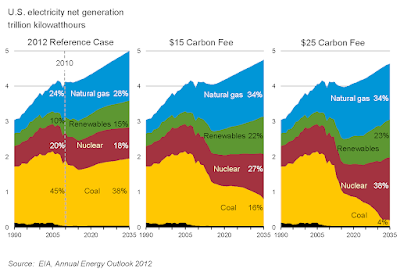
The US games out in 2012 how various carbon taxes will affect emissions, given by electricity production. These are modest levels of taxation, and have modest effects. To actually address the climate crisis, a whole other magnitude of taxation and other tools need to be brought to bear. The actual trajectory came out to more renewables, no growth for nuclear power, and we are still burning coal.

Let me touch on just one topic from the book- carbon taxes. This is classic case of squeemish policy-making. While it is not always obvious that carbon pricing would be a more fair or effective approach than direct regulation of the most offensive industries and practices, it is obvious that putting a price on carbon emissions can be an effective policy tool for reducing overall emissions. The question is- how high should that price be to have the effect we want? Well, due to the universal economic consensus that carbon pricing would be a good thing, many jurisdictions have set up such pricing or capping schemes. But very few are effective, because, lo and behold, they did not want to actually have a strong effect. That is, they did not want to disrupt the current way of doing things, but only make themselves (and ourselves) feel good, with a slight inducement to moderate future change. Thus they typically exempt the most polluting industries outright, and set the caps high and the prices low, so as not to upset anyone. And then Adrienne Buller wonders why these schemes are so universally ineffective.

Carbon prices in California are currently around $30 per ton CO2, and this has, according to those studying the system, motivated one third of the state's overall carbon reductions over the current decade. That is not terrible, but clearly insufficient, even for a forward-thinking state, since we need to wring carbon out of our systems at a faster pace. Raising that price would be the most direct way for us as a society to do that. But do we want to? At that point, we need to look in the mirror and ask whether the point of our policies should be addressing climate heating in the most effective way possible, or to avoid pain and change to our current systems. Right now, we are on a sort of optimal trajectory to avoid most of the economic and social pain of truly addressing climate change, (by using gradualist and incremental policies), but at the cost of not getting there soon enough and thus incurring increasing levels of pain from climate heating itself- now, and in a future that is measured, not in years, but in centuries. 

The second big point to make about this book and similar discussions is that it largely frames the problem as an economic one for humanity. How much cost do we bear in 2100 and 2200, compared with the cost we are willing to pay today? Well, that really ignores a great deal, for there are other species on the planet than ourselves. And there are other values we have as humans, than economic ones. This means that any cost accounting that gets translated into a carbon price needs to be amplified several fold to truly address the vast array of harms we are foisting on the biosphere. Coral reefs are breaking down, tropical forests are losing their regenerative capability, and the arctic is rapidly turning temperate. These are huge changes and harms, which no accounting from an economic perspective "internalizes". 

So, we need to psychologically progress, skipping a few steps to the facing-it part of the process, which then will naturally lead us towards truly effective solutions to get to carbon neutrality rapidly. Will it cost a lot? Absolutely. Will we suffer imbalances and loss of comforts? Absolutely. But once America faces up to a problem, we tend to do a good job accepting those tradeoffs and figuring out how to get the results we want. 


Saturday, May 27, 2023

Where Does Oxygen Come From?

Boring into the photosynthetic reaction center of plants, where O2 is synthesized.

Oxygen might be important to us, but it is really just a waste product. Photosynthetic bacteria found that the crucial organic molecules of life that they were making out of CO2 and storing in the form of reduced compounds (like fats and sugars) had to get those reducing units (i.e. electrons) from somewhere. And water stepped up as a likely candidate, with its abudance and simplicity. After you take four electrons away from two water molecules, you are left with four protons and one molecular oxygen molecule, i.e. O2. The protons are useful to fuel the proton-motive force system across the photosynthetic membrane, making ATP. But what to do with the oxygen? It just bubbles away, but can also be used later in metabolism to burn up those high-energy molecules again, if you have evolved aerobic metabolism.

On the early earth, reductants like reduced forms of iron and sulfur were pretty common, so they were the original sources of electrons for all metabolism. Indeed, most theories of the origin of life place it in dynamic rocky redox environments like hydrothermal vents that had such conducive chemistry. But these compounds are not quite common enough for universal photosynthesis. For example, a photosynthetic bacterium floating at the top of the ocean would like to continue basking in the sun and metabolizing, even if the water around it is relatively clear of reduced iron, perhaps because of competition from its colleagues. What to do? The cyanobacteria came up with an amazing solution- split water!

A general overview of plant and cyanobacterial photosystems, comprising the first (PSII), where the first light quantum hits and oxygen is split, an intervening electron transport chain where energy is harvested, and the second (PS1), where a second light quantum hits, more energy is harvested, and the electron ends up added to NADP. From the original water molecules, protons are used to power the membrane proton-motive force and ATP synthesis, while the electrons are used to reduce CO2 and create organic chemicals.

A schematic of the P680 center of photosystem II. Green chlorophylls are at the center, with magnesium atoms (yellow). Light induces electron movement as denoted by the red arrows, out of the chlorophyll center and onwards to other cytochrome molecules. Note that the electrons originate at the bottom out of the oxygen evolving complex, or OEC, (purple), and are transferred via an aromatic tyrosine (TyrZ) side chain, coordinating with a nearby histidine (H189) protein side chain.

This is not very easy, however, since oxygen is highly, even notoriously "electronegative". That is, it likes and keeps its electrons. It takes a super-oxidant to strip those electrons off. Cyanobacteria came up with what is now called photosystem II (that is, it was discovered after photosystem I), which collects light through a large quantum antenna of chlorophyll molecules, ending up at a special pairing of chlorophyll molecules called P680. These collect the photon, and in response bump an electron up in energy and out to an electron chain that courses through the rest of the photosynthetic system, including photosystem I. At this point, P680 is hungry for an electron, indeed has the extreme oxidation potential needed to take electrons from oxygen. And one is conducted in from the oxygen evolving center (OEC), sitting nearby.

A schematic illustrating both the evolutionary convergence that put both photosystems (types I and II) into one organism (cyanobacteria, which later become plant chloroplasts), and the energy levels acquired by the main actors in the photosynthetic process, quoted in electron volts. At the very bottom (center) is a brief downward slide as oxygen is split by the pulling force of the super-oxidation state of light-activated P680. After the electrons are light-excited, they drop down in orderly fashion through a series of electron chain transits to various cytochromes, quinones, ferredoxins, and other carriers that generate either protons or chemical reducing power as they go along. Note how the depth of the oxygen-splitting oxidation state is unique among photosynthetic systems.

A recent paper resolves the long-standing problem of how exactly oxygen is oxidized by cyanobacteria and plants at the OEC, at the very last step before oxygen release. This center is a very strained cubic metal complex of one calcium and four manganese atoms, coordinated by oxygen atoms. The overall process is that two water molecules come in, four protons and four electrons are stripped off, and the remaining oxygens combine to form O2. This is, again, part of the grand process of metabolism, whose point is to add those electrons and protons to CO2, making the organic molecules of life, generally characterized as (-CH2-), such as fats, sugars, etc. Which can be burned later back into CO2. Metals are common throughout organic chemistry as catalysts, because they have a wonderful property of de-localizing electrons and allowing multiple oxidation states, (number of extra or missing electrons), unlike the more sparse and tightly-held states of the smaller elements. So they are used in many redox cofactors and enzymes to facilitate electron movement, such as in chlorophyll itself.


The authors provide a schematic of the manganese-calcium OEC reaction center. The transferring tyrosine is at top, calcium is in fuschia/violet, the manganese atoms are in purple, and the oxygens are in red. Arrows point to the oxygens destined to bond to each other and "evolve" away as O2. Note how one of these (O6) is only singly-coordinated and is sort of awkwardly wedged into the cube. Note also how the bond lengths to calcium are all longer than those to manganese, further straining the cube. These strains help to encourage activation and expulsion of the target oxygens.

Here, in the oxygen evolving center, the manganese atoms are coordinated all around with oxygens, which presents the question- which ones are the ones? Which are destined to become O2, and how does the process happen? These researchers didn't use complicated femtosecond X-ray systems or cyclotrons, (though they draw on the structural work of those who did), but room-temperature FTIR, which is infrared spectroscopy highly sensitive to organic chemical dynamics. Spinach leaf chloroplasts were put through an hour of dark adaptation, (which sets the OEC cycle to state S1), then hit with flashes of laser light to advance the position of the oxygen evolving cycle, since each flash (5 nanoseconds) induces one electron ejection by P680, and one electron transfer out of the OEC. Thus the experimenters could control the progression of the whole cycle, one step at a time, and then take extremely close FTIR measurements of the complexes as they do their thing in response to each single electron ejection. Some of the processes they observed were very fast (20 nanoseconds), but others were pretty slow, up to 1.5 milliseconds for the S4 state to eject the final O2 and reset to the S0 state with new water molecules. They then supplement their spectroscopy with the structural work from others and with computer dynamics simulations of the core process to come up with a full mechanism.


A schematic of the steps of oxygen evolution out of the manganese core complex, from states S0 to S4. Note the highly diverse times that elapse at the various steps, noted in nano, micro, or milli seconds. This is discussed further in the text.


Other workers have provided structural perspectives on this question, showing that the cubic metal structure is bit more weird than expected. An extra oxygen (numbered as #6) wedges its way in the cube, making the already strained structure (which accommodates a calcium and a dangling extra manganese atom) highly stressed. This is a complicated story, so several figures are provided here to give various perspectives. The sequence of events is that first, (S0), two waters enter the reaction center after the prior O2 molecule has left. Water has a mix of acid (H+) and base (OH-) ionic forms, so it is easy to bring in the hydroxyl form instead of complete water, with matching protons quickly entering the proton pool for ATP production. Then another proton quickly leaves as well, so the waters have now become two oxygens, one hydrogen, and four electrons (S0). Two of the coordinated manganese atoms go from their prior +4, +4 oxidation state to +3 and +2, acting as electron buffers. 

The first two electrons are pulled out rapidly, via the nearby tyrosine ring, and off to the P680 center (ending at S2, with Mn 3+ and Mn 4+). But the next steps are much slower, extricating the last two electrons from the oxygens and inducing them to bond each other. With state S3 and one more electron removed, both manganese atoms are back to the 4+ state. In the last step, one last proton leaves and one last electron is extracted over to the tyrosine oxygen, and the oxygen 6 is so bereft as to be in a radical state, which allows it to bow over to oxygen 5 and bond with it, making O2. The metal complex has nicely buffered the oxidation states to allow these extractions to go much more easily and in a more coordinated fashion than can happen in free solution.

The authors provide a set of snapshots of their infrared spectroscopy-supported simulations (done with chemical and quantum fidelity) of the final steps, where oxygens, in the bottom panel, bond together at center. Note how the atomic positions and hydrogen attachments also change subtly as the sequence progresses. Here the manganese atoms are salmon, oxygen red, calcium yellow, hydrogen white, and a chlorine molecule is green.

This closely optimized and efficient reaction system is not just a wonder of biology and of earth history, but an object lesson in chemical technology, since photolysis of water is a very relevant dream for a sustainable energy future- to efficiently provide hydrogen as a fuel. Currently, using solar power to run water electrolyzers is not very efficient (20% for solar, and 70% for electrolysis = 14%). Work is ongoing to design direct light-to-hydrogen hydrolysis, but so far uses high heat and noxious chemicals. Life has all this worked out at the nano scale already, however, so there must be hope for better methods.


  • The US carried off an amazing economic success during the pandemic, keeping everything afloat as 22 million jobs were lost. This was well worth a bit of inflation on the back end.
  • Death
  • Have we at long last hit peak gasoline?
  • The housing crisis and local control.
  • The South has always been the problem.
  • The next real estate meltdown.

Saturday, May 20, 2023

On the Spectrum

Autism, broader autism phenotype, temperament, and families. It turns out that everyone is on the spectrum.

The advent of genomic sequencing and the hunt for disease-causing mutations has been notably unhelpful for most mental diseases. Possible or proven disease-causing mutations pile up, but they do little to illuminate the biology of what is going on, and even less towards treatment. Autism is a prime example, with hundreds of genes now identified as carrying occasional variants with causal roles. The strongest of these variants affect synapse formation among neurons, and a second class affects long-term regulation of transcription, such as turning genes durably on or off during developmental transitions. Very well- that all makes a great deal of sense, but what have we gained?

Clinically, we have gained very little. What is affected are neural developmental processes that can't be undone, or switched off in later life with a drug. So while some degree of understanding slowly emerges from these studies, translating that to treatment remains a distant dream. One aspect of the genetics of autism, however, is highly informative, which is the sheer number of low-effect and common mutations. Autism can be thought of as coming in two types, genetically- those due to a high effect, typically spontaneous or rare mutation, and those due to a confluence of common variants. The former tends to be severe and singular- an affected child in a family that is otherwise unaffected. The latter might be thought of as familial, where traits that have appeared (mildly) elsewhere in the family have been concentrated in one child, to a degree that it is now diagnosable.

This pattern has given rise to the very interesting concept of the "Broader Autism Phenotype", or BAP. This stems from the observation that families of autistic children have higher rates where ... "the parents, grandparents, and collaterals are persons strongly preoccupied with abstractions of a scientific, literary, or artistic nature, and limited in genuine interest in people." Thus there is not just a wide spectrum of autism proper, based on the particular confluence of genetic and other factors that lead to a diagnosis and its severity, but there is also, outside of the medical spectrum, quite another spectrum of traits or temperaments which tend toward autism and comprise various eccentricities, but have not, at least to date, been medicalized.


The common nature of these variants leads to another question- why are they persistent in the population? It is hard to believe that such a variety and number of variations are exclusively deleterious, especially when the BAP seems to have, well, rather positive aspects. No, I would suggest that an alternative way to describe BAP is "an enhanced ability to focus", and develop interests in salient topics. Ever meet people who are technically useless, but warm-hearted? They are way off on the non-autistic part of the spectrum, while the more technically inclined, the fixers of the world and scholars of obscure topics, are more towards the "ability to focus" part of the spectrum. Only when such variants are unusually concentrated by the genetic lottery do children appear with frank autistic characteristics, totally unable to deal with social interactions, and given to obsessive focus and intense sensitivities.

Thus autism looks like a more general lens on human temperament and evolution, being the tip of a very interesting iceberg. As societies, we need the politicians, backslappers, networkers, and con men, but we also need, indeed increasingly as our societies and technologies developed over the centuries, people with the ability and desire to deal with reality- with technical and obscure issues- without social inflection, but with highly focused attention. Militaries are a prime example, fusing critical needs of managing and motivating people, with a modern technical base of vast scope, reliant on an army of specialists devoted to making all the machinery work. Why does there have to be this tradeoff? Why can't everyone be James Bond, both technically adept and socially debonaire? That isn't really clear, at least to me, but one might speculate that in the first place, dealing with people takes a great deal of specialized intelligence, and there may not be room for everything in one brain. Secondly, the enhanced ability to focus on technical or artistic topics may actively require, as is implicit in doing science and as was exemplified by Mr. Spock, an intentional disregard of social niceties and motivations, if one is to fully explore the logic of some other, non-human, world.


Saturday, May 13, 2023

Founders, Schmounders

Elie Mystal rakes constitutional originalism over the coals, in "A Black Guy's Guide to the Constitution".

I was raised to revere the founders and the elegant, almost scriptural document they constructed to rule our society. But suppose I was a black person, knowing that these founders were the rich white guys of their time, owners and abusers of slaves? I might think that while their aspirations were rhetorically high, their constitution was rather more utilitarian in its denial of true democracy to most people living in the colonies, its indirect and unjust approach to the democracy it did allow, and its euphemistically stated, but absolute, denial of freedom to "other persons". I would have experienced the US legal and cultural system as one of systematic oppression, dedicated to the proposition that while white, rich, men might be equal in some way and enjoy a rules-based system, the larger point of the system was to maintain power in their hands, and deny it to all others.

At least that is the sense one gets from Mystal's book, which, along with a lot of colorful language and wry jokes, assembles a trenchant rebuke of the American constitution, of conservatives, of Republicans, and especially of the originalist ideology of jurisprudence. Every hot button topic gets its due, and every amendment its contrarian interpretation. The second amendment is easy- it is about a regulated militia, after all, not about some commandment handed down from Charlton Heston to the ammosexuals of the nation to stock up on AR-15s and have a mass shooting if they are feeling a little antsy. 

Police brutality, prejudice, impunity, and immunity from accountabiliy is another easy, if painful, target. Mystal describes how he has been profiled and roughed up, for no other reason than being black. The legal system seems to have driven a semi through the fourth amendment against unreasonable searches when it comes to vehicles owned by black people, for one thing. And the fifth amendment comes into play as well- why do we allow police to play cat and mouse with suspects, trying to trip them up and get them to confess, cutting corners and playing games with their Miranda rights? Mystal makes a strong case for doing away with this whole theater of intimidation, with its slippery slope to fraud and torture, by barring police from eliciting or transmitting confessions at all, period. He notes that anyone with even a glancing acquaintance with the legal profession has learned to say nothing to police without a lawyer by her side.

Mystal's approach to abortion, however, is where this book really shines. Was Roe "wrongly decided"? Hardly. In the first place, Mystal provides an interesting discussion of "substantive" due process, (fifth amendment, and fourteenth), meaning that the rights and protections of the constitution are not to be taken merely literally or trifled with by twisting their meanings. They must be afforded by realistic means and set in a legal / civil system that supports their spirit. And that means that the right to privacy is a thing. While its poetic origin may be in the "penumbras" of the constitution, it is integral to the very idea of much of it- the concept unreasonable searches, of rights against self-incrimination, of any sort of rights of the individual vs the state. This is not to mention the ninth amendment, which asserts that just because the constitution and bill of rights mentions some rights explicitly, that others by their ommission are not covered. Privacy would, in general terms, clearly fall in this category.

But where else could a right to abortion be found? Plenty of places. One is the equal protection clause of the fourteenth amendment. Mystal, and many others, note that this should be taken as applying to women, making the whole equal rights amendment (ERA) unnecessary, given a modicum of enlightened interpretation. It could also be taken to afford men and women equal protections regarding reproduction, meaning that the penalty for a roll in the hay should not be grossly unequal, as it is when abortion is banned. Mystal goes on to suggest that the eighth amendment against cruel and unusual punishment could be invoked as well. If men were faced, as a penalty for sex, months of mental and physical torment, and then the excruciating labor of birth, one could be sure that no court would consider banning abortion for a nanosecond. And how much more cruel and vindictive is it be if that pregnancy arose from rape? There is also, after all, the thirteen amendment against involuntary servitude/labor.

Originalists brazenly throw their so-called principles out the window when it comes to abortion. Unenumerated rights? Never heard of them. Keeping the state out of the most sacred precincts of our private lives? No comment. Colonial attitudes towards abortion were very loose, nothing like the personhood-at-conception garbage we get today from the right/Catholic wing. It just goes to show that a little knowledge (here, of biology) can be a dangerous thing.

It is really originalism and conservatism, however, that is the overarching and corrosive topic Mystal takes on. The founders were people of their time, and that was a white supremacy kind of time. They wrote a constitution with hopeful ideals and judicious language which insulated it somewhat (though hardly enough!) from the prejudices of their day. To say that our current interpretation of their words should be confined to whatever psychoanalysis we can make of their meanings at the time would lock our whole political and legal system into those same prejudices that they were trying to overcome. To take the second amendment, Mystal argues (I am not sure how successfully) that its "militias" were most keenly understood to mean bands of Southern planters gathering together to prevent or put down slave revolts. Southerners did not want to be dependent on Federal sympathy and arms, and thus insisted that a right to raise their own militias for their own peculiar needs should be enshrined in the constitution. Well, if we were to restrict outselves to such an interpretation, that would have significant effects on our practice of the second amendment. Gun control would be allowed in the North, just not in the South, allowing guns to white males with certain property qualifications, perhaps, and certain mental proclivities.

Even the civil war amendments would be infected with originalism, since very few people at that time envisioned the full social equality of black citizens. It is remarkable to consider the flurry of anti-miscegenation laws passed during the Jim Crow era, after the Southern slave owners had spent a century or two conducting forced miscegenation. Whence the squeemishness? Anyhow, consistent originalism would never have struck down such laws, or abetted the civil rights movement for blacks, let alone gays. Mystal imagines the nettlesome questioning of a prospective conservative justice going like: "Do you believe that Loving v. Virgina was rightly decided?" This case was about the social system of the South, which Mystal tries to separate from the legal and political aspects, and clearly on originalist principles could not be decided as it was. And much more so on Obergefell, which draws on the fourteenth amendment's due process concept to free personal choices (of gay people) from government intrusion, again doubtless totally in contradiction to the social vision and intention of any of its authors.

Instead of fixating on the past so much, in constitutional interpretation, we might think about the future more.

So originalism, for all its rhetorical seductiveness, (after one has been properly indoctrinated in the divine virtues of the founding fathers), is an absurdity for a country with even the tiniest ambition towards social progress, or change of any kind. It amounts to extreme conservatism, pure and simple. Mystal is relentlessly dismissive of the conservative mindset, tied as it is (ever more explicitly in our polarized moment) to regressive, even violent, racial anti-minority politics. 

What is the deal with conservatives? I think there is another unenumerated right that undergirds all these tensions, which is the right to win, and win by inheriting what our forebears wrought- physically, monetarily, politically, socially. America is a highly competitive country- we compete in making money, in politics, in sports, in war. In any society there is an inherent tension between the cohesiveness required to build common structures, like a constitution, or a military, and the the competitiveness that, if channeled properly, can also build great things, but if let loose, can tear down everything. The right to succeed in business, and to bequeath those gains to one's children- that is a widely shared dream. Our founders saw that there had to be limits to this dream, however. The creaky aristocracies of Europe fed on centuries of priviledge and inheritance. America was fundamentally opposed to noble privileges, but in their slaveholding and other businesses, the founders were far from averse to hereditary privileges in general.

It was the whites who won all this- won the American continent from its native inhabitants, won the slaves from their native hearths, invented the technologies like the cotton gin, devised the capitalist system, etc., etc. Who has a right to inherit all these winnings? Conservatives subscribe to a fundamentally competitive system. That is why Trump won the hearts of a rabid base. Lying isn't a bug, it is a feature, an intrinsic part of winning in a duplicitous cultural competition- and winning is everything. To conservatives, social justice is a fundamental affront. Who said the world was fair? Not us! Constitutional originalism is way of expressing this denial of social progress and justice in concrete, and superficially palatable, terms. For as Mystal reiterates, the justices are not calling balls and strikes- constitutional interpretation runs rather freely, as we can see from second amendment jurisprudence. That is why capture of the supreme court has been such a existential project of the right for decades.

Counterpoised to the conservative conception of (lack of) justice in America is that of the left, perhaps best exemplified by the California Reparations task force. If one looks back and considers the losses of enslaved and oppressed Americans, one quickly reaches astronomical levels of reparations that would be required in a just world. How to make up for death and torture? How to make up for the bulldozing of entire communities? How to make up for centuries of economic, social, political, and legal disadvantage? There is simply no way to make up what has been lost, and to do so would open up many other claims, especially by Native Americans, all inhabitants of Vietnam, Iraq, and Afghanistan, not to mention countless other victims of historical processes going back centuries and ranging world-wide. Justice is a massive can of worms, if looking back in time. But how about something simple, like affirmative action, giving formerly oppressed people a small leg up in the current system? Conservatives can't stand that either, and cry anti-white racism. 

It frankly boggles the mind, how greedy some people can be. But I think the problem of inheritance remains a central touchstone. In each generation, does everyone share equally in the inheritances from the past, or does one race inherit more, do children of the rich inherit more, do the well-connected send their children into the halls of power? The only way to insure a fresh and fair start for each generation is to, not only demolish the idea of inherited nobility as our founders did, (and which we are edging back toward with extreme economic inequality), but go a little beyond that to end other forms of inheritance ... of money and power. The meritocratic systems of higher education did a great deal in the twentieth century to advance this ideal, allowing students from all backgrounds to aspire to, and achieve, all kinds of success. This made the US incredibly powerful and the envy of the world. Liberals should continue this tradition by attacking all forms of entrenched and inherited power, from private schools to the shameful lack of inheritance taxation. The better way to make reparations is to pay it forward, with more just future world.


  • Entering blackness.
  • "Private jets are on average 10 times more carbon intensive than commercial flights"
  • The perils of ransomware.
  • The incredible and thoughtless craven-ness of Republicans.
  • Our problem with futile medicine.
  • Wow- lots of papers (in bad science journals) are duplicated, plagiarized, or fake ... the paper mills.

Saturday, May 6, 2023

The Development of Metamorphosis

Adulting as a fly involves a lot of re-organization.

Humans undergo a slight metamorphosis, during adolescence. Imagine undergoing pupation like insects do and coming out with a totally new body, with wings! Well, Kafka did, and it wasn't very pleasant. But insects do it all the time, and have been doing it for hundreds of millions of years, taking to the air and dominating the biosphere. What goes on during metamorphosis, how complete is its refashioning of the body, and how did it evolve? A recent paper (review) considered in detail how the brains of insects change during metamorphosis, finding a curious blend of birth, destruction, and reprogramming among their neurons.

Time is on the Y axis, and the emergence of later, more advanced types of insects is on the X axis. This shows the progressive elaboration of non-metamorphosis (ametabolous), partially metamorphosing (hemimetabolous), and fully metamorphosing (holometabolous) forms. Dragonflies are only partially metamorphosing in this scheme, though their adult forms are often highly different from their larval (nymph) form.


Insects evolved from crustaceans, and took to land as small silvertail-like creatures with exoskeletons, roughly 450 million years ago. Over 100 million years, they developed the process of metamorphosis as a way to preserve the benefits of their original lifestyle for early development, in moist locations, while conquering the air and distance as adults. Early insect types are termed ametabolous, meaning that they have no metamorphosis at all, developing straight from eggs to an adult-style form. These go through several molts to accommodate growth, but don't redesign their bodies. Next came hemimetabolous development, which is exemplified by grasshoppers and cockroaches. Also dragonflies, which significantly refashion themselves during the last molt, gaining wings. In the nymph stage, those wings were carried around as small patches of flat embryonic tissue, and then suddenly grow out at the last molt. Dragonflies are extreme, and most hemimetabolous insects don't undergo such dramatic change. Last came holometabolous development, which involves pupation and a total redesign of the body that can go from a caterpillar to a butterfly.

The benefit of having wings is pretty clear- it allows huge increases in range for feeding and mating. Dragonflies are premier flying predators. But as a larva, wallowing in fruit juice or leaf sap or underwater, as dragonflies are, wings and long legs would be a hindrance. This conundrum led to the innovation of metamorphosis, based on the already somewhat dramatic practice of molting off the exoskeleton periodically. If one can grow a whole new skeleton, why not put wings on it, or legs? And metamorphosis has been tremendously successful, used by over 98% of insect species.

The adult insect tissues do not come from nowhere- they are set up as arrested embryonic tissues called imaginal discs. These are small patches that exist in the larva at specific positions. During pupation, while much of the rest of the body refashions itself, imaginal discs rapidly develop into future tissues like wings, legs, genitalia, antennas, and new mouth parts. These discs have a fascinating internal structure that prefigures the future organ. The leg disc is concentrically arranged with the more distant future parts (toes) at its center. Transplanting a disc from one insect to another or one place to another doesn't change its trajectory- it will still become a leg wherever it is put. So it is apparent that the larval stage is an intermediate stage of organismal development, where a bunch of adult features are primed but put on hold, while a simpler and much more primitive larval body plan is executed to accommodate its role in early growth and its niche in tight, moist, hidden places.

The new paper focuses on the brain, which larva need as well as adults. So the question is- how does the one brain develop from the other? Is the larval brain thrown away? The answer is that no, the brain is not thrown away at all, but undergoes its own quite dramatic metamorphosis. The adult brain is substantially bigger, so many neurons are added. A few neurons are also killed off. But most of the larval neurons are reprogrammed, trimmed back and regrown out to new regions to do new functions.

In this figure, the neurons are named as mushroom body outgoing neuron (MBON) or dopaminergic neuron (DAN, also MBIN for incoming mushroom body neuron), mushroom body extrinsic neuron to calyx (MBE-CA), and mushroom body protocerebral posterior lateral 1 (PPL1). MBON-c1 is totally reprogrammed, MBON-d1 changes its projections substantially, as do the (teal) incoming neurons, and MBON-12 was not operational in the larval stage at all. Note how MBON-c1 is totally reprogrammed to serve new locations in the adult.

The mushroom body, which is the brain area these authors focus on, is situated below the antennas and mediates smell reception, learning, and memory. Fly biologists regard it as analogous to our cortex- the most flexible area of the brain. Larvae don't have antennas, so their smell/taste reception is a lot more primitive. The mushroom body in drosophila has about a hundred neurons at first, and continuously adds neurons over larval life, with a big push during pupation, ending up with ~2200 neurons in adults. Obviously this has to wire into the antennas as they develop, for instance.

The authors find that, for instance, no direct connections between input and output neurons of the mushroom body (MBIN and MBON, respectively) survive from larval to adult stages. Thus there can be no simple memories of this kind preserved between these life stages. While there are some signs of memory retention for a few things in flies, for the most part the slate is wiped clean. 

"These MBONs [making feedback connections] are more highly interconnected in their adult configuration compared to their larval one: their adult configuration shows 13 connections (31% of possible connections), while their larval configuration has only 7 (17%). Importantly, only three of these connections (7%) are present in both larva and adult. This percentage is similar to the 5% predicted if the two stages were wired up independently at their respective frequencies."


Interestingly, no neuron changed its type- that is, which neurotransmitter it uses to communicate. So, while pruning and rewiring was pervasive, the cells did not fundamentally change their stripes. All this is driven by the hormonal system (juvenile hormone, which blocks adult development, and ecdysone, which drives molting, and in the absence of juvenile hormone, pupation) which in turn drives a program of transcription factors that direct the genes needed for development. While a great deal is known about neuronal pathfinding and development, this paper doesn't comment on those downstream events- how it is that selected neurons are pruned, turned around, and induced to branch out in totally new directions, for instance. That will be the topic of future work.


  • Corrupt business practices. Why is this lawful?
  • Why such easy bankruptcy for corporations, but not for poor countries?
  • Watch the world's mesmerizing shipping.
  • Oh, you want that? Let me jack up the price for you.
  • What transgender is like.
  • "China has arguably been the biggest beneficiary of the U.S. security system in Asia, which ensured the regional stability that made possible the income-boosting flows of trade and investment that propelled the country’s economic miracle. Today, however, General Secretary of the Chinese Communist Party Xi Jinping claims that China’s model of modernization is an alternative to “Westernization,” not a prime example of its benefits."

Saturday, April 29, 2023

War is Politics by Other Means

What happened in the American war in Vietnam?

I am watching the lengthy PBS series on Vietnam, which facilitates a great deal of sober reflection. This dates me, but I recall (barely) the nightly body counts on TV, and the arguments with family about what was going on, both abroad and in the US in reaction to the war. I was too young to be particularly anti-war or pro-war, but I was very perplexed. The US was the greatest nation ever, had nuclear bombs and aircraft carriers, and had sent people to the moon. What power did this tiny country so far away have that we did not have?

The salve of time helps to clarify that we had lost this war long before it ended. Because, in the Clausewitzian dictum, war is politics by other means. The North Vietnamese had something that we didn't, which was an unassailable political position and ideology. They were in effective charge of much of the South, especially rural areas, for most of the war. The North Vietnamese had the double political distinction of military victory against the French, and of effective land reform against the landlords. In comparison, the South Vietnamese government was a bumbling, corrupt holdover from the French, which spent its time alienating the majority religion of the country, Buddhism, and keeping the landlords in power over the peasants of the countryside. Who was going to win this battle for hearts and minds?

Yes, North Vietnam was run by communists, and is still. But their propaganda and policies were effective to the mass of the population, in selling themselves as nationalists first and foremost- victors over the Japanese, the French, and later on the Americans too. Who would mess with that kind of record? Unfortunately, to put it in LBJ terms, we got into a pissing match with the North Vietnamese. No one wanted to "lose" South Vietnam, or let communism snatch one more country, or be the first president to lose a war. So it was our pride vs the North Vietnamese pride. Sadly, this did not translate into political support or governing competence in South Vietnam. Its government crumbled in our hands, and no amount of napalm was going to fix that.

We should at this point (that is to say, roughly 1963) have reframed the whole effort in Vietnam as one strictly in support of the South Vietnamese government. The US military is never going to win hearts and minds in foreign countries, not unless, as in World War 2, we have utterly destroyed those countries first and brought all their civilians to their knees in thankfullness for ridding them of their demented fascist government. Not conditions that come around very often, thankfully. The more time we spend somewhere, (say, Afghanistan, or Iraq), the worse it gets. The fact that the US had previously propped up the French position in Vietnam didn't help either. So all we can realistically do is support the native government (and even that may bring taints of colonialism and racism, rendering that support rather poisonous). And in this case, the government of South Vietnam was a mess, and should have been left to die on its own. That is what the politics dictated at the time, and the PBS series makes it clear that this was apparent to those who knew what was going on. They showed a great passage by an ex-soldier from the North, to the effect that, were it not for the US, the North would have taken Saigon by 1966.

It is instructive to compare our effort in Korea. North Korea tried to set up a Viet Cong-style insurgency in the South as well, but it was crushed by our client there, Syngman Rhee. North Korea tried to drape itself in the banner of anti-Japanese militancy, but that didn't play particularly, since the overwhelming US role in defeating Japan was so clear. South Korea instituted effective land reform in 1948 as well, which was key to dampening enthusiasm for communism. One might wonder why communism excites enthusiasm at all, but to landless peasants whose rent is half their crop, and who suffer countless other humiliations, it is a pretty easy sell, at least before the collectivization drive begins(!) So the political position of South Korea, destitute as it was, was far better than that of South Vietnam vs their respective northern antagonists. One might also add ancient cultural patterns, whereby modern Vietnam was created over the preceeding millenium by the gradual southward military expansion of the North Vietnamese, after they had successfully defended themselves against the Mongol and Chinese empires. 

Ho Chi Minh city, present day. Is this communism?

So, communism. Vietnam suffered terribly upon reunification due to a decade of doctrinaire communism, as if the aftermath of our brutal war hadn't been bad enough. After the wonderous dispensation of market-Leninism (!), begun in 1986, it is now a moderately prosperous but still one-party state with a miserable human rights record. Vietnam is reaping rewards from the US-China trade tensions as it becomes a top destination for low cost manufacturing. The US is its top export market. Its citizens have 1.4 cell phone subscriptions per capita, and its Gini coefficient is now similar to that of the US. Buddhism remains the leading religion, which, while confined to a state-run Sangha and political impotence, is relatively free otherwise. 

The US was right to be against communism. States like North Korea, Cuba, China and Vietnam show that communism, even after all the reforms and backtracking on Marxist theory, is antithetical to fundamental human freedoms, due to its Leninist / Stalinist greed for single party political control, which implies vast intrusion into all aspects of civic, social, and personal life. Russia is backsliding into that mindset, and we are right to stand once again with a friend in need, this time Ukraine, against its onslaught. But the new war just goes to show the critical importance of having a friend able to stand on its own feet, politically. Our military help would be pointless if Ukraine were a rotten state, with Russian insurgents and sympathizers, say, running 70% of the rural communities, and the central government pursuing vendettas against the Orthodox church instead of shoring up its support on all fronts.


Integral to the politics of warfare are economic factors like land reform and inequality. It was the corruption and steadfast lack of recognition of the peasant's plight that destroyed South Vietnam. The Viet Cong would not have been able to mount an insurgency were the peasants not desperate and open to well-honed propaganda based on economic equality / opportunity. Ruthless terrorism played a role, as it did for the Taliban. But the basic position of hopelessness versus an uncaring state and economic system was fatal. We are facing similar issues ourselves, as people in rural areas feel left behind and neglected, despite being the beneficiaries of such various and generous handouts from the state that would make welfare recipients blush. No matter- the US has become incredibly unequal and economically/socially stagnent, which is a recipe for populism and revolt, of which we recently had a taste. As inequality rises in China and Vietnam, will they face class-based revolt, driven by some new ideology of equality, fraternity, and liberty?


Saturday, April 22, 2023

Deep Inside the Ribosome Factory

Hundreds of processes are involved in cranking out ribosomes. One is carried out by an RNA helicase.

Our evolutionarily older molecules have been through a lot, and show the scars of billions of years of jury-rigging. The ribosome is among the oldest, and most ornately decorated, with dozens of extra proteins pasted around the outside, chemical modifications of its RNA and proteins, and a system of scaffolding and maturation factors. It even has its own organelle to develop in- the nucleolus. The nucleolus organizes spontaneously around the portions of the genome that encode the ribosomal RNA (rRNA), which are transcribed in prodigious amounts and whose products go through a lengthy maturation process.

To give an idea of the scale of all this, the ribosomal RNA is about five thousand nucleotides long, and about a hundred of these nucleotides are chemically altered by extra processes, all of which are highly unsual, at least versus normal messenger RNAs. At least three sites are cleaved during maturation, and seventy nine different proteins are added that join the mature structure. There are also over two hundred accessory proteins and seventy-six small RNAs that do not join the mature ribosome, but are needed to facilitate the various folding and chemical modifications during the construction process, which is all done in an ordered fashion. In a cell like yeast, two thousand ribosomes are assembled per minute, taking up a huge share of cellular resources. For example, the ribosomal proteins take up about sixty percent of the mRNA production machinery in a growing yeast cell.

Overview of ribosomal RNA maturation. 25S is the large subunit precursor rRNA segment, while 18S is the small subunit precursor. The ITS segments are intervening  portions that are clipped out of the original long RNA. The small subunit (orange) has a somewhat quicker maturation path than the large subunit (red). Shapes change extensively as the nascent RNAs get prodded and pulled into their final shapes, as if the nucleolus were a tiny little hair salon.


The two halves of the ribosome, the small and large subunits, are separately made and matured, (with all the various constituent and helper proteins being imported back from the cytoplasm to take up their places in these nascent structures) and then exported from the nucleolus out to nucleus and on to the cytoplasm, where some final maturation steps take place, including removal of any remaining accessory factors, Last comes a test run through a fake synthesis cycle without any mRNA or tRNA substrates, after which defective ribosomes are destroyed.

This system is truly daunting in its complexity, but obviously not complexity borne of design. Rather, it is borne of desperation, as bandaid after bandaid has been applied to produce the massive machine that currently sits at the heart of protein synthesis. It is a classic snowball effect, where items added to provide a modicum of extra stability, speed, or accuracy each reinforce the conservation of the core mechanism, making it increasingly impossible to create any radical change or redesign. Optimization in this case has been the enemy of efficiency, since the core of the enzyme, based on RNA, is so intrinsically inefficient.

Structure of the ribosome at an intermediate state, when helicase Spb4 (pink) is attached. All of the colored proteins, in fact, are modifier/accessory factors and are destined to fall off eventually. The ITS2 is the intervening sequence from the ribosomal RNA which has also not yet been cleaved and prised off the structure, but will be soon.


A recent paper sought to look at one small part of this byzantine construction process- where a helicase attaches and participates in one of the later steps as the nascent large ribosomal subunit exits from the nucleolus to the nucleoplasm. Helicases are enzymes that help nucleic acids unwind, (and rewind), which is just the kind of thing the ribosomal RNA so desperately needs as it wends its way from a linear RNA to the compact final structure. The authors use the new method of cryo-electron microscopy to obtain atomic structures of the large subunit in various stages of dress. One image, below, shows some detail about how helicase SPB4 (pink) holds on to one small segment of the ribosomal RNA, wrenches it apart, and thus enables its small structural transition.

Closer structure of Spb4, showing how it grips the ribosomal RNA, which is denoted by the high numbers, G1919 to G1948, based on the nucleotide positions. It is also an ATPase, which powers its helicase activities. RecA1 and RecA2 refer to proteins domains within Spb4 that are characteristic of helicase enzymes, as their "hands". CTD refers to the end of the protein, its carboxy-terminal domain.


The paper is a long-winded discussion of the many protein-protein contacts being made among these accessory factors,  which come on first, then next, then which force others off, etc. Their conclusions are shown below, as a sequence of states where, though at first glance nothing seems to have happened, the final state is quite different in detail from the state C coming in, not only in terms of the accessory proteins present, but also in the structure of the core ribosome. Only eight different proteins are in play here, so this is a tiny slice of the whole process. What is happening to the ribosomal RNA, the target of all this activity? They provide a rundown of some of Spb24's effects as follows, though a full appreciation of its role remains unclear:

The accommodation of the rRNA substrate between the two RecA-like domains induces bending and strand separation of the rRNA around the base of ES27, resulting in an alternate base-pairing of helices H62/H63/H63a compared to nucleoplasmic maturation intermediates and mature 60S subunits. This may explain why the rRNA area at the base of 25S domain IV initially appears to form stable duplexes, while it becomes more flexible and accessible for chemical modification in presence of Spb4, suggesting that the helicase disrupts this region upon its association. In addition to the catalytic domain, Spb4’s essential CTD appears significantly involved in inducing substrate RNA strand disruption and establishing this alternate conformation. In the obtained substrate- bound state, the first half of the CTD (aa 406-499) is tightly docked onto the C-terminal RecA- like domain (RecA2) and binds H62/H63 nucleotides A1936 to C1941, thereby maintaining separation of the rRNA strands. Furthermore, a conserved tryptophan (W536) within the flexible C-terminal tail of the CTD (aa 500-606) intercalates between nucleotides of the immature H62/H63/H63a rRNA, which later adopts its mature-like fold in nucleoplasmic pre-60S particles. - Authors; (ES27 denotes a region of the ribosomal RNA near the active site, as does domain IV. H62/63 denote helices of rRNA, as shown in the diagram above.)


Schematic of what is happening to the large ribosomal subunit during these few steps. Accessory factors by the dozens are coming and falling off as the whole process happens, while also guiding the ribosome through its transport process from nucleolus out to the cytoplasm, while in addition doing various QC steps that can shunt defective complexes to cellular waste bins.

Saturday, April 15, 2023

Prisons as Social Prisms, Mirrors, and Shadows

From deTocqueville to BLM by way of Solzhenitsyn.

Carl Jung promoted the concept of the psychological shadow- that part of ourselves that is dark, bad, and repressed. It tends to be what we project on others, leading to the kind of political and cultural polarization we see so much of today. For individuals, integrating the shadow, (that is, at least perceiving it, if not valuing it), is difficult but an important path to a more mature and integrated self. Societies have similar psychological characteristics, and have shadows that they project on others, both other cultures and unfortunate classes in their own system. Unlike shadow elements in individual psychology, which are all too easily hidden and ignored, people are harder to keep out of sight, so societies do a lot of explicit work to heap opprobrium on the lower classes- minorities and the poor, in a social process that keeps the social hierarchy stable, and keeps the majority self-satisfied.

A big product of the shadow work of society has appeared in prisons. In primitive times, no one had prisons, and criminals were tortured, killed or ostracized. Now, the world is too small, ethical standards have risen somewhat, and we have turned to prisons as a general purpose punishment- a modern form of ostracism. Prisons express (and contain) our attitudes and definitions of antisocial activity and contagion. Alexis de Toqueville came to the early US to investigate our prisons, as a way of gaining insight into our society, before being waylaid into a much more general tour of this vibrant country. But his instincts were sound. France had been through its revolution only forty years prior, with its gruesome imprisonments and executions, which mirrored the tumultuous reversals of the social order. In the US, de Toqueville found a relatively unsophisticated and small carceral system, as money was short and there was plenty of room for criminals to disappear out west. It did not turn out to be an interesting prism on American life.

Today things are vastly different. The gangster era of the 20's and 30's led to a new focus on crime, noir, and high-profile prisoners like Al Capone. The crime and drug era of the 80's and 90's led to an almost four-fold increase in the prison population, so that now the US leads the world with a prison population of roughly 0.5% of the population behind bars. The BLM movement and defund the police movements were in part about recognizing that something had gone serious astray here. Whether it originated from environmental lead poisoning, or social breakdown, or drug cartels, the result was a huge population of ostracized, mostly male, and disproportionately minority people locked away. On top of that, the society had lost interest in rehabilitation amidst its turn to more conservative attitudes that valorize the rich and powerful and disparage the poor and disadvantaged. 

Our prisons today say alot about us as a society. Not that prisons are not needed, and that there aren't true criminals and insidious criminal organizations that prey on the rest of society; but our lack of empathy and lack of a wider social vision is palpable. Particularly, our attachment to property, its "rights", its local and parochial control, and particularly its inheritance, has gotten a little extreme. It is the perpetuation of privileges through property and wealth that explain a lot of the persistent lack of social mobility, the vast industries of greed/tax avoidance, easily politicized fears. Capitalism is at its heart competitive, and having winners of billions implies also having losers- those who sleep on the street, and those locked up, not to mention the hordes of low-wage workers who make everything go.

All this came to mind as I read Aleksandr Solzhenitsyn's Gulag Archipelago. It is a vast tome, befitting the vast archipelago it describes, its huge population, its protracted duration, its unimaginable suffering, and what it says about its society. While unexpectedly enjoyable to read, as Solzhenitsyn is joking the whole time in various sarcastic and dark modes, it is an indictment of Soviet Russia on a comprehensive basis. One particularly striking theme that he weaves through is comparison with the Tsarist period that came before. Solzhenitsyn meets prisoners, often dedicated socialist revolutionaries, who had done time under the Tsar, and regarded that experience as heaven compared to what they were faced with now, under Stalin. To put it very bluntly, Russia used to be a civilized country. Now, under the Bolsheviks, torture of the most vile kinds is practiced, less vile kinds are routine, execution is carried out on a whim, and law and justice are a mockery. The Gulag is loaded up with many orders of magnitude more political prisoners than the Tsar had ever contemplated and works them mercilessly to early graves.

Breaking rocks in the gulag.

While this all mostly reflected the paranoia and totalitarian genius of Stalin, he was only following his model, Lenin, as Solzhenitsyn lays out in particularly damning detail. The larger Russian society clearly had, and still has, an ambivilent nature, as close students and subjects of the Mongols, but also as eager to engage with and learn from Western Europe. Who knew that the most left-tinged and idealistic ideology to be imported from the West would so quickly curdle into a second coming of Ivan the terrible? But so it did, and Solzhenitsyn describes what that really meant in human suffering, in this book that may have done more than any other to delegitimize and ultimately destroy that system.


  • The neighborhood to prison pipeline in the US.
  • The questionable science of ice cream.